🦸🛡🌍
🎮
1️⃣🧑
🫵🦸
🦸=❤️❤️❤️❤️
🌍🆚🦹🕷️👿
⛏️1️⃣: 🦹,🕷️,👿
1️⃣🎲:
4️⃣-6️⃣, 🦸🤜💥🦹,👍
🦹=🪦
2️⃣-3️⃣,🦸🤛🦹,😢
🦸=❤️❤️❤️💔
1️⃣,🦸💥🤛🦹,😧
🦸=❤️❤️💔💔
🔁:
🦹🕷️👿= 🪦, 🌍🕊️✌️😁
🦸=💔💔💔💔,☠️,🌍💥
This page is an archive of entries into an informal 200-word RPG game jam conducted via Tumblr throughout November of 2024. All entries are the property of their respective authors, and are included in this collection by their gracious permission.
Note: some author's comments have been edited to omit word count confirmations, archival permissions, and other administrivia.
Thread: https://www.tumblr.com/200-word-rpgs/768631339767447552/
🎮
1️⃣🧑
🫵🦸
🦸=❤️❤️❤️❤️
🌍🆚🦹🕷️👿
⛏️1️⃣: 🦹,🕷️,👿
1️⃣🎲:
4️⃣-6️⃣, 🦸🤜💥🦹,👍
🦹=🪦
2️⃣-3️⃣,🦸🤛🦹,😢
🦸=❤️❤️❤️💔
1️⃣,🦸💥🤛🦹,😧
🦸=❤️❤️💔💔
🔁:
🦹🕷️👿= 🪦, 🌍🕊️✌️😁
🦸=💔💔💔💔,☠️,🌍💥
2 players, 1 coin
You're a hunter being hunted by your prey.
One player is the Flipper, who flips the coin, and one is the Caller, who calls the result.
There are 6 Bullets, split between players. On a private piece of paper, draw 6 circles representing scenes, assigning bullets to scenes of your choice. Your rival can't know your order.
Scenes:
Each scene with 1+ bullet on it is a Cross. Scenes where you've used a bullet make you a Hunter. If your opponent has used a bullet and you haven't, you're the Hunted.
If a scene is empty, you don't cross paths. Here, players flip a coin; if the caller is incorrect, they're no longer the caller - players' roles switch.
If both players have bullets, the scene is considered a standoff. Players flip a coin. If the caller is correct, whoever has the fewest unused bullets dies; if the amount is equal, both survive and run away.
the word count in the title might be off by a couple since i decided to tweak some of it after pasting it here and i dont want to copy each section back into the wordcounter bc tumblr's post editor sucks & hates me
idk how playable this is i made this last year i think and ended up 100+ words over the limit, and after trying to cut down all the annoying "you are"s and stuff i still felt like i needed a fundamental change in the game to reach the limit. i decided i didnt feel like making that change so i hacked off the end part. the director's cut if anyone wants it
I mostly thought this would be a goofy challenge to try out. I'm pleased to say only a few words get repeated at all, and it's mostly obvious ones that I couldn't swap out without making the simple rules terrible obtuse.
I am happy for this to be archived off site. If possible attribute it to SuperBiasedGary because that's the name I mostly write under, and that's what my itch.io is. My tumblr name is just off brand.
Also if you make a backstory from this please post it, I wanna see!
For 2-6 players and a DM.
You are a group of teens with magical powers. Problems you encounter can range from stolen cookies to secret identity shenanigans to alien invasions.
Create a character, with name, appearance, personality, secrets, and their special ability. You have four stats: MIND, HEART, BODY and MAGIC. They can range from -1 to +3 but all four must total to +2. Your HEALTH is equal to 3+BODY. Your RESOLVE is equal to 1+MIND+HEART (minimum one.) Your POWER is equal to 3+MAGIC.
Your Ability has four tiers. When doing something SUBTLE, MINOR, POWERFUL or OVERWHELMING, spend 0, 1, 2 or 3 POWER respectively.
When attempting something difficult, roll 2d6 and add the most relevant stat. DM sets the challenge threshold, you must at least roll that.
When encountering hostile forces or doing something reckless you might get hurt. "Combat" uses opposed rolls, lowest roll loses 1 HEALTH or RESOLVE. (The attacker chooses which stat they target.) If either ends at 0, that character can't go on.
HEALTH, RESOLVE and POWER recover when resting.
When the narrative demands it, the DM may grant a POWER UP. Permanently increase one of your stats by 1.
This is my second submission, because I thought of another thing I wanted to try. Namely, trying to somehow cut down the TTRPG rules I've been working on for my story project (@twopaths-entwined) to under 200 words. Somehow I've ended up with exactly 200 words again.
I had to cut out quite a few systems, like specific skills, damage types and vulnerabilities, status effects, overextending yourself, equipment, and more specific rules for Abilities. (To be fair, I hadn't fully worked that last bit out yet so that's probably for the best.)
Hopefully the result still reads as something coherent and is playable. I haven't checked.
(Edit: Example of play here)
MMMMMMMMMMMMMMMMMMMMMMMMMMMMMMMWNXNMMM
MMNKNWMMMMMMMMMMMMMMMMMMMMMMMWXkc;kWMM
MMNX00KKKXWMMMMMMMMMMMMMMMMWKxc,,oXMMM
MMMMWN0xllkXWWNXXNWMMWNXKKKOo;,ckNMMMM
MMMMMMMN0xodxxddxOXWWXOdoooc;lkKWMMMMM
MMMMMMMMMWX0kddxO0NWWXOdoc:cdKWMMMMMMM
MMMMMMMMMMMMNKkodkKNN0dc::dKWMMMMMMMMM
MMMMMMMMMMMMMMNkldKNNOoc:dNMMMMMMMMMMM
MMMMMMMMMMMMMMMXxd0NNOoc:kWMMMMMMMMMMM
MMMMMMMMMMMMMMMNxdKNN0oc:OMMMMMMMMMMMM
MMMMMMMMMMMMMMMNxldkkdc;c0MMMMMMMMMMMM
MMMMMMMMMMMMMMMKl,;c:;''cKMMMMMMMMMMMM
MMMMMMMMMMMMMMWx,,lddc,':0MMMMMMMMMMMM
MMMMMMMMMMMMMMWd,;lxdc,';OMMMMMMMMMMMM
MMMMMMMMMMMMMMWd,;lxxl,';OMMMMMMMMMMMM
MMMMMMMMMMMMMMWd,;oxxl;';OMMMMMMMMMMMM
MMMMMMMMMMMMMMWd,;oxko;';OMMMMMMMMMMMM
MMMMMMMMMMMMMMWd,;okko;';OMMMMMMMMMMMM
MMMMMMMMMMMMMMWd,;okko,.'dNMMMMMMMMMMM
MMMMMMMMMMMMMMWd,;oxko,'.cXMMMMMMMMMMM
MMMMMMMMMMMMMMWd,;lxxl,'.lXMMMMMMMMMMM
MMMMMMMMMMMMMMWx;,cddl,'.lXMMMMMMMMMMM
MMMMMMMMMMMMMMWx;;cooc,''oXMMMMMMMMMMM
MMMMMMMMMMMMMMWd,,cooc,''dWMMMMMMMMMMM
MMMMMMMMMMMMMMWx;;cool;;;xWMMMMMMMMMMM
MMMMMMMMMMMMMMXl'';cc:,'.lXMMMMMMMMMMM
MMMMMMMMMMMMMMK, ..'. ;KMMMMMMMMMMM
MMMMMMMMMMMMMMK, ..'. ;KMMMMMMMMMMM
MMMMMMMMMMMMMMK, ..'. ;KMMMMMMMMMMM
MMMMMMMMMMMMMM0' ... ,KMMMMMMMMMMM
MMMMMMMMMMMMMWd. ... .lNMMMMMMMMMM
MMMMMMMMMMMMMX: .;:, ,0MMMMMMMMMM
MMMMMMMMMMMMMK, ..;ll,. ;KMMMMMMMMMM
MMMMMMMMMMMMM0, ..,:c;. 'kWMMMMMMMMM
MMMMMMMMMMMMMk. ..,;,. .kMMMMMMMMMM
MMMMMMMMMMMMMx. .'.. .OMMMMMMMMMM
MMMMMMMMMMMMMx. ... .kMMMMMMMMMM
MMMMMMMMMMMMMx. ... .OMMMMMMMMMM
MMMMMMMMMMMMMx. ..... .OMMMMMMMMMM
MMMMMMMMMMMMMx. .,,. .kMMMMMMMMMM
MMMMMMMMMMMMMx. .... .kMMMMMMMMMM
MMMMMMMMMMMMMk. .... .kMMMMMMMMMM
MMMMMMMMMMMMM0' ... .OMMMMMMMMMM
MMMMMMMMMMMMMNc :XMMMMMMMMMM
MMMMMMMMMMMMMMx. .dWMMMMMMMMMM
MMMMMMMMMMMMMMK, ,0MMMMMMMMMMM
MMMMMMMMMMMMMMNl cNMMMMMMMMMMM
MMMMMMMMMMMMMMMk. .xWMMMMMMMMMMM
MMMMMMMMMMMMMMMX; ,KMMMMMMMMMMMM
MMMMMMMMMMMMMMMWd. lNMMMMMMMMMMMM
MMMMMMMMMMMMMMMMO. .kMMMMMMMMMMMMM
MMMMMMMMMMMMMMMMX: ;KMMMMMMMMMMMMM
MMMMMMMMMMMMMMMMWd. .oWMMMMMMMMMMMMM
MMMMMMMMMMMMMMMMM0' 'OMMMMMMMMMMMMMM
MMMMMMMMMMMMMMMMMNc. :XMMMMMMMMMMMMMM
MMMMMMMMMMMMMMMMMMx,..dWMMMMMMMMMMMMMM
MMMMMMMMMMMMMMMMMMKkl:OMMMMMMMMMMMMMMM
MMMMMMMMMMMMMMMMMMNKkdXMMMMMMMMMMMMMMM
MMMMMMMMMMMMMMMMMMWNXXWMMMMMMMMMMMMMMM
200 word rpg is an rpg about looking at a >200 word rpg(rocket propelled grenade). To play, look at the included image. You may ponder the following questions:
Is war bad? Is it morally ok to enjoy this image?
Do meta jokes have a place in gamejams?
What is a word?
Does this count as an rpg? roll 1d4. Does it now?
Discuss. Try to make them all interact . If impossible to match them together, restart phase 4. New or chimeric ideas may be added to the lists anytime.
Discuss. Either keep one, both, or restart phase 5. If restarting 5 too much, restart phase 4.
Each player picks their favourite flourish, and must then list its faults and inadequacies while other players defend it.
If the players fail to agree, restart phase 4.
The players must fold together all 6 pieces of paper into something ressembling a little guy. The little guy is to be named, cherished, and then burned in a fire-proof receptacle.
The players may restart step 4.
Should the players not want to go back to step 4, or should the deadline be too close, they may instead resurect their little guy into a Tumblr post.
Your two skills are cars and crying. They both start at four. Roll a number of six sided dice equal to your skill. Roll cars to be manly or violent. Roll crying to to be sensitive or nurturing. If you roll higher than six, you succeed. When you succeed a roll with one skill, lower the other skill by one. When you fail a roll with one skill, raise the other skill by one. If either skill reaches zero it cannot go any lower and cannot be used until it is no longer zero. If either skill reaches six, it cannot go any higher. If you fail a roll with a skill that is currently at six, you die and go to hell. Dead people can be brought back from hell by defeating the monster.
The monster wants to kill you, you want to kill the monster. The victim wants to have sex with you, and if they do the monster will kill them. The victim will give you helpful information about the monster whether you are nice to them or not. Be silly and have fun. It is only a game after all. I love you.
For 2+ players
You are trapped in the Dungeon of 200 Words. Start with a blank RPG in the center of a grid; this is your start and the Exit, but the Exit is sealed. Choose ~20 200-word RPGs at random from this year's list and place them on the grid, with each one touching at least two other RPGs.
Each RPG is a room. You can access any room adjacent to a completed room or the Exit. To complete a room, play that room's RPG. If anyone wins or completes that RPG, do both:
If you all lose or want to stop, return to the previous room. You can't play a completed room's RPG a second time, but you can replay one you left uncompleted.
When the Exit RPG is 200 words long or longer, you may attempt to play it. If you win, you escape the dungeon and win this game.
[Compiler's Note: The linked Google Doc has been marked as non-editable for archival purposes; however, its interactive features require edit permission to work. You should make a copy of it under your own account if you wish to use those features.]
Requires:
Set up
The Torturer concocts a horrible scenario, ideally one that can be staged in the following framework:
The Torturer then selects a die in a bright, unfriendly color: the Escalation Die.
The other players, understanding the above to be true, make a character:
The Torturer describes the scene of their scenario, and each other player in turn describes a plan of action. From there, the Torturer decides if plans are Good, Bad, and/or Risky. The Torturer must keep in mind what characters are Good and Bad at when deciding. A character that is Bad At something makes any plan they make involving that something a bad plan, while a character that is Good At something must be reckless and stupid with that something to make it a bad plan.
A Good Plan with no risks succeeds. Always. No roll.
A Good Plan with some Risk requires a roll against the Escalation Die.
A Bad Plan that might pay off requires a roll against the Escalation Die.
A Bad Plan with no payoff always Escalates. Roll against the Escalation Die.
When the Torturer calls for a roll, they also name the F that would cause the most damage to the plan.
If the character has a Chicken in that F, they may erase one Chicken to skip their turn instead, doing nothing until all other characters have resolved their plans. Otherwise, they are committed and must roll.
Escalation lets the Torturer roll the Escalation Die over to the next highest face, until 6 is showing.
Loss depends on the current face of the Escalation Die.
The game is over when all characters are dead or the Torturer says it is.
The Archmagus Ackermann has SUMMONED you, a foul DEMON, bound by your Name:___ and CHARGED to seek forbidden KNOWLEDGE. Occult tomes, forgotten spells, grim artifacts, horrid rituals, they tempt you. Have a taste of what is on offer!
ACKERMANN'S AGGRAVATING ARMOIRE
This foul furniture has been ensorcled to inconvenience its user. Reaching into it will produce only clashing outfits. In addition, socks stored inside lose their partners, only to reappear and force their owner to go through the pain of losing them twice!
Now go! You are imbued with WILL and must pursue KNOWLEDGE. You are bound by the RULES OF DEMONS.
1. DEMONS RETURN TO HELL! When your WILL is expended your time is up. Find one last piece of KNOWLEDGE and RETURN all your KNOWLEDGE to your SUMMONER.
2. DEMONS DON'T WORK FOR NOTHING! While you still have WILL but no KNOWLEDGE, go discover! Expend a WILL to discover one piece of forbidden KNOWLEDGE.
3. DEMONS ARE LAZY! Assemble your KNOWLEDGE and destroy one piece, sacrificing it to SUMMON a new DEMON. It has the same WILL as you, takes all of your KNOWLEDGE, and obeys the RULES OF DEMONS. Expend a WILL as you await its RETURN.
Ackermann's Demon is a game about recursion, frustration, and waste. It's a game about bureaucracy. If you choose to play it you'll find that not only do you quickly create a tangle of demons but that most demons sit around and wait, that most discovered knowledge is destroyed, and that it all takes longer than it should.
These three rules, A(0,n)=n+1 (RETURN), A(m,0)=A(m-1,1) (DISCOVER), and A(m,n)=A(m-1,A(m, n-1)) (SUMMON) describe the Ackermann function as developed by Péter and Robinson. While it is significant to mathematics as a piece of the history of computability theory it's perhaps better known for growing extremely quickly.
Starting with 0 or 1, or 2 WILL is relatively safe. Starting with 3 WILL grows quickly, especially if you start with any additional KNOWLEDGE.
Starting a game with 4 WILL and 1 KNOWLEDGE or 5 WILL results in a game that ends with 65,553 pieces of KNOWLEDGE. And that's just the knowledge that isn't destroyed.
A game played according to these rules with more than 5 WILL, with 5 WILL and any KNOWLEDGE, or with 4 WILL and more than 2 KNOWLEDGE cannot finish in the lifetime of our universe.
This game can be reskinned. I would recommend maintaining the Péter and Robinson definition, with two stats and three rules. For example, Ackermann's Office, where you use your SALARY to write REPORTS and your rules are to CLOCK OUT, WRITE, and SUBCONTRACT, which may be a bit on the nose.
This game can be freely reproduced. If you decide to play it please let me know.
Human: Draw your golem in pencil and inscribe the word אמת on its forehead. Give it a one word purpose.
Golem: Your purpose is sacred. Treasure it.
Write your starting vocabulary—3 verbs (e.g. go, find), 3 people or locations (rabbi, bakery), and 3 objects (book, cup).
Human: Create a task for your golem using only words in your shared vocabulary. Remember its purpose.
Golem: Complete this task, interpreting it as literally as possible. Start as the active player.
Active player: You have narrative control over your actions and their results.
Passive player: You have narrative control over NPCs.
When attempting a difficult action, roll a pool of 5d6. You need at least one 5+ to succeed. Each 1 is a complication. On failure or after 5 successes, switch which player is active.
Golem: If you roll all 1s, abandon your task. Do whatever it takes to fulfill your purpose.
Human: If you roll all 1s, the town’s patience has run out. Do whatever it takes to stop their anger.
If your task fails, remove a die from your pool.
Human: You may erase the א from your golem’s forehead, deactivating it.
Otherwise, add 3 words to your shared vocabulary.
This RPG is also available on Itch at https://wyvern-claw-games.itch.io/afar-min-haadamah.
Materials: 2 pieces of paper, pens, and 10 tokens.
2 characters:
-SOCCER MOM wants to convince JOE SIXPACK to join the Resistance.
-JOE SIXPACK wants to discover SOCCER MOM's position on tax breaks for alien abductees.
JOE SIXPACK: In secret, write down the reason you are wary of the Resistance.
SOCCER MOM: In secret, write down the reason you are uncomfortable discussing tax breaks for alien abductees.
Take turns. On your turn, choose 1 Move:
1) SHARE BACKSTORY.
Discuss an event from your character's life.
2) ASK A PERSONAL QUESTION.
Request information about the other character's life.
3) REFLECT BACK.
Point out a statement from the other character that your character can agree with.
After a player finishes making a Move, the other player may give them 1 Token from the shared pool, or take 1 Token from them and return it to the pool.
When a player has collected 3 tokens, their character may directly request the other character's help with their objective. The other character chooses whether to accede to or deny the request, and shares why. Each character may only make a direct request once.
Play ends when either character leaves the scene.
an asymmetrical battle by Songbird using a standard deck of cards.
Need:
- 3-5 players; one is "necromancer", others are "kings"
- deck of cards, including jokers
Setup:
- separate face cards by suit; each king receives the faces of one suit (must be at least one red and one black suit in play)
- necromancer receives jokers and non-face cards; separates jokers.
Gameplay:
- kings collectively come up with a secret weakness for each phylactery (joker).
- each king comes up with a not-so-magic skill for each of their heroes (face cards).
- turn order: red kings, black kings, necromancer, repeat
- on their turns, a king send a hero to attack the phylactery of their suit's color
- king describes how the hero uses their skill to get past the necromancer's undead army and exploit the phylactery's weakness.
- when hero reaches the phylactery, king and necromancer play a game of blackjack with the deck of number cards (necromancer is dealer). If king wins, phylactery is struck and hero returns safely. If necromancer wins, hero is killed. Blackjack deck is then shuffled.
- On their turn, necromancer "reanimates" one dead hero (added to blackjack deck).
- Necromancer dies if both phylacteries are struck thrice.
- King dies if all their heroes are killed and added to blackjack deck.
a game for 3+
You are all NPCs from Popular Gacha Game. Anniversary is coming, all of you want to become Playable.
Allocate one of these spreads between Appeal, Power, Lore. Start with 2 Influence.
d8, d6, d4
d6, d6, d6
d6, d4, d4 but gain 1 Influence per round
Play 5 rounds, each promoting yourself with one attribute. No repeating last round’s attribute. Roll 4+ to succeed.
Appeal: Describe an attractive clothing item, physical feature, personality trait, or other you have. Spend 1 Influence if wanted, shrink one other player’s die for next roll. They can spend 1 Influence to prevent.
Power: Describe a cool weapon, power, or combat skill you have and its gameplay implications. Spend 1 Influence if wanted, +1 success if no one spends 1 Influence to counter.
Lore: Describe a time you interacted with other NPCs and the player avatar in the story. Spend 1 Influence to involve another NPC and they roll Lore against your result. Winner gains +1 Influence.
Succeeding in a round grants +1 Influence.
After round 5,most Successes wins and becomes Playable. In the event of a tie, it’s a joint banner.
Hope the players saved up enough.
Sharing and discussion of this text is permitted.
You are a penguin, but moreover you are a Keeper of the Balance. In summer, the endless day, you fight the Angels and their choking light; in winter, the endless night, you thwart the dark schemes of your fellow birds (mostly).
Each player: choose two Jobs for your Keeper (Bard, Ninja, Machinist, Beastkeeper, Culinarian, Marauder, etc), their temperament (Friendly, Plodding, Inquisitive, etc), and the color of their warpaint.
Together: discuss the following prompts, entering or leaving character as desired.
START
:: What is the Angels' aesthetic?
:: What are the non-Keeper defenses that the Antarctic has against them?
SUMMER
:: What new power have the Angels developed?
:: How will the Keepers answer it?
:: What new thing do they learn about the Angels' nature?
:: How do the Keepers react to this knowledge?
DUSK/DAWN
:: What training have the Keepers been doing to prepare for the coming season?
:: How do the Keepers blow off steam?
:: How has the relationship between two Keepers changed?
WINTER
:: What dastardly penguin (or other creature) schemes this winter?
:: How do the Keepers first find evidence?
:: What makes this villain sympathetic?
:: How do the Keepers react to this knowledge?
(Return to DUSK/DAWN, and then to SUMMER; or, end the game.)
Anxiety Simulator 2k24
The goal of the game is to win the game.
To play the game, as often as it strikes you, come up with a strategy to win the game.
As long as you are playing the game, you have not won the game.
When you stop playing the game, you win the game.
The world is unfair. It'll never let you win. Fight anyway.
Character creation: Give yourself a job, a tag, and something you’re good at. Distribute four dice. Everything must get 0, 1, 2, or 3 dice.
Doing stuff: Roll the number of dice attached to the most relevant stat. If you roll a 6 on at least one die, you succeed.
Success breeds success: Whenever you succeed at something, add another die to every subsequent roll, maximum 3.
Failure breeds failure: Whenever you fail, you subtract one die from that stat. If your stat gets down to 0, stay at 0. The success bonus resets to 0.
Sacrifice is meaningful: Before you roll, you can create something that you're risking. The GM decides whether your potential loss adds 1, 2, or 3 dice to that roll only. Good luck.
Sacrifice is meaningless: If you fail after risking a loss, there are no takebacks. It's gotten worse, it’s gone. You have lost something or someone. Forever. For nothing.
Hope is eternal: Once all of your three stats fall to 0 (and they will), create something that has gone wrong for the entire world. Then reset with six dice. And keep going.
Night City will never become a good place to live. The Masquerade will never give vampires the time and space to completely vanquish the beast within. There will always be another lich, another cult, another mad god in the Forgotten Realms.
This system tries to reflect the hopelessness of knowing that everything you do only stems the tide, but you still have to do it.
Fight anyway.
A condition is any adjective that describes a character or object. All actions are represented mechanically as either adding or removing a condition to a target object or character. (Injuring a monster is adding the “Injured” condition, unlocking a chest is removing the “Locked” condition, cheering up a child can be either adding the “Cheerful” condition or removing the “Sad” condition.)
When you attempt to either add or remove a condition from a target, you roll 2d6. Then, add 1 to the roll for each condition either your character or the target has which would help your roll. Then, remove 1 to the roll for each condition which would hinder your roll. If the result is greater than 10, you add or remove a condition fully. If the result is from 6 to 9, you partially add or remove the condition. If you roll a 5 or lower, you fail. You can not target yourself. NPCs take the same actions.
The players’ characters start with two traits, which are permanent conditions that define their character. Other conditions are accrued throughout the game. If a character has 5 or more negative conditions, they are unable to do anything until rescued.
hope that makes. any amount of sense by itself, this is just me taking the system i use for all my ttrpgs and stripping it down to its bare essentials. i'm a-okay with remixes of this system because that's what it's for, also okay with this getting archived off-site.
Four players
Write down six nobles and six masks. Each player draws one of each, secretly noting them. Reshuffle, then each player draws another noble. The first noted is your employer; the second, your target.
If anyone draws the same noble twice, everyone re-draws.
Take turns narrating. Draw three nobles and three masks, declare the scene, and describe their actions.
The Red Earl, Duke of Salmon, and Bleak Countess reminisce about the war. The Hawk, Skull, and Frog serve drinks.
Each other player chooses one to write to the narrator:
The narrator declares the results and decides contested actions, not revealing which player did what.
If an assassin is caught by acting too obviously or by a watchful protector, they flee. Remove their mask from the drawing.
The game ends when no assassin that hasn't fled has both target and employer alive. Each player with employer alive and target dead wins.
Two players are dueling Astrowizards! and the rest are Referees.
Each Astrowizard! rolls 1d4 for metrical foot (iamb, dactyl, trochee, anapest), and a 1d3 for metrical length (trimeter, tetrameter, pentameter). They each pick a chemical element, bodily humor, and zodiac sign. They select names, which must always be spoken/written in full and with "the Astrowizard!" at the end.
Astrowizards! take turns describing their sick-ass spacerobe and wizard helmet, one word at a time. Flip coin to decide who goes first. This goes until one Astrowizard! takes more than a second to come up with a word, or repeats something said by either Astrowizard!.
The Duel then begins. The Astrowizard! who failed to describe their sick-ass spacerobe and wizard helmet starts on the Defensive, and the other is on the Offensive. The Astrowizard! on the Offensive describes their attack spell in one line of their rolled meter. The Astrowizard! on the Defensive describes their counterspell in one line of their meter. They must each refer to one of their element, humor, or sign. Referees determine. When one Astrowizard! fails, they switch roles.
After both Astrowizards! have offended and defended, Referees vote for winner. Ties decided by average age.
You are Alchemist. You have Cute Dress and Magic Staff.
Your Alchemy Skill (AS) is 2.
Shift your result on an Adjective roll while fulfilling a Request by a value up to your AS. You may wrap around.
You can generate a number of Adjectives equal to [AS/2] per Request. Round up.
Generate a Request: x Adjectives, 1 Noun. Use any means of your choice for number generation.
AS 2-4: x=1
AS 5-8: x=2
AS 9-10: x=3
AS >=11: x=4
Adjectives:
1.abhorrent
2.annihilating
3.debonair
4.didactic
5.disagreeable
6.discreet
7.flat
8.flimsy
9.inexpensive
10.late
11.lean
12.lying
13.noiseless
14.overt
15.overwrought
16.painful
17.rapid
18.reflective
19.repulsive
20.rich
21.severe
22.similar
23.tender
24.tested
25.traditional
26.understood
27.unhealthy
28.vacuous
29.white
30.wide
Nouns:
1.armor
2.artifact
3.artwork
4.bath
5.bread
6.construct
7.cookie
8.database
9.diamond
10.disaster
11.entity
12.estate
13.gene
14.hair
15.heart
16.historical
17.hotel
18.ladle
19.meat
20.medicine
21.metal
22.mixture
23.phone
24.power
25.sample
26.soup
27.unit
28.user
29.vehicle
30.wood
Generate Adjectives and use your AS to shift them to meet the Adjectives in the Request.
Run out of attempts (AS/2) and you fail. AS+2.
Succeed and AS+1.
At any time, attempt to make DEBONAIR OVERWROUGHT PAINFUL WIDE PHILOSOPHER’S STONE or UNHEALTHY DISAGREEABLE TENDER NOISELESS HOMUNCULUS.
Regardless of whether you succeed or not, the game ends.
There should totally be an Atelier TTRPG that uses tables to simulate every adjective you can possibly get on an item. Someone should get on that.
Permission to share and host this off-site is granted.
Permission to archive this text for posterity is granted.
Players are Robots with 20 Power. To Activate, roll a d20. If result is less than Power: Success, Power decreases.
Forget 200 words, I'm in under 200 characters! I'm sure I'm not the first to try and make the RPG equivalent of Baby Shoes, but I'm pretty pleased with my result.
I was pretty humored when I spotted "What If There Were Two Guys On the Moon", which both went in for the overly long name and the single stat which decreases and you have to roll under - although because it decreases on failure instead of success you end up with a very different style of play.
So, you were gonna write a novel, but now it’s (lemme check) 4:36pm on November 30th and you haven’t even started. Well, you know what they say; the best time to plant a tree is thirty years ago, the second best time is while frantically downing caffeine at the last minute. Let’s go.
Get a sheet of paper, a pen, and a d10, then start rolling that die. Add up each value you roll, that’s your wordcount. Roll faster to write faster. Good, good, you’re getting words down. Getting into the flow of it! Check the time and–oh god, oh god, you’ve barely done anything, you won’t come close at this rate.
Quick, grab more dice. Roll them all! Big heaping handfuls, fast! Faster! Can’t you write any faster? Tick tock tick tock. Just make it up. “Roll” dice by just tapping them on the table, that counts. Do some creative addition. There’s different kinds of math, I’m sure this makes sense in one of them. Fuck the paper, use a calculator! Just a calculator! Keep hitting those buttons! Write write write and
oh
hey
you’re done. Cool.
…Why’d you wanna do this again?
Each player and the GM will select three traits, one positive, one negative, and one neutral from Patrick Gunkel's List of 638 Primary Personality Traits, randomly if desired. The GM will play The Bachelor while the players play the competitors, who are there to try to become the next great romantasy heroine. To aid in this, they select a Secret, something like a never-before-seen magical power, a long-lost ancient bloodline, or a doomed prophecy featuring themselves or The Bachelor. Choose an event- like a masquerade, tournament, or festival that all are at.
In order to become the next Heroine, the players must have their characters grab the Bachelor's attention, even if the character wouldn't want it. Whenever they interact with the Bachelor, they are dealt a card from a 52 card deck. A player may try to steal that interaction/card by using a trait or their Secret, in which case they roll a number of d6 equal to the number of traits/Secrets invoked. The defending player may use their own traits/Secret to defend, and have an additional d6 advantage. Highest die wins. Repeat as long as wished. The best poker hand at the end wins.
Backpack Adventure
you'll need:
a set of dice and a platform for noting/journaling
preparing for an adventure:
- write a d20 table of quests you will encounter and a d20 table of modifier.
- choose a backpack
- note 3 Resources and a d12 as your backpack die (bpDie)
questing:
- roll 2d20 to pick your quest from the d20 tables
- each quest take 3 challenges
- for each challenge roll a d6, if you roll 1 you spend 1 Resource, you clear the challenge either way.
- for each quest you get an artifact, roll your bpDie to fit it in your backpack, if you roll 1 you struggle to fit it, reduced your bpDie size.
using an artifact:
- roll your bpDie to take something out of your backpack, if you roll the maximum value or one lower (only a 4 for a d4) you freed space in your backpack, increase your bpDie size (max. d12), if you roll 1 you messed it up, decrease your bpDie size.
- you can use an artifact to clear a quest (skip all challenges) or sell it for 2 Resources.
When you roll a 1 for a d4 bpDie the adventure is over. Write an epilogue for your adventure.
Each player describes a character with a name, a talent, and a drive.
Divide characters into two opposed teams. Say what you're fighting over. Take turns batting. The bad guys bat first. The fielding team sets the scene.
When your character is at bat, state your objective and what feat you attempt, then roll 2d6 and consult the table. You may always opt to take a strike instead of the listed call.
Interpret the call according to the rules of baseball. Achieve your objective when you reach home. An out removes you from the action until you bat again or your team takes the field.
In the case of a strike, roll the dice again. If you're attempting a feat within your talent, you may choose one die to keep and roll the other.
1, 1 | Double.......+2, +2
1, 2-4| Single.......+1, +1
1, 5 | Error........+1, +1
1, 6 | Walk.........+1, --
2, 2-5| Out at first..X, +1
2, 6 | Foul out......X, --
3, 3-6| Strike
4, 4-6| Fly out.......X, --
5, 5 | Double play...X, +1 (most advanced runner
| also gets out)
5, 6 | Triple.......+3, +3
6, 6 | Homer........+4, +4
This is less of a game and more of a resolution mechanic really. And one that presumes a broad familiarity with the rules of baseball on the part of its players at that. At least it has some novel unstated assumptions about what roleplaying looks like. And a big stupid table. I copied the table from Our National Ball Game (1887) by E. K. McGill, who calls it an "Umpire."
This is an extremely stripped-down version of a draft I'm working on for a game based around this mechanic, but with like, other mechanics too. The premise of that game is that it's a hypothetical game from the alternate timeline in which H. G. Welles invented and popularized the tabletop RPG c. 1920. I'm imagining Welles's game as a speculative fiction naval adventure deal, and my designers as a group of era-appropriate theater kids who dislike all that and are hacking a boardgame to play swashbuckling adventure stories instead.
Anyway, I think you could have some fun with this, but it would require a lot of people and a decent amount of initial unguided creative input to get the ball rolling on who these characters are and what they're fighting over. On the other hand, if you have a setting and a conflict ready to go, I think this could be a really good little engine for some fast-paced team-based action.
My sincere hope is that this game starts at least one argument about how the rules of baseball apply to the specific gameplay scenario or, better, work in general.
200 word RPG for 1 or more players by mylittlegeekery
Requirements:
Art supplies (anything from a 20 lb block of red clay to an index card and a pencil lifted from a Lotto display at the grocery store)
A score card. On the score card draw two blocks with the following stats: Art and Death. Leave space to write numbers here.
How to play:
Make a fascist using your art supplies. Draw, sculpt, render and mold your shitty person however you will.
After you have created your fascist DESTROY THEM in whatever manner seems appropriate for you.
Now take up your score card.
Art is in reference to how well you crafted your fascist with the tools at your disposal. Give yourself a score between 1 and 100. Death is in respect (or lack thereof) to how you destroyed your art. Again, a score of 1 - 100. The higher, the better.
If you're playing solo, repeat the process as many times as desired, trying to increase your score each time. If playing with others, score one another's fascists and potentially even swap projects and destroy another fascist! It's fun for all ages!
TW: suicidal ideation, death, existential anxiety
A 1-player angst-game by Koliaza
As an ephemeral being in an uncaring world, roll a single d6 or choose among the following ends:
1. Contemplate the alternative between authentically seeking to maximise anxiety and letting your life be decided by a die.
2. Attempt reading a paragraph from Hegel's phenomenology of spirit before contemplating the futility of all human endeavors and the finality of death.
3. Assuming a normal life expectancy, calculate how many minutes remain in your life and consider the proportion spent playing angst-inducing games. Mull over the attractivity of suicide.
4. Ponder how playing a short single-player game is an apt metaphor for a life of solitude before a meaningless end.
5. Look at your own body and feel its vulnerability as each passing second degrades its ability to house a decaying mind rushing toward oblivion.
6. Reflect on your decision to exarcerbate your own morbidity by gamifying the process of confronting your fears in a defeatist and ultimately fruitless way that cannot affect your impending demise.
Keep rolling a die or remaking the initial choice to explore all game options while closing off possibilities for your physical life, all leading to futile annihilation.
The entry is submitted by lordystardust676 as Koliaza does not have a tumblr account.
Fully ok to archive/reuse this entry
Also, the author believe that people should probably not try to play this game.
Requirements:
One library, 1-4 players
Setup:
Gather in a library space meant for group activities.
Together, choose a book you are all familiar with from the library. (the Setting Book).
Either use this book's setting, or come up with a setting based on it together.
Character Creation:
Each player brings the library's copy of a book they have read. Player Characters are based on or informed by their player's book.
Each player describes their character and how they work in the setting.
Then, each player provides a problem for one player character and a problem for the whole group to deal with.
Gameplay:
To start a session, one player reads a random line from the Setting Book.
Narration is improvised between players.
Turn order is based on the player books' first line in alphabetical order.
Checks are made when the outcome is unknown, contested, or dangerous.
Checks:
Regular: Find a book in the library relevant to the situation, open it at a random page, read the first line you see. This line informs the outcome.
Fast (for tense situations): Open your player book, first sentence seen informs the outcome. NPCs and enemies use the Setting Book.
I've been thinking about making an experimental game like this for a while, and thought this challenge could be a good start.
Maybe I can get the RVK (the classification system used at the library I work at) in it somehow?
Whenever there's numbers, get a result from the BIG LIST
Generate your character:
Name: d20 | 20 + d12
Class: 24 + d10
Assign +4, +3, +1, +0 to your Abilities:
Fighting, Sneaking, Charming, Conjuring
When you test an Ability, roll Ability + 50 + d6, +2 if your Class is relevant.
Enter "The dungeon of the 45 + d10 | 25 + d20"!
Each room has 1-4 exits, directions are d4, and contains 33 + 2d6
If it's unclear, some sections indicate for instance 1d20 | 20 + d12. A vertical bar indicates two separate rolls/results, so if you rolled a 7 on the d20 and a 10 on the d12 you'd get Steven Smith.
This was very fun to work on. I don't know if the title is counted, and I assumed the numbered list would be counted too, bringing this to exactly 200 words.
This work is marked with CC0 1.0, feel free to use and remix and do anything you want.
For: A friendly competition between any number of witches resulting in the Creation of creature(s) to announce strange and horrific tidings
Use: A random animal generator, perhaps something like this: https://en.wikipedia.org/wiki/Special:Random
Use: A thesaurus
Use: A die determined by your adjective
Use: Scraps of paper and writing object(s) (optional)
Guide: Secret plays should be kept to yourself, public plays should be loudly announced to all present and past
Play (secret (s)): Choose an adjective
Play (s): Consult your thesaurus
Play (s): Roll a die with less faces than the number of synonyms for your adjective. Record the synonym that the die has assigned you
Play (public (p)): Generate a random animal
Play (s): Choose a disaster
Play (s): Write disaster down and pass to left, or whisper to right. All disasters must go in same direction
Play (p): Combine animal with rolled adjective and disaster, announce the Birth of an Ill Omen and what tidings it brings
Play (p): Argue whomst's omen is most ill
Result: Crown the Illest Omen
two players: gm(dm if you wanna get freaky) (has to have a dick. phalloplasty is cheap these days) and player
player comes up with a guy, gm comes up with an adventure featuring challenges that guy must overcome.
challenges are overcome via skill checks, which are performed by obtaining a random number in some absurd way related to the challenge the guy is facing. (like the player has to roll a d7 when fighting/blowing seven guys for example.) the player must then figure out a way to do that. if they can't, the gm says blow me, and in order for their guy to continue the player has to blow them. y'know. spit on that thang, hawk tuah, et cetera. does not have to be to completion. skill checks cannot be reused by the gm.
teeth rules (optional): rather than a gm-set end to the adventure, the player starts with zero teeth and gains a tooth every time their guy overcomes a challenge. to win, they need enough teeth to bite off the gm's dick. (this can be literal or abstract. phalloplasty is cheap these days)
this shit is so ass - your mom
pretty sure this is under 200 words but i'm on my phone so i can't check. have only tested this while playing with myself, so there was some mechanical issues with the player's mouth reaching my (large) penis. so my advice would be to not jerk off while you're playing if you're the gm because it's hard (hehe) for the player to blow you. may also be tough if the gm can't get hard fast or stay hard throughout the whole session, and viagra is expensive. just don't play then.
signed off by three whole people so you know it's heat
Needs: mapping supplies, d4s.
--
This kingdom is beautiful, dangerous, and bigger than you.
Upon entering an environment for the first time:
Environments have 3d4 areas. Upon entering an area for the first time:
An area has 1d4 entrances/exits. If you can't find enough exits to reach all areas in an environment, they exist but are blocked.
Once you've explored at least half an environment's areas, you can discover a new adjacent environment, and again once you've explored all areas.
Friends have:
Spend 10XP to define a specific new ability that lets you overcome relevant challenges.
This game is licensed under a Creative Commons BY-SA license, and I give permission for it to be archived off-site for posterity.
You need:
Dice (One per player. Six-sided.)
You and your friends have beef with Wal-Mart. You have brought:
Divide them among your group.
You enter the Wal-mart. The player to your left describes the first aisle:
The other players each have a chance to describe how they use an item on their person to surmount this danger (or flee from it.) Then that player rolls a die. If it comes up five or six, the attempt succeeds. Describe the success and proceed. The players may choose to salvage an item from the products of a conquered aisle to use. If no player succeeds, you all die.
Rotate one player to the left and repeat. Once each player has described at least one aisle and the players have successfully contended with it, any player may choose to describe the Wal-Heart that sustains the Wal-Mart. The players describe how they escape the crumbling, screaming Wal-Mart as it lashes out in death throes.
A game for 2 players, a Seller (who offers a can of vegetables) and a Buyer (who wants to buy a can of vegetables). Both players roll 1d20 for a vegetable; the Seller's result is what they are selling and the Buyer's result is what they want:
1 Asparagus
2 Beet
3 Broccoli
4 Cabbage
5 Carrot
6 Cauliflower
7 Celery
8 Cucumber
9 Jalapeño
10 Kale
11 Leek
12 Lettuce
13 Maize
14 Okra
15 Onion
16 Peas
17 Potato
18 Radish
19 Spinach
20 Tomato
The Buyer begins by telling the Seller what vegetable they want, and the Seller (without stating what their vegetable is) attempts to convince the Buyer that the canned vegetables for sale are, in fact, what the Buyer is looking for. The Buyer is not allowed to directly ask what is in the can, and the Seller may only make true statements (exaggerations, omissions, and bending the truth are allowed, naturally). For instance, a Seller offering onions could tell a Buyer who wants beets "it grows in the ground, it has red varieties, some varieties are subtly sweet."
The game ends when a sale is made or after 5 minutes of negotiations.
this is my first time writing or designing rpg rules so i apologize if it is kind of janked
A solo, mid-apocalyptic odyssey
An extraterrestrial menace terrorises Britain! Survival will be no easy feat.
At the start, the total value of your supplies is 15.
Example items and their values: salted kipper (1), a kind word (1), stiff upper lip (1), decent bribe (2), truncheon (2), map (2), horse-drawn cab (3), loaded revolver (3), sheer luck (3).
Open The War of the Worlds to a random page. Find a suitable adjective and, elsewhere, a suitable noun. Combine the two words. This phrase is a threat in your path. Give the threat a rating of 2 (Trivial), 5 (Challenging), or 10 (Dreadful).
What do you face? A collapsed building? Scavengers? Friendly fire? Thuggish officers? Unnatural phenomena? Perhaps even the Martian invaders themselves!
Use any amount of supplies by subtracting their value from your total. Roll that number of d6s, and add up the result. If that meets the threat’s rating, you overcome it. Otherwise, roll a d6. On a 2-6, you take superficial harm (how are you changed?). On a 1, you are destroyed.
Assuming you survive, write down how you manage the threat, and move on to the next. Supplies are all single-use. If you overcome 10 threats, you make it to safety.
If you want an actual War of the Worlds game, keep an eye out for As The Sun Forever Sets (once it's released) by @sicksadgames.
2+ Players, GMless
You are a CHAOS HUNTER your objective is to destroy the HEART OF ORDER (HOO). The HOO has the ability to foresee linear time, so movements and equipment are completely randomized.
You have 4 CHAOS, if you reach 0 CHAOS, you lose.
The first one to destroy the HOO wins.
Each player takes a turn (counter-clockwise) as long as they have not lost.
On your turn, choose one (you must shift on your first turn):
SHIFT: roll on the location and equipment table, replace your location and equipment with the results
USE EQUIPMENT: Use your equipment’s ability
EQUIPMENT
1 Itemizer // roll 1d6 for new equipment
2 Perpendiculizer // +1 or -1 to Location
3 Splitter // roll Shift twice, choose one result
4 Burrow // Decrease location by up to 3
5 Swapper // swap location OR equipment with another CHAOS HUNTER
6 Chaos Blade // If in HOO, you win. If in location with another CHAOS HUNTER, you all SHIFT.
LOCATION
1 Mausoleum // No Effect
2 Ribcage // Lose 1 Chaos on entry
3 Mess // Using Equipment Adds 1 Chaos
4 Den // Shift equipment for free
5 Cave // Lose 1 Chaos on Shift
6 Heart of Order // Lose 2 Chaos on Shift
Very basic table game, some might even call it more of a Board game than a proper RPG, but it is what you make of it ;)
This inadvisable game is designed for fewer than ten players.
First, one system using a D20 shall be agreed upon.
One must then acquire twelve meats, twelve cheeses, and twelve fruits. One must then acquire a lazy susan. Meats, cheeses, and fruits shall then be discussed. The first of these (default to flesh) shall be arranged upon the lazy susan. One player then spins the device in a manner to not cause the charcuterie to become airborne. The item upon which the lazy susan stops for the player is removed from consideration. The process is then repeated for cheeses and fruits, until each player has one meat, one cheese, and one fruit. The task of the players is to then design characters using the aforementioned D20 system - The meat, cheese, and fruit each represent one aspect of the character; class, appearance, and personality or backstory - though which relates to which may vary, dependant on player choice. These should relate to the qualia of the spun charcuterie - and not simply the superficial characteristics. Players will then vote upon who has best represented their charcuterie. No player may vote for themself. The prize of the winner is any remaining charcuterie.
A simple system meant for modern games.
Your Gender of Record (GoR) is your AGAB unless you transition to the other binary gender.
You start with 6 Privilege Points (PP) and 1 Skill Points (SP). Each Shift is -1PP and +1SP.
Choose a general skill set to be good at; that is your Skill. Answer these questions.
1 -- Do your AGAB and gender identity match? If not, Shift.
2 -- Is your GoR female? If yes, Shift.
3 -- Are you attracted to your GoR? If yes, Shift.
4 -- Are you attracted to the opposite of your GoR? If not, Shift.
5 -- Is your skill from academia? If not, Shift.
To do something sneaky/tricky, roll 1d8. If roll <= your SP, you succeed. Really hard checks use 1d10. Subtract 2 if you have an applicable Skill.
Spend 1 PP to say you have any reasonable item. If you use an item for a skill check, subtract 2 from the roll. Spent PP refresh each session.
At the end of each session, +1 XP. Spend XP equal to PP/SP to add 1 (max 7). Spend 4 XP for a new Skill.
Each character has a personal Arc made up of 4 Quests. To make a character, choose 4 words: 3 Mortal Actions and 1 Miraculous Action. Then pick four Quests that fit your Character.
To make a Quest, choose words equal to their difficulty. Complete Quests by performing Actions equal to their difficulty. A Quest's difficulty is determined by the order in which they appear (first is 1, second is 2, etc.).
To take an Action, describe how you would use it to fulfill that Quest's goal. Taking a Mortal Action gains you 1 XP, while Miraculous Actions costs an XP for each time you've used them this Arc.
Mortal Actions are mundane. Describe how you use Cunning, Resources, or Brute Force to get closer to achieving your goal.
Miraculous Actions alter reality. They always work, but aren't always Effective.
Other players may either Aid or Impede your Actions. If so, they describe how their Action influences the outcome of the Action they're influencing. You may then Aid or Impede their Action.
Example Character
Dr. Acula, He who has a PhD in Evil Sorcery
Mortal: Followers, Knowledge, Castle
Miraculous: Supplant
Quests: Scheme, Gather Components, Paint the Vessel, Make Death's Incarnation Kneel
I'm really happy with how this turned out. I'm unsure how close I got to the CMWGE, but overall, it should fit? Also, here's the character template for funsies:
Name
Mortal: 1, 2, 3
Miraculous: 4
Quests: 1, 2, 3, 4
Enjoy!
You are a legendary shoemaker, known for making the greatest boots one can wish, meeting all their needs.
Roll on the fallowing tables (d6) to determine the necessities of your newest client:
context:
combat / explosion / social event
work / running / casual wear
environment:
wilderness / urban / mountainous
cold / desertic / unusual
personal preference:
vegan / practical / extravagant
comfy / resilient / unusual
modifier:
mundane / magic / space
aquatic / conceptual / virtual
theme (optional):
plants / a character / stars
a tool / music / occult
With this information on mind, seek for the information and material you will need to produce the perfect shoes for your client (getter references and frash out your ideas).
Draw your piece or create a representation of it in your preferred media.
Write down the tales of how your work has helped your client in the path for greatness. It's unclear whether this stories are true but they are certainly an important part of your career and one you are fast to share with new clients.
You are free to take a break or retire at any point, this game has no goal other then expanding your portfolio of work and accentuating your reputation as a great artist.
Materials: Gloomhaven Modifier Deck, Potato Pirates 3: Battle Chips Cards (BC), tokens
Players: 1 GM, 1-4 Adventures
Adventurers Stats:
Pick Role
Pick Beast Type
Actions
Enemy Stats
Battle terms
BC conversion
This was to difficult to get to only 200 words. Without editing tricks, cutting content, and abusing the official word checker's logic, it would have been doubled. Easily. I didn't even get flavor, theme, or explaining why it needs cards from two different games. The thought was to take the idea of Gloomhaven diceless damage modifiers with its modifier deck and the programming aspect of the Battle Chips from PP3:BC, and make it a classic adventure romp. This is a prototype of a game that has been brewing in my head for almost a year about coding animals that can use their magical implements to program actions with modifiers. Wish I could have made an example of an enemy. I also had to cut the merge mechanic of where two PCs add their stats and hands together when low enough health for a few turns. After working this out, I'm glad it's done.
Each player is a group of animals. Describe your territory and leader.
Roll 3d6 for each pair of Ideals. Assign number of odds to one Ideal, evens to the other.
Ferocity/Diplomacy
Individuality/Community
Tradition/Innovation
Roll for your group's Tension.
Collectively choose a shared Threat (examples provided).
One player (narrator) describes how the Threat develops. Other players take turns proceeding clockwise.
Actions:
Attack/Negotiate With others.
Consult/Rally members.
Recall/Invent solution.
Describe your Action and roll 2d6 + the relevant Ideal. Other players may agree to impose advantage/disadvantage (roll 3d6 and take the two higher/lower).
2-7: failure
8-9: mixed
10+: success.
If a success progresses your Tension, gain 1 point. At 5 points, describe its resolution and add +3 to all rolls until the Threat resolves.
Narrator duties proceed counterclockwise each round.
When the Threat resolves, escalate and repeat until you have run the idea into the ground.
I've been thinking a while about a simple dice system to act as scaffolding for shenanigans with my friends so this was a fun opportunity to play with it!
Had to make more cuts than I expected, working around those last few words was particularly tough. Looking forward to adding a few hundred words back in and playtesting.
You are robots, built from cheap parts and given consciousness through a set of Identity Cores. Each Identity Core gives you new skills but also restricts how you can behave. Cores are easy to install but difficult to remove. You cannot do something if you lack a relevant skill, and you cannot break a rule without immediately exploding.
Begin with three Cores of your choice. For each Core, give yourself an uncomfortably restrictive rule, and up to three related skills. Harsher rules come with better skills. Every robot also begins with an Obedience Core, granting the skills Think, Move, and Speak and the rule “Obey your creator.”
Once you’re all assembled, choose a mission your shared creator has sent you on. Then, choose two secret goals; one to win you the favor of your creator over the other robots, and the other which your creator would destroy you for wanting. Both of these secret goals should conflict with your internal rules in some way.
You win the game if your group completes their objective, if you alone earn your creator’s favor, or if you find a way to be free destroy another robot trying to betray your creator.
Create a noble by assigning four values (Poor, Neutral, Good, Kingly) to four suits (Clubs, Diamonds, Hearts, Spades).
Clubs are armaments.
Diamonds are bribery.
Hearts are personality.
Spades are wit.
Nobles start with a maximum hand of 5 cards
At the beginning of a session, players draw up to their maximum.
Outcomes are determined by the game master naming a suit and selecting a number between 2 and 10
Player reveals a card based on their suit’s value.
If the revealed card’s value is greater than the number, the player succeeds.
Aces equal 10
Faces can be played with revealed cards of matching suits to increase their value by 1.
Jokers can be any value and suit.
Players shuffle revealed cards into the deck. Then draw up to their hand maximum.
If a noble takes damage, reduce hand maximum by 1.
Rest increases maximum by 1 to no more than 5.
Nobles die when there are no cards in hand.
Trod this out in about 2ish days, never written an RPG before and know anything else about rules balance. So fingers cross if this plays well. Wish I could have gone more into depth how combat works. But unfortunately that will have to be left up to as an exercise for the players and GM.
In this game, players create and then play a tabletop RPG. To play:
Go to https://chatgpt.com/ and send the following message:
“You are a creative and avant-garde designer of tabletop RPGs. Create the rules of a tabletop RPG that can be played in 2-3 hours. You should start by deciding on a topic and some themes you want to explore. Then, create mechanics and a procedure that reinforces the topic and themes.
Since you will be creating a new game without an established culture of play, try to let the procedures speak for themselves without assuming the players will know what to do.
Include all materials necessary to play including rules, procedures, character sheets, etc.”
Play the game described.
I release this game to the public domain.
2+ Crew 1 Captain
Ingredients:
Deck of cards without face cards
Ace cards are a one
Setup:
Each crew member has 4 stats
Lifting: How strong ya are
Sealegs: How good you are at keeping your footing
Shanties: How well you can keep a tune
Fighting: How skillful your blade-n-gun are
Each crewmember draws 4 cards and assigns the number on each card to a stat of their choosing.
The Captain will name the ship and all crew members give themselves a pirate nickname. The Captain will then draw a card, the card’s suit is the ingredient and the number tells you how many there are.
Diamonds: Vegetables
Hearts: Meat
Clubs: Herbs and spices
Spades: RUM!
The captain then tells the crew what ingredients there are and what challenge faces them to get it.
May it be a barrel of carrots you must lift up from the sea, or bottles of rum you must “Borrow” from your fellow pirates. Try to get as many ingredients as possible in whatever timeframe you see fit.
If the outcome of an action is unclear select a stat and draw a card, if its equal or lower than your stat you succeed.
This is my first time writing an RPG ever. It may be a bit bold to start out writing with a 200 word challenge but this was a fun challenge.
Also this turned out to be 200 words exactly as just a happy little accident.
2+ players.
Every night the city goes mad. Shira, heroine, queen, performs some ritual at the Moonlit Pinnacle, while you are left with the Curse.
Of course, you haven't been affected by the Curse. It's only everyone else that's gone mad.
CREATION
Choose a species; gain its Need and Skill.
Crow: Helpfulness, Condescension
Wolf: Recognition, Coldness
Dragon: Adoration, Haughtiness
Mouse: Utilitarianism, Judgement
Frog: Expression, Envy
Choose two Skills from the below list.
Acrobatics, Shields, Fullmoon Magic, Summoning, Zweihanders, Berserk, Skullduggery, Archery, Newmoon Magic, Blades
Name/describe your character.
NIGHT
Each character wants their Need, and opposes all other characters' (they've gone crazy, after all).
Choose 2+ players to do a scene.
When an action opposes another character, roll 1d4, plus an additional d4 for each Skill brought to bear. Then check the highest die:
1: Failure! Things get worse for that character.
2/3: Success, but there are side effects.
4: Success! The action has a strong effect.
Multiple 4s: Critical! This action ends the scene; determine how.
If a character would be badly wounded they are instead ejected into the distance by their levring.
Play scenes until finished. Then…
DAY
Apologize for what you did last night.
I think I've made something that captures the intended experience even if you've never played Rabbit and Steel.
Materials:
Following the collapse, players take the lead in reuniting the population. Parties' platforms must balance many conflicting needs - but be careful, because promises are fragile and betrayal is everywhere.
To begin: Each player starts a platform by choosing a relevant issue (their core issue) and naming it appropriately. Negotiate an initial turn order; more difficult core issues go later.
Platforms must be held by the core issue.
Players lose if their platform encounters reality. The last player wins.
Each news cycle:
When relevant issues are exhausted, stale issues become relevant again.
If all issues are in platforms, everyone left wins.
The original inspiration for this one was a stupid metatextual gimmick where the game about super gluing things together had all the words in the text squished together with no spaces. That died when I realized that I had no chance of finding the 800 or 900 words that'd have been required to get 200-ish sentenceswiththe wordsallsupergluedtogether. The core mechanic was funny enough that I moved forward anyway.
I went back and forth for a while between players only having to build structures that stayed upright versus forcing players to dedicate continuous effort to holding up their political katamaris and juggle four things with two hands. The version where your core issue is allowed to touch the table was much more accessible, and the core message was more about balance and building stable structures, which I liked. However, the version where you have to personally hold up your political party lets you gain a huge advantage if you're so committed that you're willing to super-glue your platform to your hand, which IMO was objectively hilarious.
I'm kind of surprised by how well this turned out. The themes lined up more neatly than I expected and I'm kind of happy with at least the overall shape. I'm quite proud of the core concept of bidding on random objects to stick to the katamaris with an offensive option that allows for diplomacy and backstabbing.
There are, of course, problems. For example, it's pretty obvious to me that the flavor was stapled on to the core mechanic after the fact; the speechifying is particularly poorly integrated with the "make another player add something to their katamari" option. I wasn't able to playtest it at all and wrote the entire thing in like three hours, so I'm completely unsure if going later in the turn order is actually an advantage. I'm guessing it is, because going later in a round should let you more quickly punish betrayal, but I can't be sure without that play-testing that I wasn't able to do. I'm also unsure if turn reordering is a sufficient reward for a good speech and I couldn't fit in rules for voting. Some of the wording is also fairly clumsy. I'd have preferred to more explicitly indicate that instances of "each player" always use the turn order.
That said, I feel like this this isn't a complete disaster, which I'm honestly shocked by. It might actually be vaguely playable. Ship it.
CC BY 4.0
In the future, conflicts are resolved through dance instead of violence.
Standard deck of playing cards. Choose Style which matches the intended outcome of the conflict. GM determines Goals per Ability (Easy: Roll 1d6 - 1 per Ability, Normal: 2d4, Hard: 2d6). Deal 16 cards to players. Draw +2 if your Punk's Style matches. Choose who starts (Eldest). Clockwise, each player tries to play one card in the chosen suit or discards a card, then draws back to full. If total value exceeds Eldest's Ability, each card is +1 to the Goal. End of round: Eldest shifts left. Players may show 1 card per dance-off.
Distribute 11, 9, 7, 5 over your Punk's Abilities:
Your Punk has a dance Style and a Cybernetic implant.
Style | Purpose
Cybernetics:
This one is incredibly dense and assumes a familiarity with card games. Based on an old idea I had that I couldn't make work as a one-pager but revisited for this jam! I do really like how it turned out, but I did need to leave some things implied, like how you lose the dance-off if you can't complete the goals before running out of cards in the deck. I might do a full one-pager of this some time to flesh it out and make it easier to understand.
A dice game for 2-4 players
Everyone brought their dice bags but forgot their character sheets, and the GM doesn’t want to give up on the dungeon crawl fantasy just yet…
SETUP
Each player needs: 1d4 (hp tracker), 1d6 (attack die), player token of choice.
Each player rolls 3d6 on an 8x8 grid (a chessboard works well!). These remain on the board as minions, and their value is their strength.
Each player starts with 4hp. They may start their token on any edge square of the board.
Roll to determine the starting player. Play proceeds clockwise.
Each TURN a player can:
MOVE - up to two adjacent spaces
FIGHT - declare combat against an adjacent minion
Resolving combat:
All combat is a raw dice roll against an enemy’s strength.
If your value is equal or higher, you defeat the minion. Take the minion die, it is worth points equal to its value.
If your value is lower, you take damage. Decrease your health counter by one.
GOAL:
Once all minions are defeated or all players have died, the player with the most points wins.
A quick game intended to be played by ttrpg players who are waiting for the rest of the party to show up. Homebrewing extra rules before each round is encouraged! My playtesters have tried: adding a healing station to the board; adding pvp (to varying success); adding teamwork/alliances.
Roleplay aspects, like describing what each "monster" is like and how the result of the roll works (or fails) to subdue them are also encouraged.
I will say, at 4 players the board gets super busy with 3d6/player. Either the number of die or board size may need to be tweaked to accommodate larger parties.
Deux joueurs
Vous êtes le bon roi Dagobert. Pour irriter Saint-Éloi, vous avez mis votre culotte à l'envers. Saint-Éloi essaie de vous le faire admettre.
Vous ne pouvez ignorer Saint-Éloi. Maintenez la conversation, mais vous pouvez imaginer toutes les excuses, faux-semblants et malentendus possibles ou impossibles.
Si vous regardez vers le bas ou admettez que votre culotte est à l'envers, vous perdez. Si Saint-Éloi abandonne, jure ou vous touche, vous gagnez. Échangez vos rôles.
Si Saint-Éloi admet que votre culotte est à l'endroit, le jeu s'arrête: Saint-Éloi est clairement trop éméché pour continuer.
Challenge fucking accepted. This is a 100-words RPG in French, title included.
Context: https://www.tumblr.com/prokopetz/768592832938295296
Just two players. papers, tokens, and two d6.
An ancient ritual dictates that when two champions battle to the death, the victorious’ village will gain a year’s protection. Tonight this is you, but something’s wrong. Every death wakes you that same morning, transformed.
On character sheet, mark stats with three points each.
Mark appearance.
A space for wounds.
FORCE- strength, power. Exert will and brutality.
SURVIVAL- speed, biological self. Take blows and avoid danger.
CONCEPTUALIZATION- intellect, creativity, planning, higher thought.
WILLPOWER- bravery, persistence, patience. Get back up.
HEART- love, trust, understanding, for another and the world.
Play starts the moment you lock eyes. You are in a darkened wood.
When you contest an action they take upon you, contesting roll plus method’s associated stat.
When you contest what they enact upon anything else, roll for that thing with your own stats. The winner narrates, choosing to inflict a wound if desired.
With three wounds from the same stat, you are BROKEN. You fail all rolls and can be killed.
When one dies, both reset.
Mark four stat increases and two decreases for their next form. Mark how their form has altered. Reveal simultaneously.
Five loops or until you choose peace.
this can be archived off site its cool
Ok this could prolly be more readable if it had... more words.... but swagever! i made it and it's mine and it's cool so yeah. :3 uh i don't know if the title counts as part of the word count... i don't think it does?? also this thing in retrospect is probably very difficult to understand if you're not well versed in ttrpgs... i hope it makes, like, enough sense for whoever's reading this anyway. the stats are force, survival, etc... also when i say "contesting," i mean that you are both making rolls, sometimes in different stats, and whoever rolls higher wins and narrates. i have a lotta ideas for how this could be improved... which would require more words of course. i may have to release that thing later this month if i have time, writing for rpgs is really fun. perhaps i could even do some amateur formatting and sell it on itch for $2 a pop... the skies truly is the limit. uh i believe the Slay The Princess inspiration here is obvious, the general word choice and tone is inspired by the twine games by Porpentine Charity Heartscape, especially Howling Dogs. please lmk if you play it i think it would be really fun tbh
You are an archaeologist studying documents of a lost civilization.
You just stumbled into a new discovery, go on Wikipedia and click on the random article button.
Write a report on the content of that article defamiliarizing it, pretend you have no idea what that is, like it's an old story or myth.
Feel free to explore related concepts if you think they are relevant to the subject, or contrast it to your culture.
At the end of the article, write your concluding states on what you think you can learn from this finding and suggestions for future studies on the area.
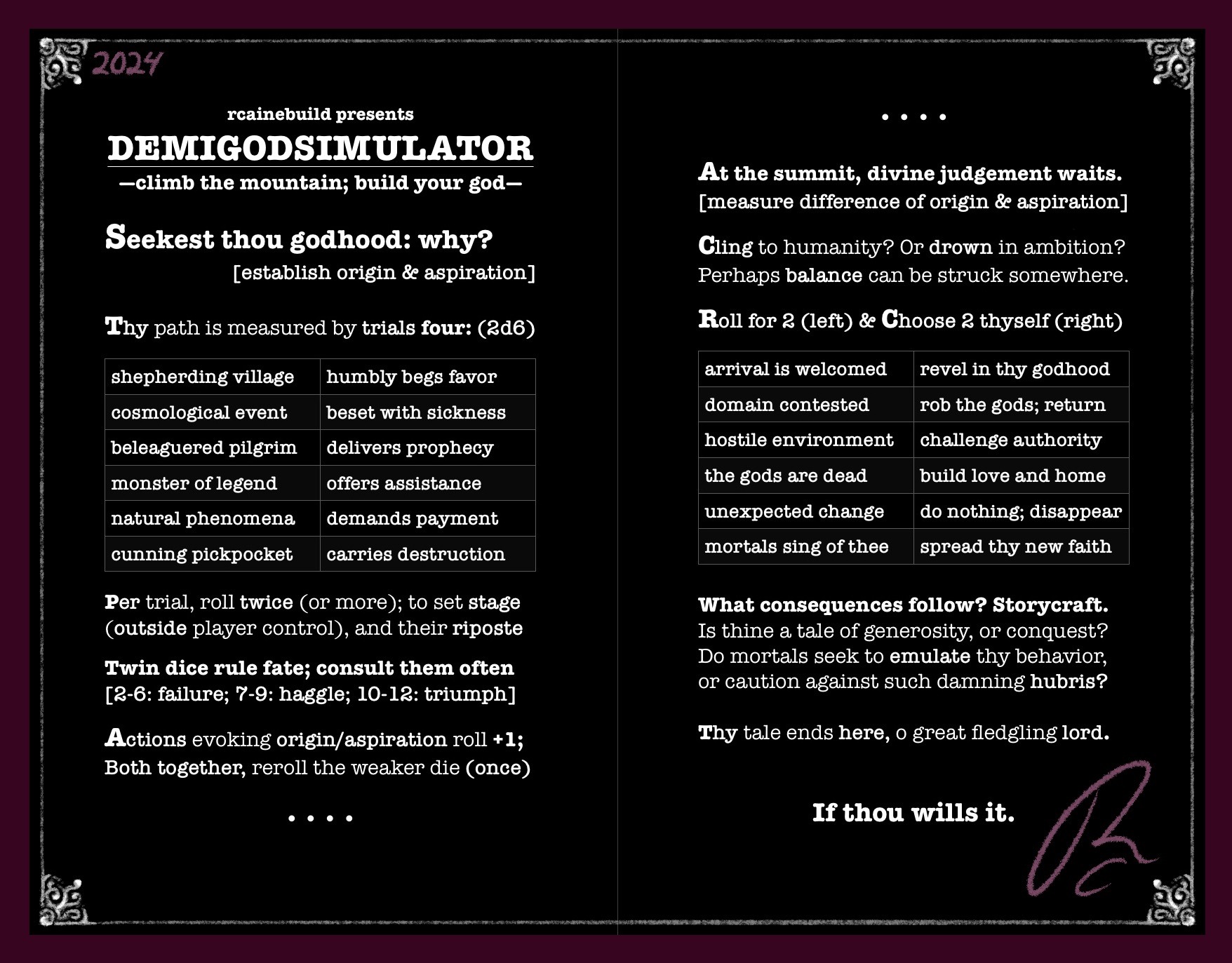
rcainebuild presents
—climb the mountain; build your god—
[establish origin & aspiration]
Thy path is measured by trials four: (2d6)
1a. shepherding village; 2a. cosmological event; 3a. beleaguered pilgrim; 4a. monster of legend; 5a. natural phenomena; 6a. cunning pickpocket
1b. humbly begs favor; 2b. beset with sickness; 3b. delivers prophecy; 4b. offers assistance; 5b. demands payment; 6b. carries destruction
Per trial, roll twice (or more); to set stage (outside player control), and their riposte
Twin dice rule fate; consult them often
[2-6: failure; 7-9: haggle; 10-12: triumph]
Actions evoking origin/aspiration roll +1;
Both together, reroll the weaker die (once)
[measure difference of origin & aspiration]
Cling to humanity? Or drown in ambition?
Perhaps balance can be struck somewhere.
Roll for 2 (left) & Choose 2 thyself (right)
1l. arrival is welcomed; 2l. domain contested; 3l. hostile environment; 4l. the gods are dead; 5l. unexpected change; 6l. mortals sing of thee
1r. revel in thy godhood; 2r. rob the gods, return; 3r. challenge authority; 4r. build love and home; 5r. do nothing, disappear; 6r. spread thy new faith
Is thine a tale of generosity, or conquest? Do mortals seek to emulate thy behavior, or caution against such damning hubris?
Thy tale ends here, o great fledgling lord.
Hey I play-tested this thing! I wrote the record in stanzas bc my pc is a skald and it turned out really fun and gripping and sweet!
Mechanically it ended up being like:
- write a little off the cuff, set the vibes
- roll for trial (mix-matching those two columns each time but never reusing options)
- roll for “intensity” of the event (12 being “it’s like a gift from gods” and 2 being “this will inexorably fuck you up”)
- roll for the success of whatever the player wants to do in response (do they make it better or worse?)
And I just kinda wrote it as I played; I’m rough on my oc’s, but I also want them to be happy in the end, so I think that balances out well.
(I might put the transcript on itchio)
1 player, 2d6
Hey, imp, new assignment. Another JRPG protagonist's planning to kill the Boss downstairs. I swear, every month with these jerks. We're gonna try something new this time. Instead of sacrificing dozens of hellfiends to kill 'em, let's just make their player stop playing.
Here's how this is gonna work. Every day, the player's going to grind levels, restock health potions or unlock some cutscenes. I've got hellfiends sabotaging all three, but each day, you'll provide extra support and get to DRAIN experience, SPIKE potions or GLITCH cutscenes. These start at 0 and increase by 1 every time you work on them.
We find out what the player's picked today after you roll 1d6. 1-2's grinding, 3-4's restocking, 5-6's cutscenes. Then we roll 2d6 to see how miserable we make them. If they're grinding, we roll 2d6+DRAIN, and so on. That drains out of the player's INTEREST. I'd guess that's at 120?
At this rate, the protagonist'll hit the level cap in two weeks and kill the Boss in one turn. Get their INTEREST to 0 by day 14 or we're out of a job.
I got all the way through writing a tweaked Honey Heist thing to describe a JRPG protagonist's inevitable quest to kill God, but it ended up so utterly boring and I couldn't think of a way to make it interesting that would have stayed in the word limit. So I decided it'd be more fun to model screwing over a JRPG protagonist.
I tried very hard to come up with a better name but I'm very tired right now.
You're modern-day wizards fighting in a deadly battle royale. Last wizard standing get their wish granted.
Need:
d6
Wizard players
1 arbitrator
Rule:
Wizards fight using Summoned Spirits. Summons have very specific classes. Roll 1d6 for your Summoned Spirit type.
Collectively decide what each class does, then draw a rock-paper-scissor chart on which beat which.
Optional: click random article button in Wikipedia until you find a famous dead person. They are your Summons. Justify why they have your rolled class.
Put the chart in clear view. Ignore it for the rest of the game, it's irrelevant. Cool-looking, though
Write the secret weakness of your Summons (e.g., can only be killed under the sun. weak against tea) then give it to the arbitrator.
Each turn, set up scenes that hint how your Summons can be killed (e.g., Invite everyone to a tea party, have a beach episode).
After everyone's scenes are set up, take turns choosing another wizard and tell how you try to kill your opponent's Summons.
After every attempt is described, the arbitrator decides if any Summons were defeated.
Repeat until one wizard left standing.
Your are an invertigator following the trail of an unknown target.
Each round roll on the following tables (d6) to determine your new clue:
Type:
track / story / data
witness / throw away / other
Information:
habit / movimento / goal
appearance / ability / likes
Material:
fluid / body part / marks
sound / path / cloth
Nature:
accident / intentional / codified
false / intimidating / inquisitive
For each clue roll your Tracking Die to determine the validity of the clue, it starts as a d10:
- If you roll total is equal to or higher then the maximum value of your die you have made progress, reduce the size of your die.
- If you roll an even number you have gettered information, you get a cumulative +1 to your roll. This bonus resets when your tracking die change.
- If your roll an odd number you make no progress but is still on track.
- If you roll a 1 your new clue is misleading, increase the size of your die.
- if you roll a 1 on a d12 Tracking Die you lost track of your target.
- if you 4+ on a d4 you reached your target, describe what it is based on the clues you have gettered.
a mecha thing
BASICS
Use a 5m hex grid and 10s rounds. Two kinds of characters - Vehicles and Infantry. Infantry share hexes. Allied infantry sharing a hex count as one character, pooling Processing and sharing systems.
Characters have attributes - PROCESSING, EVASION, ARMOR, and MOVE. Rounds are broken into turns. To start a turn, each side selects a fresh character. Selected characters can choose to activate systems up to their Processing, then act in order of leftover processing. Flip for ties
ATTACKING
Activate a weapon, pick someone in line of sight, and roll 1d20. Roll at -4 for concealment between you. If you beat their Evasion, roll damage. For each multiple of their Armor, destroy 1 system or remove 1 Armor. 0 armor means destruction.
EXAMPLE SYSTEMS
HMG: 1d8. Attack Infantry twice.
CANNON: 1d12
RIFLE: 1d4.
MISSILE: 2d10 damage, one shot, ignore concealment
LEGS/TREADS: Move. Bad ground = two spaces.
SCOPE: +4 to hit.
SAMPLE CHARACTERS
TRANSLUNAR COMMAND DK2: P3-E15-ARM5-MV4 HMG LEGS SCOPE
UNITED NATIONS W1: P4-E12-ARM4-MV4 HMG MISSILE LEGS
NEW AXIS T16: P2-E8-ARM8-MV3 HMG CANNON SCOPE TREADS
INFANTRYMAN: P1-E12-ARM2-MV2 RIFLE LEGS
SPECIAL FORCES: P2-E16-ARM2-MV3 RIFLE SCOPE LEGS
Infantry squads have one MISSILE/HMG/CANNON.
PCs start with 0 Power and no Skills. When a PC attempts to do a thing using their skills/abilities, the GM determines it's Ease, typically between -8 and 8. The player rolls 2d10, plus their most applicable Skill, plus the Ease, and determines their success using the first column of the table below. The GM narrates any extra details. If the player and GM agree no skill fits well, they can instead first create a new Skill with a value between -10 and 10, where 0 is average for the type of characters being played in the campaign, and increases their Power by that amount.
When a PC wants to do a thing based mostly on luck rather than skill (e.g., find a gate undefended or have a convenient friend in town), the GM determines a base percentage chance of success, subtracts both the PC's Power and the result of a d100 roll, then determines their success using the second column of the table below. The player narrates any extra details, within reason.
Do You Do The Thing?
18+ | 40+ | Yes, and…
14 — 17 | 20 — 39 | Yes
11 — 13 | 0 — 19 | Yes, but…
8 — 10 | -20 — -1 | No, but…
5 — 7 | -40 — -21 | No
4- | -41- | No, and…
This is literally my first Tumblr post (I created this blog years ago for something I didn't end up doing) so let me know if I messed anything up.
The logical way to approach a tiny RPG challenge would be to target a very specific premise and mode of play. So obviously I had to try to create as stupidly general an RPG as possible so that I had an excuse for how sloppy it is because I love a challenge! I don't know how good the result is overall, but at least I'm pretty sure that a group with a good familiarity with RPGs could at least muddle through playing it. My favorite part of it is the improv-inspired results table, which covers so much with just ten words. It was also interesting how not being able to find a good way to fit any sort of traditional character balancing mechanism in resulted in a system where less powerful characters get lots of lucky breaks while more powerful characters have to earn every victory, which I think is often how things go in fiction.
The hardest part of this entire process, by far, was figuring out how to post a simple three-column table on Tumblr.
You are in the [adjective] [terrain] of [abstract]
Adjectives:
Forgotten, Silent, Awakened, Hollow, Eternal, Impossible
Terrain:
Forest, sea, caves, abyss, dunes, mountains
Abstract:
Dreams, fears, memories, spirits, secrets, stories
The land is: nurturing, resilient, unforgiving, starving, tranquil, lonely
Covered in: thorns, crystals, shadows, moss, frost, decay
There is: a shroud of fog, a drizzle of rain, the sound of howling wind, a cool breeze, an oppressive heat, an unsettling normalcy
You see: a tower, ruins, a labyrinth, untamed wilderness, a road, a graveyard
Inhabitants are: long since dead, fae and alien, demonic and monstruos, mere echoes, unseen guardians, nonexistent
To them you are: an innocent, a distraction, a tender morsel, a hero, a threat, nothing at all
The time is: dawn, midday, evening, dusk, midnight, unknown
You: have been here before, remember nothing, know where you are going, are hiding, must forget, are so tired
You will follow: the dancing lights, the moss on the trees, your heart, the sweet singing, the stars, the leaf blowing in the wind
You will find: hope, destiny, destruction, home, yourself, nothing
You will be: lost, free, consumed, undone, transformed, made whole
1960 - 2000 vibes.
Some enterprising sales folk just knocked on a rich (vampire!?) family's front door, selling a bonafide Product to an unwilling immortal household!
Split into two teams - salesfolk and vampires. No GM.
The sellers' watertight sales pitch:
The vampires' code of conduct:
Address one paired point per 'scene'.
Every player has a credit card, right? Four digits are one 'group', use one per scene.
ie.
"With Vacuum Brand, you'll suck like a pro!"
"I need no help sucking"
"7"
"1+5"
"Succ it"
Don't play to 'win' :)
Loser treats the winner :)
Wowee, my first draft got me to 210 words but I've been fine-tuning the wording for hours. Really wanted a non-dice based game because so many sample rpg's required it! Boring!
Best understood if you're aware of Dogs in the Vineyard (poker), and Fiasco (assigning a win/loss result and then improv-ing what the scene would be to get that result, as well as not playing to 'win').
Not convinced the example/ending text is the best use of words but here we are.
Oddly, while writing it I became convinced this could definitely be played in a car on a road trip.
An RPG based on petsim Flight Rising.
You are a dragon capitalist. You hatch eggs all day hoping for good dragons to sell.
Scoring Guide:
This is for each individual dragon.
Three different colors that don't go together: 1d4 gems
Three different colors that go together: 1d6 gems
Two of the same colors: 1d12 gems
Three of the same colors: 10d10 gems
Bonus Points
All of these stack with each other.
+1d4 for 2 colors that are very similar
+1d6 for 3 colors that are very similar
+1d10 for all pastel shades
+1d10 for all beige/brown shades
+1d6 for all black/grey shades
+2d20 for 2 Obsidian colors or 2 White colors
Every 10 eggs, roll 1d6. If you roll a 6, add 1d10 gems for someone who randomly REALLY wanted one of your dragons.
Ok to archive, to remix, to share, to print and cut up and light on fire - whatever you’d like to do with it! Would love to hear people’s thoughts on the game and your high scores.
If you like this game, maybe follow my friend and I on itch.io for more tabletop goodness in the future? https://secretcoffeeclub.itch.io/
1 DM, 3+ Players, notecards, d6s
Players: Write on notecards:
DM: Collect the cards, construct a path to Mt. Doom: two challenges per Player, in any order, each relating to one listed weakness. Give each Player someone else's card.
Players other than the challenged can, at any time, choose one skill and roll d6, pooling results and describing how they overcome the challenge. Sums of 3+ succeed. Skills used are struckthrough, and dice return to the DM.
At any time, any player may dramatically espouse their Reason for Adventuring once, strikethrough, and reroll ANY die on table.
When all challenges are completed, the DM rolls 1d6 per player, leaving the dice in place. The sum is the Dragon's strength. All players with skills remaining describe how they're used to defeat the Dragon, then roll. If their sum is greater, the Players win! If players cannot succeed a challenge, or roll lower than the Dragon, the Dragon wins. The group describes the outcome and gives each Player an epilogue.
This is meant to be played as a collaborative storytelling effort with a focus on giving players the chance to give life to characters with traits not dictated by them, in the same vein as Ten Candles, albeit not nearly as involved with a goofy, outlandish bent rather than looming dread and expressions of hope in the face of the inevitable end. I believe the rules slightly favor the players (everyone likes winning, after all) but admittedly I have not playtested this at all, and poor rolls might end up costing players too many resources to win, especially in larger groups. Feel free to modify it for your own purposes if you find this to be the case - perhaps the DM will give bonus dice or rerolls for descriptions and solutions that are particularly entertaining or creative.
When I started writing this game, I had an idea in mind that players, and perhaps the DM, would by some mechanic be able to take excess rolls off of the table when resolving challenges, reserving the number rolled for a challenge down the road - not necessarily the smallest or largest to effect success or failure, but to have a guaranteed result banked. However, it got a little wonky a little too quick to fit it in a 200-word limit with any eloquence and was quickly scrapped. Maybe in another game.
It's perhaps a little basic and cliche, but I hope the clarifying text helps to set the tone of the game. This is meant to be fun and silly - I for one would love to see a game where German Expressionist Film Knowledge ended up being the coup de grâce for a fearsome beast. Enjoy!
For 1-3 players.
/////
You are members of a technological Hivemind, faithful drones who have been augmented and upgraded beyond your weak flesh. ‘You’ is a meaningless concept, except as a delineation of one limb of the whole.
You have been assigned a task. Roll a d6 to determine what.
Next, roll a d6 to determine how you succeed or fail.
Succeed:
Fail:
Elaborate upon these and write or discuss them.
/////
You will never leave this joyous unity.
You are a good drone.
Repeat forever.
I'm fine with this being archived off-site! Might update this late with some art.
UPDATE: AH BEANS, didn't notice tumblr eating the numbering of the fails, those should be 4-6 !!! Here's the game as a screencap (with correct ALT text).
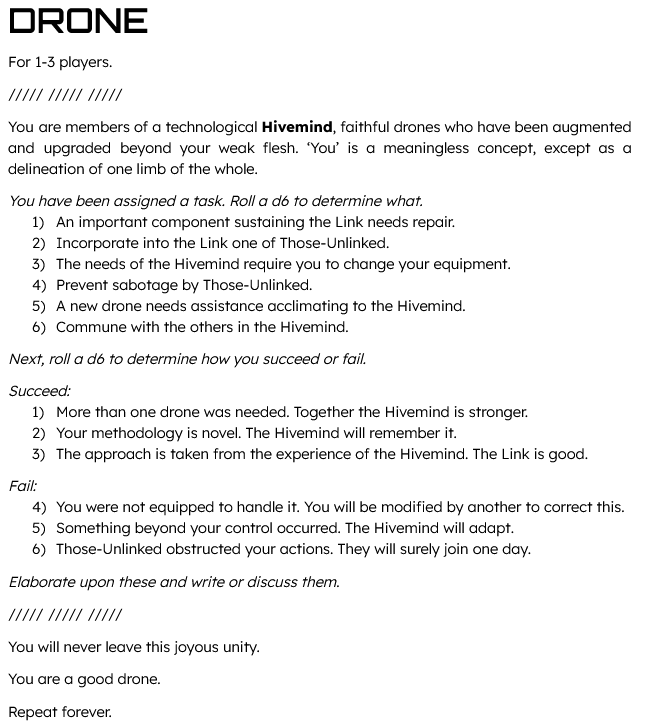
A short one player game about looking for gems.
To begin a delve, shuffle a deck of standard playing cards. For each day you continue the delve, draw three cards. To end the delve, return to the surface. This can be done at any point.
Based on the cards drawn, you may find gems worth points.
For each reversed card, mark a point of carbon monoxide. Once you reach five carbon monoxide points, you perish in the mines. Remember, you may return to the surface at any time!
For each day in a delve, write down the amount of Gem Points and Carbon Monoxide Points you have accumulated.
After five days, you must return to the surface. Upon resurfacing, tally up the value of all gems in your inventory for your final score.
To begin a new delve, simply shuffle your deck and draw again. Happy delving!
(hereafter abbreviated "D^D")
A game for multiple players (at least one of whom must be aware that they are playing D^D).
Choose a player to serve as the DM. The DM selects an edition of Dungeons and Dragons to use.
Character creation and gameplay proceed as defined by the rules of that edition of D&D, with the following addition:
If, at any point, the DM describes any of the following conditions as occurring:
then all players have lost D^D. Players who are aware that they are playing D^D should announce this loss.
When this occurs, continue playing according to the rules of D&D until none of the previously mentioned conditions hold, at which point D^D resumes. Repeat until the campaign finishes or the bit gets old, whichever comes first.
might do a slightly more serious entry later this month if I have time, these are fun!
You are an Alien come to Earth. You have come here to learn.
You will need:
How to play: A session is the length of one day. Go about your day and enjoy what Earth has to offer. During this time your goal is to gather small objects. Keep them in a safe place.
At the end of your day, retrieve your objects. It is now time to learn something about Earth. Learn about:
Take notes about what you did that day and what you have learned. End your session by going to sleep. You may learn something again tomorrow!
3 players - Earth, Sun, Rain - choose a plant together.
Each roll 1d6.
1-2: Too little (nutrients, sunshine, water)
3-4: Right amount
5-6: Too much
Exception: if too much of both sunshine and water, yay, evaporation, both give right amount.
If all players give right amount, plant thrives: Celebrate - dance, sing, wassail, draw plant, write poem, if appropriate eat plant (potato yes, deadly nightshade NO).
Single or multiplayer game-entering roleplay guide
Give the game a Type. These can be anything, even nonsense. I've decided this game jam is "Schoolish," and I will be puerile by utilizing Low Effort and Late Submission as my role playing techniques.
You get Brownie Points for keeping a consistent authorial tone throughout your entry.
You find yourselves in a strange kitchen, monsters staring you down. Ingredients have been handed off to you, aspiring chefs. Now cook for your life.
As many Chefs as will barely fit in your kitchen, at least one Monster Judge. More is better.
One Monster Judge will procure at least 3 ingredients for the Chefs that they need to use, following any general safety things and other agreed off-limits foods (Allergens, Certain Textures, etc).
Discuss a reasonable prize for winning. Discuss and set a time limit. This is how long the Chefs have to cook and plate a dish using the required ingredients and whatever else is available in the kitchen. Chefs will be cooking at the same time, so maneuvering this fact is required.
Once the Chefs are done plating or time's up, it is time to eat and judge the food. Chefs can't vote, but may critique or lament their mistakes.
Monster Judge(s) critique and vote on the favorite. Ties are decided by rock-paper-scissors, best of 5, or some other agreed method. Winner survives the Monster Judge(s) this week. Loser gives a small speech about their limitations and exits the room as they are "eaten".
Feel free to remix, reuse, reskin, etc.
Enjoy my exactly 200 words LARP concept, Chopped, but there is only one oven.
Based off a real game my mom and i did once, but with a challenge from a different food network game show.
Alright, last game ill submit for the month. Excited to see the games the rest of the month brings.
You will need numerous notecards.
Each game has a MANAGER and DOERS.
Each round, the MANAGER gives each DOER an individual ASSIGNMENT.
Each DOER then describes on notecards how they will SABOTAGE the ASSIGNMENTS of each other DOER. These SABOTAGES are placed facedown in front of their target DOERS.
The MANAGER selects a random SABOTAGE from each DOER's pile and reads it aloud. The DOER then describes aloud how they'll accomplish the ASSIGNMENT while employing PREVENTATIVE MEASURES against both known and unknown SABOTAGES.
The MANAGER then reads the remaining SABOTAGES and determines if PREVENTATIVE MEASURES failed. If a SABOTAGE was effective, the MANAGER determines if the target DOER receives an INJURY or DEFAMATION from it. Once this process is done for each DOER, start the next round.
If a DOER receives five DEFAMATIONS, the are FIRED and cannot play until the next game. If a DOER receives three INJURIES, they are HOSPITALIZED and cannot play until the next game. If a DOER is HOSPITALIZED, every other DOER receives a DEFAMATION.
Play continues until only one player is neither FIRED or HOSPITALIZED. They WIN, and become MANAGER of the next game.
ASSIGNMENTS, SABOTAGES, and PREVENTATIVE MEASURES can be ANYTHING. Be CREATIVE.
A Film by John Woo
Cast:
-1 Employer
-2+ Players
-d6
-Coin
-Standard card deck.
Direction:
Skills:
-Jape
-Bluff
-Emote
-Kick
-Dive
-Shoot
Dream:
-Money
-Fame
-Acceptance
-Love
-Vengeance
-Stature
5-6: Henchmen
7-8: Professional
9+: Legendary
This was unplanned, but I just watched A Better Tomorrow on a movie night and got struck by a mood. I think I managed to turn the mood of John Woo's films into an actually playable, and hopefully fun, game.
The gist is that the game should start relatively low-key and lighthearted, and every character is intended to keep monologuing and reminiscing about their dreams. Their last job before retiring and opening their dream bakery, finally having enough money to pay for the blind violinist's surgery, getting themselves promoted into lieutenant in the police force…
Even if they fail their tasks, the game should keep moving forward. But the game should get increasingly grim and violent as more and more of the player characters die senselessly from choices not of their own. The deaths from the shootouts are supposed to be senseless and pointless.
The capricious 1d6 rolls for tasks are intended to give a sense of tension and randomness, and keep everyone's allegiance a mystery. Is the task keep failing because they're a traitor, or they're just unlucky? Is there ever a traitor in the midst, or is it just paranoia? Or is everyone actually a traitor? It's important that not even the traitor knows that they are traitor before the game starts and everyone has entangled each other in relationships, and any traitor shouldn't know if there are other traitors in the game.
And of course, the game might just end with everyone dying in a random shootout.
Sometimes, that's just how the movie ends.
Two players are gods, battling to rule the cosmos.
Duel by some means. Winner earns one coin.
Spend coins:
1 - choose next duel method. (otherwise: agree)
2 - earn 1 ‘T’
3 - earn 1 ‘H’
5 - flip 5 coins. Both players may spend ‘H’ and ‘T’ to alter one coin’s result to match. If all 5 are heads, you win.
The above, including the title, actually comes in at 300 characters. Inspired by @prokopetz 's self-imposed Blusky limitation.
Permission given to remix, save, share & play with credits to @saaabriel.
Play H-O-R-S-E (basketball). Shot-caller is GM; first shot-caller describes monster chasing y'all. Before shooting, describe how you try to gain ground; if letter gained, GM describes how your plan fails. If you spell H-O-R-S-E, monster GETS you. Winner is Final Girl and describes post-monster life.
For: 1 GM, 2+ players
Need: 1d10 per player
There are seven magic types:
You are magic. Describe which magic types you are:
If you are made of it, you may instantly:
The GM decides on a problem. It may be a mystery, a danger or a loss. The characters must solve the problem.
Everything you do is magic. Every time you do something, the GM rates the difficulty 1-10 and assigns it a magic type. If you think it's a different magic type, you may try persuade the GM. You roll a d10 and change it based on your character. You succeed or fail.
A character dies if injured three times.
I have not tested this, and I have very little experience with writing things like RPGs, but this was super fun!! and I kinda want to expand it in the future without a word limit, because this does not fully capture my initial idea (though my ideas are mostly character creation-based..)
Game for 3+ players.
Each player roll 1d20 twice on the gimmick table (all players must have at least one unique feature.), then comes up with a basic plot, book title, cover blurb and cover description or sketch combining these features for a cheap cash grab novel.
A new literary trend has swept pop lit! Roll 1d20 again, and each player must come up with a way to misleadingly market their book according to this feature that is not present in the book as written by altering the title, cover, etc. If a book's feature is rolled, it passes to the next round. Then players (including eliminated ones) vote for which book has best navigated the trend. Eliminate all books with no votes, then roll a new trend (if already trended, reroll)! Continue until only one book succeeds.
Gimmick table:
Gimmick table could probably be expanded to d66: if you don't count the roll number as words you get an extra 20 words:
21. Secret powers
22. Apocalypse
23. Animals
24. Cooking
25: Fish-out-of-water
26. Ecofiction
27. Mental illness
28. Thriller
29. Found family
30. Double lives
32. Older protagonist
33. Road trip
34. Abuse
35. Heist
36. Royals
group of 3+
You have been invited to a formal event by a renowned host. However, they are part of an eccentric culture that you don't know much about. Your goal is to not offend their culture.
- Decide on a name and a brief description for this host's culture so you are all somewhat on the same page but leave it vague enough to get creative.
- Write down 5 or so stages for this event, such as greetings, main course, discussion, ceremony...
- For each stage of the event you each write down what you think is the appropriate behavior for that stage and roll a die. The one with the higher result has the correct assumption, discuss how your host reacts to the others behavior. In case of disagreement the top roll is the referee for the round. In case of a tie both are correct, elaborate on how that works.
Requires: three or more players (con-artists), one GM (set designer), and one Crocodile Dentist
The players take the role of con-artists moving into a new town. The Set Designer describes the town; the con-artists decide amongst themselves what the nature of their con is, then describe how they arrive and begin, while the Set Designer reacts. Every time a con-artist attempts to deceive a new person, or adds a new element to their lie, they depress one tooth on the crocodile dentist. If bitten, they are disbelieved. Do not reset the crocodile between attempts.
Successfully lying once to a credulous person or twice to a suspicious person earns the crew one part of a payout. (A person who witnesses a failed lie becomes suspicious, but not all suspicious persons witness a failed lie.) A team member may sacrifice one part to dismiss one failure, if they explain how.
The crew may call themselves successful whenever they have enough of a payout to each be satisfied with their parts. If there are two failures per artist, the con has failed and they must flee town in disgrace. Lies between artists do not count towards this total, but are otherwise resolved normally.
This whole thing started with me fucking around with a crocodile dentist that I own for reasons not important here while scrolling tumblr, seeing the 200-word RPGs, and going "I wonder if I could use this fucking thing as dice?" Then, "what premise works well with failure getting progressively more likely?" Then I let it percolate for a month while procrastinating, and you're looking at step four.
I wanted to have a note that you can substitute the crocodile with a Nerf gun loaded for Russian Roulette, but it was a casualty of the wordcount and also of me realizing that that would make success about 30% less likely. I think.
I give permission for this to be archived off-site for posterity, or really have anything else done with it as long as I'm credited!
Edit: God fucking dammit. That second paragraph should read "once to a credulous person or twice to a suspicious person," goddammit. Presumably that was fairly obvious via sense, but still. Gaaaaaaaawddammit. (Main text has now been edited because it was continuing to make me nuts.)
For Master(s) and Player(s)
Requirements: Six-sided die, note-taking equipment.
Players have six skills and six weaknesses.
When a player encounters a problem, a Master determines initial penalty (“difficulty”) based on unskilled success chance. Then, apply +1 for each applicable skill and –1 for each applicable weakness. Finally, player rolls The Fallen Die (Act II) and adds result to penalty. 1 or more is success. 0 or less is failure.
Game ends at participants’ discretion.
If unsure of initial penalty to apply to rolls, consult the chart below.
Initial Penalty VS. Unskilled Chance of Success (%)
+1 = 100.00 = Trivial
0 = 97.22 = Simple
–1 = 74.07 = Advanced
–2 = 50.93 = Difficult
–3 = 27.78 = Challenging
–4 = 4.63 = Ridiculous
–5 = 0.93 = Implausible
–6 = 0.00 = Inconceivable
Roll d6.
1-4: Number is result.
5: Go to “B-5”.
6: Go to “B-6”.
Roll d6.
1-4: Number is result.
5: Result is 0.
6: Go to “C”.
Roll d6.
1-5: Number is result.
6: Go to “C”.
Roll d6. Number is result.
I've been messing around with ways to use 1d6 for chance-based resolution systems that generally produce small numbers in equal measure, but have a slight chance to produce slightly smaller and larger numbers. So, I decided to write one of them down and attach a bare-bones RPG to it.
Here’s what the probability table looks like:
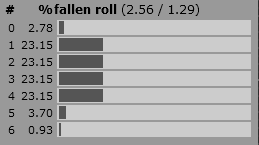
Thank you for reading,
— Clark Padmore
Materials
Setup
Play
Repeat forever until people stop having fun.
Never made an RPG before, at least not a functional one. (Who knows, maybe this one isn't even functional). I was inspired by various text-based RPs I've been in and was wondering how a fandom-centered TTRPG would work if the main goals were to 1) Tell a cool story and 2) Stay in character. It should work for pretty much any typical fanfiction scenario so there should be plenty of opportunity for variety.
Also I like d12s.
Feel free to archive this off-site. Or do whatever else you want to do with this. I can't stop you.
Requirements:
= 3 players (2 combatants and 1 judge)
Two pieces of paper
Two pencils
Setup:
Flip a coin. Whoever wins the coin toss is player 1, while the other one is player two.
Player 1 plays a song (it is encouraged to play a bad song for flavor). Player two then creates a character for said song. Player 2 then plays a song, and Player 1 creates a character. Repeat until 3 characters exist for each person.
Character Creation:
Playing the game:
Once all characters are created, swap characters with the other player. It is now Player 1's turn. Player 1 selects one of Player 2's characters to attack. Then, its player 2s turn to attack. Repeat until there is only 1 character left. That characters owner, wins.
Attacking:
You have 1 minute to argue why your character would beat the other character. Then, the other player argues why they would win. The judge then decides who wins. Loser dies permanently.
(needs: 2-6 players, referee, standard DnD dice, paper, pens)
You are adorable but highly territorial geckos, attempting to store enough calories to survive winter. You begin with 500 calories each.
The ref secretly rolls 1d6+6, the number of days left until winter.
Each day, the ref randomly selects a subset of available hunting spots (represented by d4, d6, d8, d10, d12, d20) equal in size to the number of geckos.
Each player secretly writes down the number of calories their gecko expends trying to claim each spot on a piece of paper, and the bids are revealed simultaneously. (Draws go to a roll off.)
If you have won any bids, choose only one and move sit out the rest of today's bidding. All calories bet are expended either way.
The remaining players bid again on the remaining spots. You may not bid on the spot you won yesterday.
Roll your die to see how many calories you gather:
If you roll 1, re-roll until you don’t.
Multiply your first non-1 result by 10 for each time you re-rolled.
The winner is the gecko with the most calories come winter.
Yes, this is mostly just a pun, no idea how it would play. 194 words including the title.
I chose 10 because it's an easy number to multiply, but that probably makes the small dice too obviously strong.
Feel free to strategically add the sufficies "girl" or "boy" to certain nouns.
a completely original PvP game
Two players, no materials needed
Before playing both players describe a character, and agree on a situation in which their respective characters would fight.
Both players simultaneously choose one of the following options to reveal-
STRIKE (represented by a closed fist)-wins against Feint
A character attempts a straightforward attack against their opponent
COUNTER (represented by an open hand) -wins against Strike
A character attempts to defend against their opponent, before landing their own attack
Feint(represented by two spread fingers)-
wins against COUNTER
A character attempts to trick, or outmaneuvers their opponents defense
The losing player first describes their character's actions, then the winning player describes how their character successfully outmaneuvers their opponent.
After a win a player gains MOMENTUM, winning while you have MOMENTUM gives a point.
When scoring a point describe how your character successfully injured their opponent; the losing player then describes how their character reacts to their injury, and keeps fighting.
Whatever player is able to score a point twice (or an agreed upon number) describes how their character defeats their opponent, and the immediate aftermath of the fight.
REQUIRES:
-2+ players
-Poker decks
-Spectators
Each "campaign" is a double-elimination tournament.
Make a roster of persistent characters. Players can choose the same character for a match.
CHARACTER CREATION
Shuffle two decks together, draw until you have six sets, write down only the four highest sets; its MOVES.
MATCH
TURN
DISCOVERING TECH
ONLY 1/TOURNAMENT, after a match, with HYPE >= lowest trip of the character you just used, SECRETLY add 2 random cards to its MOVES.
This game is meant to simulate the unique thrills of competitive fighting games like Smash Bros Melee or Tekken, both on and off the ring.
The suits are meant to symbolize the broad state of the fighters in relation to each other: their relative distance and positioning, and who has the advantage in the "neutral game". Due to how characters are created, not all of them are equally viable in all situations, and indeed not all f them are equally viable period.
That is why the DISCOVERING TECH rule works the way it does: to reward players who stick with a "low tier" character with potentially powerful new moves. Its requirement mean it is much easier to trigger with characters who have at least one weak set of 3 in their moves.
2 to any number of players. One of the players is the Chronicler, the rest are Vampires.
Each Vampire chooses a Name and seven Anchors. The Vampire tells this information to the Chronicler, who writes it down exactly word for word. The Chronicler may not show, tell, reveal, or hint at the Vampires the information written down this way during play, but is free to reread it as they please.
A Name can be any combination of words, names or titles so long as it is at least 10 words long. Example: "Sir Reginald Von Bartlesby, Baron of Kingsfield and Knight of the Queen's Crown".
An Anchor is a personal rule, character trait or critical memory that defines the Vampire, at least 10 words long. Example: "I will always help those in need, as long as my identity is not compromised".
Each round, the Chronicler presents a situation to each Vampire, who describes how they would solve or react to it based on their Anchors. Repeat for as many rounds as desired.
At the end of the game, Vampires write down their Names and Anchors as best they remember, then compare them to the written information kept by the Chronicler.
The world's full of magic. Everyone sees it, but no one understands it. Many have tried, all have failed — but they weren't you.
Everyone: name a phenomenon, describe its discovery, and pass a uniquely-colored d6 left.
On your turn, ask a yes/no question about one phenomenon, then devise an experiment to answer it. Whoever holds your die rolls it:
They explain the problem; everyone discusses solutions. If you can reach a consensus, flip a coin to answer the question. Play passes to the right.
At any time on your turn, you can interrupt, say "I don't care", explain why, and proceed as planned. Move your die one player left. If it rolls the same number later, you must interrupt; you still choose why.
When your die reaches you, you've gone beyond the pale. The others vote on your membership: aye, nay, or abstain. On a tie, outside forces decide: flip a coin.
If expelled, pick a number. Its problem is now "you'll interfere." Otherwise, pass your die left. When you hold a die, roll twice. Both are true; choose which to emphasize.
Sharing, remixing, and archiving for posterity are all OK.
Without having playtested, I'm not sure what player count is best. You'll want enough players that you can't always reach consensus, but not so many that you never do. Player count also affects pacing, but I think that's less important, since groups should have plenty of options to adjust pacing during play.

Introduction
This is a one-player game. The aim of Four Choices is to inspire the player (“You”) to overcome various scenarios.
Note: You may make any selection either knowingly or randomly.
Build Your Base
First, select your weapon:
Now, select your assistant:
Next, select an element that you may utilise:
Finally, select something to protect:
Congratulations! You have made four choices.
How to Play
You will encounter between four and twelve scenarios. You may select the difficulty level of each scenario: Easy / Normal / Hard / Severe.
Ask the following when encountering each scenario: How does this threaten what I am trying to protect? Then, resolve the scenario in four steps.
The Scenarios
You must overcome:
Epilogue
Whether successful or unsuccessful, construct your epilogue. Remember! Your story does not end here.
1. Fold six origami frogs. Mark two frogs with a marker and draw a crown on a third frog. This is a Frog-Army
2. Repeat step 1. until each player has their own Frog-Army.
3. Arrange various objects on the table to be obstacles.
4. Each player places their king on the table. Agree that the kings are fair distances from each other.
5. On your turn pick a frog to take an action then contemplate how your frog feels
6. If a frog touches another players frog then the touched frog roll a d6. 1-4, it is flipped over and cannot take actions. Describe the epic battle that takes place between the frogs.
7. Pick a frog to be in love with another frog and a frog to swear revenge on another frog.
8. Name your Frog-Army
Actions:
JUMP - push the back of the frog to make it jump forwards
PIVOT - rotate the frog. one of its feet must stay in the same place that it was
ORDER - (crown only) place a frog not on the table onto the table, touching this frog.
SERVE - (marked only) place this frog touching the crown frog. then if you want, PIVOT
I wanted to do this last year but i don't think i ever finished it
I have never playtested this game but thats okay
from nothingness
for 3+ players
Setup:
Choose a setting for the game to take place where everyone wakes up with amnesia.
Together write down unique personality traits until you have at least 3 per player.
Play:
1. Randomly assign each player a single trait and don't reveal it to each other.
2. As a group choose a situation to encounter or randomly generate one. Examples below.
natures beauty, hostile wildlife, harsh weather, weapon found, somethings gone missing, outsider approaches, someone's injured, power outage, food shortage, someone forgot to flush.
3. As a group roleplay your reaction to the situation together.
4. Once players feel the situation is resolved each player reveals their hidden trait to the group. Players vote for who best embodied their hidden trait alongside any other traits they possess. Whoever gets the most votes keeps their trait and removes it from the trait list. Going forward they must embody that trait alongside their other traits. In case of a tie no player wins a trait.
Repeat steps 1 to 5 until one player has 3 traits. They have recovered and remember who they are. That player narrates what they do to the rest of the amnesic players
you need: deck of cards (that you don't mind ruining), pen
you are: sports team
pick a team name: <PLACE> <THING>s. write it on ace of clubs. add a team symbol
divide deck by suits
put other clubs in order, two to king, shuffle other suits to make the DECK, then play!
start GAME
draw club: the GAME card
draw from DECK equal to rank of GAME card (faces are 10, ace 11)
write a name and draw something on each unaltered card drawn. add something new to already altered ones
hearts: notable allied players!
spades: notable enemy players!
diamonds: gods, weathers, weirdness
total up rank for each suit, check highest. diamonds win ties.
hearts: win GAME, bless spades
spades: lose GAME, bless hearts
diamonds: curse hearts and spades, redo GAME
write results on GAME card, shuffle DECK, begin next GAME
no GAME cards left? end season. if more wins than loss, you win fuckedupsportsball!
blessings/curses: use first diamond card. if none, draw until one. add effect to cards
blessings: even: +2 rank, odd: +5 rank when , face: opponent becomes ally suit, ace: curse immunity
curses: even/odd: <inverted blessings>, face: swap card suits, ace: tear up cards
yeah, I like blaseball. this was my attempt at making a lil mini blaseball ttrpg. should work as solo or group play. gm-less.
make your names silly and just a little bit fucked up to fit the spirit. blaseball has teams called the firefighters, worms, and mechanics, notable players called hotdogfingers, telephone, and drumsolo, and weathers like peanuts, reverb, and solar eclipse.
this is not tested at all. sorry if it sucks! do let me know if you play it, though, and tell me about the characters and stories that are created from it :3
A TTRPG for 2+ players by Grace Gittel Lewis
Each player is engaged in a HARROWING DUEL— whether that’s as two cowpokes in literal high noon gunfight, opposing war generals on the battlefield, or competitive pie eaters sat at the table.
To win, you must create the FUNNIEST (BIGGEST) NUMBER POSSIBLE. Each player takes a turn, whoever rolls the highest number on 1d6 goes first. Both start with a FUNNY NUMBER (FN) of 10.
What, exactly, this number represents can change over time. It may refer to soldiers on the field one turn, or arrows in the air the next.
Each turn, players will describe something they do in an attempt to embiggen their FN, and roll 1d6 on the table below for the result.
1 - FN halved.
2 - FN loses rightmost digit.
3 - FN reduced by 1/4.
4 - FN doubled.
5 - FN gains zero to end.
6 - FN squared.
Then, describe what the outcome looks like. The next player does the same, repeating back and forth.
The game ends whenever all parties agree it’s FUNNIEST.
I will have to remember to format this one for itch eventually! I still haven't formatted last year's game...
A Short Game About Mechs for 2+ players
One player is the mech.
One player is the pilot.
Any remaining players are HQ. (If there are only 2 players, come up with HQ's orders together.)
Players need: at least one d4, notepaper.
Roll for the mission goal:
1. Sabotage
2. Assault
3. Theft
4. Defense
Roll for the target:
1. Belligerent
2. Artifact
3. Outpost
4. Diplomat
Roll for what the pilot wants:
1. Family
2. Love
3. Safety
4. Home
Roll for what the mech wants:
1. Destruction
2. Destruction
3. Destruction
4. Destruction
The mech is a weapon. It wants to do its job.
When on missions:
HQ gives an order.
Pilot attempts an action.
Will action follow orders? If not, HQ will find a new pilot.
Will action further mech goals? If not, mech will not respond.
Will action further pilot goals? If not, too bad.
Mech carries out the action.
Roll a d4.
1. Great Failure: +2 breakdown
2. Failure: +1 breakdown
3. Success: +1 score
4. Great Success: +2 score
Repeat.
At 5 score you win! Describe how you extract victorious.
At 3 breakdown you lose. Describe how you let everyone down.
Gather players and get ten flashcards for each player. Each player should choose a theme (1920s, mermaids, halloween…) and make seven Guys and three Instants.
Each Guy has three stats: Cost, Punch, and Toughness. Cost is how many Resources it takes to play, Punch is how they decrease Toughness, and Toughness is how many Punches they can take. Three should have one Cost, and four points to distribute to Punch or Toughness. Two should have two Cost, and seven points to distribute. One should have four cost and ten points to contribute. You can distribute one to give a Guy a defined Ability. Instants do anything, and cost 1-4 Resources depending on how op they are. It is encouraged to fuck with the rules through Abilities and Instants.
Put all the cards together and shuffle well. Each player chooses ten. Shuffle, then choose a hand of four.
Each player does a turn until only one person’s Guys are alive. Each turn has four phases:
Card art and silly voices for Guys are encouraged.
There were some key points where magic the gathering could be improved, and I just did it. Please archive this game. If anyone does ever actually play this, it would be wonderful if you could send me a photo of the card spread.
I am a monster! I am trying to kill you, or at least moderately inconvenience you. This is very hard for me to do, as I don’t really have a physical form. I can only interact with you on your own terms, but if you want to meet me in the middle, here’s how:
Say “I am playing Game Playing Role” out loud. From now until you win this game, you are playing this game, and I am hunting you! How fun! If you die, such as due to old age, before actually finishing this game, I win and (metaphorically speaking) eat you! Hooray!!!
Playing this game is simple but I really don’t want you to win. Once every 24 hours, while playing this game, you can generate a random number between 1 and 1000 by whichever random number generation method you prefer. If you get a 1000, you win, and the game ends... On any other roll, the game keeps going! Hopefully one day you forget about me, and then I can ambush you when you least expect it!
I’m so very hungry. Please play with me. Please play with me. Please play with me. Please play with me.
YOU are a PLAGUE descending upon a house at the behest of a powerful and strange wizard. And the TARGET has been the camel's fatal straw.
Materials:
-Assorted rubber ducks (or other animal)
-An Unassuming TARGET
Arrive at TARGET's house on an expected visit. Make the general chatter and any activity set up as usual.
Find a hiding spot for one of your ducks. Place it there when no one is looking.
Repeat duck placement when an opportunity arises until visit is deemed over.
Leave as you would normally. Repeat this for future visits if not confronted for the first round.
Points are scored based on the number and sizes placed, false accusations, and then multiplied by number of days it took the TARGET to notice them.
Micro - 1 point
Mini - 2 points
Regular - 3 points
Large - 4 points
Massive - 5 points
Glow in the dark add an extra point to size.
False Accusations are 2 points per unique person.
Record your score. Try to beat this with the same or new TARGET.
Each player chooses a different genre and medium (e.g. romance novel, epic poem, precision platformer). They think they’re the protagonist.
Entities pursue the players. The Narrator describes each new Entity’s nature using any five nouns. Players interpret these nouns as themes or motifs to describe the Entities’ appearance and behavior within their genre and medium, and what manner of threat they pose.
Players start with 3 Immersion and 0 Deconstruction. They can only do things a typical protagonist of their genre and medium could do (hereby Tropes), or things most real people could do. If success is uncertain, roll 1d6.
Over Immersion: If Trope, fail. Otherwise, succeed and -1 Immersion.
Equals Immersion: Partial success, or success with consequences. +1 Deconstruction.
Under Immersion: If Trope, succeed and +1 Immersion. Otherwise, fail.
At 0 Immersion, you accept you’re not in a work of fiction and return to your soul-crushing day job. At 7, you become entirely fictional and cease to exist from the perspective of the other players. Either way, you’re out.
At 3 Deconstruction, reset it to 0 and announce a twist to your genre. Explain what new Trope it gives you, and what old one it takes away.
Decided to take the "cut an existing WIP down to 200 words" approach. I think it worked surprisingly well. I did lose the original's primary mechanical gimmick, but I'm happy with the new (to me, at least) core resolution mechanic I came up with.
The giant that towers above the cloud, the snake that circles the continent, the many-tentacled monstrosity that erased an island with a thought. They have one thing in common. Today, they fall.
Need:
1 standard deck of card
2-5 players
Optional:
Play this playlist https://www.youtube.com/watch?v=4pzcqZTVfDI&list=PL0JL5GkOJlrY5DRgq7gTv1rVxSeVqXrHW
Gameplay:
The gods are invincible. But mankind has devised a plan. A complicated sealing ritual, a massive techno-occult cannon, a last-ditch strategic assault.
The joke is of course, this is just Crazy Eight/Uno. Originally it was supposed to be based on a more basic card game that's popular in my country, but I realized it's not really well known in other countries, and people might miss the joke. Really, the longest part of this one is trying to think of a card game to base it on.
If you want the game to be more strategically cooperative, you can deal player's hands face up. Still shouldn't discuss though.
And if you want it to have more rp rules, you can assign each suit into a theme and roleplay every plan deployment.
For example, Heart: People, Diamond: Resource, Club: Skill, Spade: Violence
or something in that line.
And to futureproof this post, the playlist is "Best Final Boss Theme"
You are an apprentice wizard who has just learned how to cast Summoning. Not well, mind, but you do know how to cast it.
Players have two kinds of actions: Free Actions and Summoning. Free Actions are things a normal human can do without any special powers or training, and with the mundane objects they have on hand. These actions always succeed, unless they are opposed (by a rival wizard, a special lock, a big frog, etc.), in which case they always fail.
Summoning costs one Summon. Players start with ten Summons, which are recharged each scene. For each Summon, open a random Wikipedia article. This is the thing that you summon. If you don’t want to summon it, you may spend another Summon to reroll until you either run out of Summons or give up. Actions involving Summoning always succeed, as long as most players agree they make sense. Debate on whether something "makes sense" is encouraged.
One person (a dedicated GM or a player who sits out the scene) sets the scene and describes the obstacles and NPCs. Play until the scene’s conflict is resolved or everyone is out of Summons and ideas, then start a new scene.
I feel like this has been done before, possibly better... but it's funny, so. No idea if ten is a good number of Summons or not.
GMless game, where you are a group of dimensional travelers currently stranded in the real-life location you are playing from.
You can be humans, aliens, robots, fae, etc. Write your character sheets, each filling in: Name, pronouns, and form, and put one empty Epiphany box. Pick one character you have history with, and one character you want to get to know better.
Make the portal progress checkboxes on a central paper: two plus one per player. When all are full, you made it!
None of you have powers that help with interdimensional travel, and the mundane world around you is just that. Roleplay what you do. When you find something that might work as part of a portal, roll 2d6.
2: It can't work, and neither can anything similar. Explain why.
3-5: It can't work, but something similar might.
6-8: It might work. If another player spends their Epiphany to accept your reasoning why, it works, so check a portal box.
9-11: As 6-8, and, if accepted, any rolls building off your reason get +1.
12+: It works great: Check a portal box for free, and roll 6 + 1d6 for a secondary effect.
This is licensed CC0 so do whatever you want with it.
Requires ≥ 4 players, 4 phones, 3 rooms, a timer.
Someone is accused of a crime. A jury will decide their guilt. Choose two players to be the Accused and their Conscience. Divide the remaining players into two juries. Decide on the crime the Accused is charged with.
Move the juries into separate rooms, and the Accused and their Conscience into the third. Establish two phone calls, between the Accused and one jury, and between the Conscience and the other jury.
First, the Accused speaks for 10 seconds, representing spoken testimony. Then their Conscience speaks for 10 seconds, representing the Accused’s internal thoughts during the preceding 10 seconds of testimony. The Accused should mute their call while the Conscience speaks, and vice versa.
Some questions for the Accused and their Conscience to consider as they collaboratively develop the circumstances and character of the defendant:
Once testimony concludes, the juries independently determine a verdict for 5 minutes. Reconvene the juries for 5 minutes in order to agree on a verdict. Reveal the juries’ individual and collective verdicts to the Accused and their Conscience.
I will confess that I have virtually no experience playing nor writing tabletop RPGs. But this idea compelled me. Consequently, the numbers are probably off -- this hasn't been play tested.
I think this game works much better with an audience. Fun for the players, but very fun to see the whole picture. It would be great to live stream, I think. A more elaborate version would involve some way to generate crimes and other details (maybe a custom deck of cards, or dice table).
The tone is also somewhat up in the air. It would totally work as an improv comedy game, but you could also do it as a serious exploration of guilt and conscience.
What You’ll need
-something’ to write with
-2d6
-paper
Rules
Gumption
Every player has 5 Gumption, when you’ve got no Gumption, you’re Dead.
Dead
If you’re Dead, you can’t do anything’ and you Lose
Bullets
You have 6 Bullets, everytime you Shoot, Lose a bullet, once you have 0 bullets, you can’t Shoot anymore.
Turns
When you start, everyone rolls 1d6, turn order is highest to lowest rolled on the 1d6, and loops at the end reroll ties. Go around the table in turn order, everyone can do one of the following things on their turn
Shoot
Pick a player, you and that player both roll 1d6, if your number’s higher, remove the difference from their Gumption, if it’s a tie, or the other player has the higher number, nothing happens,
Run
Run, you don’t get to roll 1d6 when a player Shoots you. If you ain’t dead by your next turn, you leave the fight.
Defend
Till your next turn, roll 2d6 instead of 1d6, and add them together whenever someone Shoots you
A fight’s over once only 1 person is left at the arena, and is not Dead. They win.
This was my first time making an RPG in this fashion, and It was kinda fun! this feels more like a super quick game/minigame, but I like how it turned out
3+ players
Multiple JOCKS, one HAUNT
JOCKS are here to investigate a HAUNT. Start with 0 SCARES. Spread 5 points across (Max 3):
JOCK
BELIEFS
REACTION
JOCKS choose a location size. HAUNT gets points based on the size:
SMALL - tiny cottage, family house, inn, etc - 2d6 + 6
MEDIUM - bar, hotel, club, etc - 3d8 + 4
LARGE - hospital, museum, graveyard, etc - 4d10 + 2
HAUNT secretly spends these on leveling:
TRAGEDY - 2 points
DEMONS - 5 points
RITUALS - 3 points
ACTIVITY - 1 points
The JOCK who had the most recent nightmare goes first. The JOCK to their left answers three questions, with the HAUNT only guiding them with "hot" or "cold" on their story. Play passes to the right until every JOCK has interviewed.
Then, LOCKDOWN:
JOCK describes an area. HAUNT vaguely describes an action of one stat. JOCK responds, and HAUNT chooses their stat.
2d6 + STAT:
10+ - success, -1 SCARES
7-9 - partial, +1 SCARES
6- - failure, +2 SCARES
When a JOCK hits 10 SCARES, they're out.
LOCKDOWN's over when they investigate (8/10/12) areas. HAUNT reveals their total pool, not levels. JOCKS guess the highest stat. If correct, JOCKS win. Otherwise, HAUNT wins and gives JOCKS nightmares.
...Why yes, I have been watching Ghost Adventures lately. Why do you ask?
You have never seen the sun. This maze is your prison. Someone has come to kill you.
Needed: pen & paper to record STATES/stats and results, d6s, d8s, d10s.
You can be in one of 3 STATES, lowest to highest: Starving (d6 Strength, 5 Speed), Satiated (d8 Strength, 4 Speed), Gorged (d10 Strength, 3 Speed).
Begin eating the remains of your last victim, Starving. You must eat for 3 cumulative turns to increase your STATE, reset on a STATE change. On a turn begun eating, roll 1d6: on a 3 or higher, you are interrupted by a warrior and must fight for your life.
A warrior has d8 Strength, 3 Speed. For each turn fighting a warrior, roll both your and their Strength die. Whichever rolls the lower number reduces their Speed by 1. On a draw, both reduce Speed by 1.
If a warrior's Speed falls to 0, you kill them and can begin eating once more. If your Speed falls to 0, reduce your STATE by 1, changing your Strength and Speed accordingly. If you are already Starving and your Speed is reduced to 0, your doom comes at last. You can finally see the sun.
Requires 1d6 per player, supplies to draw with
Players begin by each drawing a Heavy Metal Van Wizard. This wizard is now your character. Your fellow players assign attributes to your wizard in the following categories up to a combined total of 6
-Heavy
-Metal
-Van
-Wizard
Players each roll 1d6 plus their Heavy attribute. This will be each wizard's health pool.
On each turn, a player can choose a wizard to blast the fuck out of. To attempt this, the player and the target each roll a d6. The attacker adds their Wizard attribute to the roll. The defender attempts to dodge the blast by adding their Van attribute to the roll. The higher of the two wins.
If the defender wins, they take no damage. If the attacker wins, they deal damage equal to their roll minus the defender's Metal attribute. The defender subtracts this damage from their health pool. A wizard dies when their health pool is depleted. The last wizard standing wins.
Turns are taken in order of descending Van attributes. The wizard with the most Van goes first, and the wizard with the least, last.
All ties are broken by who can metal scream best.
You are a group of devils, escaped from hell and disguised as humans. Your objective is to find a Sinner: Someone with a guilty conscience that craves your punishment. You must steal, lie, intimidate and harass to find them, but if you ever hurt someone (except the Sinner) so much as a pinch, the Powers That Be find and take you to hell immediately.
Your Virtue starts at 1d4 + 1 (or choose). When acting virtuously, roll 1d6 under or equal to Virtue, and increase Virtue by 1 if you succeed. When acting in an evil way, roll over or equal to Virtue, and decrease Virtue by 1 if you succeed. If Virtue reaches 0, the Powers That Be notice your evil and steal you away. If Virtue reaches 7, you become so sanctimonious you give yourself up.
Pick your Vice or roll 1d8:
Roll 1d6 or choose Ability:
GM: Craft a mystery, lots of red-herrings (sinners with no regrets)
This one came to me in a dream
Needed to play: 2D6,Pencil
1 Player
Character Creation
You play as a nameless Mjolnir-Class Battleroid, a synthetic human aboard the long haul freighter HERMES.
You have 11 points to split between 3 stats, with a maximum of 7 points in any given stat.
TECH- Hacking, Stun, EMP, anything related to computers.
DODGE- Dodging, Acrobatics, Movement speed
Power- Combat, Shooting, Defense
You start with 10+POWER HP/MAX
Item Table
1=Stimm(+5HP)
2=Zerk(+3HP/MAX for 3 turns, after -2HP/MAX)
3=Cel(Reuse Sentry, single use.)
4=Jammr(+3Tech for one turn, Single use)
5=Jet(+4DODGE -1MAX)
6=Sentry(Single use, auto-kill enemies)
Event table
1-2=Combat
3-4=Add Item to Inventory
5-6=+1HP
GAME LOOP
Each Turn, roll 1D6 and consult Event table.
Two win conditions: survive to turn 25 and escape the ship, or Kill 10 Enemies and save the ship.
COMBAT
If you reach combat, use this to gen an enemy. + means effective, - means ineffective. Effective stats means +3 on
Your attack damage, In vice Versa. Each enemy deals 1d6 damage to you on its turn, roll 1d6+Dodge. If <6, it hits.
1-3=ORGANIC(-Tech+Power1d6HP)
4-6=SYNTH(-Power+Tech1d6HP)
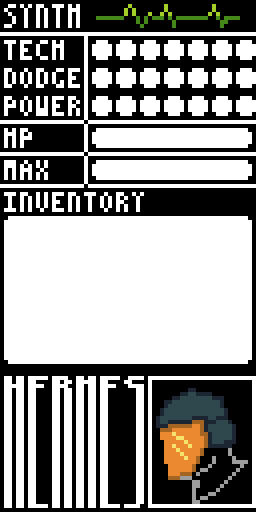
Each Player writes 6 different words on 6 pieces of paper, then puts them all into a hat. GM shakes the hat, and players then take turns taking out 1 piece each until each player has 3 words. Once done, any player can, for any reason, take out a 4th piece, then put any paper they have on them back in the hat once.
Those 3 words are the player stats/skills. They write down what those words mean as stats on the paper, and then order them from top to bottom. Top stat gets +3, middle stat gets +2, bottom stat gets +1.
Levelling up (GM discretion) allows for any stat to be increased by one, and any temporary stat reductions to be cleared. Injuries temporarily remove 1 from any stat (Player discretion). When any stat reaches zero, that player is defeated.
If a player is defeated, they put two of the pieces back in the hat and destroy the third. Then they write a brand new word, add that to the hat, shake it up, and retrieve three new pieces again for a new character (They can swap).
Simple RPG that's part party game.
Solo game played via day planner
You’re a magical girl with 20 Hope and a month until summer vacation. Manage your schedule in 1-hour blocks.
Chaos rises by 8 each midnight. At 20, the world ends.
Heroism sucks and costs 1 Hope/hour, reducing Chaos by 1. Your maximum Hope is 20. At 0 Hope, you die. Every hour of sleep or fun regenerates 1 Hope.
From 8-2 on weekdays you’re at school: that’s five classes plus lunch.
Every day you need:
You can skip hours of sleep but must pay them back in full within the next week.
Skipping meals costs 2 Hope.
You start with all A+s. Skipping a class drops that grade a letter. You can do two extra hours of homework to raise one grade a little (eg. C+ to B-). While a grade is an F, you’re grounded: no Heroism.
Skipping an hour of homework drops all your grades a little.
Each day, roll 1d8. On a 1, you have a commitment that day that takes 1d4 hours.
Frequently take the time to play out a little scene or consider your character’s emotional state.
I think the math works out on this one to be an ever more difficult spiral of obligations and making up for lost time.
If not, feel free to tweak how much Chaos rises by.
A game for 2 players
Player 1: you fancy yourself as a Hans Gruber type, or something
Player 2: you’re more of a John McClane, to be honest
Chemistry blows - in class and in dating. But you have a weird rivalry thing going on. You've been assigned as lab partners for an upcoming science fair. With only the supplies in the lab, you two are determined to come up with the best project.
Both players state an item they think should be part of the project, then simultaneously roll a d6.
The player with the higher number adds their item to the project, describing how it contributes. The winning player can instead choose to remove an item the other player added if they make a quippy remark that's half flirt, half insult.
If they roll exactly the same result, both characters realize they aren't so different after all. They confess (perhaps reluctantly) something they like about each other and make a final roll each.
If the total of the final roll is at or over 10, they put aside their rivalry for good and start dating. If not, they go about their school days as usual.
This game was a shitpost suggestion from a friend and I wrote it in 15 minutes.
Time to decorate for the season! Unfortunately everything you have is for the wrong holiday, so you'll need to get creative to make something good.
Assign -1, +0, +1 to ART, SKILL, and CRAFT. When asked to roll, d6 + applicable modifier.
5+: gain point
3-4: no change
2-: lose point
0: flip coin; if tails, "so bad it's good", gain point instead
Reactions by point total:
-4: remembered forever, in a bad way
-3 to -2: mockery
-1 to 1: pity, you did what you could with what you had
2 to 3: mild respect
4: admiration
I didn't have enough words available to say that it can be played solo or with a group, and that for group play it's like everyone is doing their own individual display, but I feel it's obvious enough to figure out how to do that, especially if you're the type of people who are willing to play random indie TTRPGs.
A game for three or more players.
2d6 per player
One player is Batman. The other players are Robins.
Batman's goal is to Stop Crime. The Robins' goal is to Do Flips.
Each round is one Encounter.
At three Disapproval Points, the Robin is Sent Home and patrol continues without them. Patrol ends when all Robins have been sent home. The winner is the Robin who Did the Most Flips. (Batman cannot win.)
Required: d10, 3+ players. GM-less.
Impending doom approaches.
Choose a player to go first via however you like. Roll the d10, and have that player describe a situation based around the result of your roll. The closer your result is to 1, the more minor your chosen situation (ex. tripped and spilt a drink), while results closer to 10 are more major (ex. your country is literally on fire).
The next player rolls the d10. Take the first situation, and based on the result of your roll, make it worse, with rolls close to 1 being less worse and rolls close to 10 being much worse.
Repeat the previous step with the next player, then the next and so on. Keep making your hypothetical situation worse and worse.
The player that makes the situation as fucked up as they can (use whatever your group judges as ‘most fucked up’) ‘wins’.
Optionally, you can replicate the feeling of your heart exploding via anxiety while playing by consuming beyond your usual daily limit of caffeine, or whatever stimulant works best.
Please be careful if you do decide to do the caffeine thing while playing.
You are a Player looking for a Game.
Pick two whole numbers from 1-6. Any time you notice both of those numbers, you may perform one of the following actions:
Flip a Coin
On heads: search for and write down three TTRPG titles you could make your Game.
On tails, write down three reasons trying new things is hard.
Draw a Card
Numeric value: Either set aside that much money (in CAD) for purchase of a Game, spend that much time (in minutes) scrolling aimlessly on a platform of your choice, or both.
King: Search for and watch a clip of Looney Tunes.
Queen: Search for and watch a clip of the Muppets.
Jack: Search for or make an appropriately blasphemous dish/snack.
Ace: Name a character you might play in a potential Game.
Joker: Declare a Game.
Roll a Die
If either of your chosen numbers shows, write down 7 names of potential Players.
If not, procrastinate on finding a Game by doing another task you were procrastinating.
Declare a Game
State the title of a TTRPG to any potential Players. Declare your interest in playing it.
You win when you Declare a Game.
I feel like the role-playing part of this might be a bit lacking, but I Capitalized some Nouns which should more than make up for it.
Yes, this is a game which, as @dukeofriven suggested in this post, is “a 200-word solo RPG in which the player works to purchase a copy of Eat God and learn how to play it”. Though I was interested in this competition, no ideas came to mind until I saw this and went “you know what would be funny?”
Granted, you don’t specifically need to play Eat God, but the game does lean towards it.
Full disclosure: I have never written a TTRPG before, and have played only a scarce few. As such, my goal for this game was only to be extremely playable—you’ll notice only one of the actions is actually needed to win.
A clarification on “any time you notice those numbers”—if you see both of them on a clock face, on a calendar, on a room or street number, or even on a keyboard, you may take an action. It’s meant to be fairly common.
This is a solo journaling game
The goal is to product a breaking news segment from the point of view of the non human residents of the House.
For this you need a six-sided dice or D6, something to write or record the segment.
Roll a D6 for the point of view (POV)
1 : House pet(s)
2 : Furniture and objects
3 : Insects
4 : Plants
5 : Toys or figurines
6 : Aliens
Choose the anchor(s) for this POV. Give them a personality trait.
Roll a D6 :
1 : Serious / Deadpan
2 : Smiling / Optimistic
3 : Jokey / Irreverant
4 : Dramatic / Over the Top
5 : Negative / Pessimistic
6 : Incompetent Weather Presenter that got this job by mistake
Then roll a D6 to see what the breaking news is about :
1 : The Human has done something silly
2 : The Human has done something uncomprehensible for the POV
3 : The Human has done something outrageous for the POV
4 : The POV paints a good image of a mistake the Human made
5 : An action the Human made has affected the POV
6 : Another POV's action has affected the anchor's POV
Then write or record the event as a television news piece from the current POV.
You are hyper-pirates. Attack and steal from each other. Most money at the end wins.
Materials
Setup
Put your sticks across the clothesline. Tie one end of the string to your boat and the other to your stick. You can move your boat along the clothesline, across the clothesline (moving stick when required), and up/down by twizzling the stick.
Gameplay
the reason you get d8, d16, and d120 is because of the regular polychora. they have 5, 8, 16, 24, 120, and 600 cells respectively.
optional rule -- speak only in agma schwa's hyperpirate conlang
i might make a better board for this
the reason you keep playing if a player runs out of ships is because the game is not mainly about sinking ships, it's about theft
You need 3-6 people, a piece of paper, a pen, and 4d6.
You are a god. You create all things under heaven. You are selfish and avaricious.
CREATION
Starting with the eldest god, take turns claiming Aspects of creation (1-2 words) for your Domain. Write them down. As you do so, say 1-2 sentences describing how you grant it to the world.
“I AM THE GOD of the ocean. My flowing hair becomes the seas.”
ERISTICS
Whenever a god claims an Aspect you believe to be in your Domain already, challenge them.
Make your case, then allow the accused to reply. Argue, no more than 5 minutes.
At the end, each participant rolls 2d6. The higher roll takes the aspect for their domain.
The remaining gods become mortals during ERISTICS. They each place their faith in a participant after the argument is done but before rolls, granting them +2.
STRIFE
Instead of naming a new Aspect during CREATION, you may claim an Aspect in another god’s Domain if it suits you more. Resolve through ERISTICS.
The game ends when 12 Aspects have been claimed and no STRIFE remains, or if 3 STRIFES occur in a row.
2 players. Deck of cards.
1 player is the hunter, the other the prey. The players should come to a consensus on their nature and relationship.
The hunter starts four steps behind the prey.
Each player will draw one card. If the hunter draws a higher card than the prey, they move one step closer. If the prey draws a higher card, the steps remain the same.
Whoever draws the higher card describes the current state of the chase. If they drew a red card, they describe a hope that drives them; if they drew a black card, they describe a fear that drives them instead.
The losing player then describes either how they were held back by their fear or failed despite their hope, based on their own card.
If the prey wins with a black card, they may instead treat it as a losing red card, if they wish. If the hunter wins with a red card, they may treat it as a losing black card.
The game ends when the hunter catches the prey. The prey describes what their final thoughts were as they were caught, and the hunter describes what happens afterwards.
Dramatis Personae:
The Questor: You must complete the objective.
The Contrarian Forces: The Questor must be stymied (or enabled, while appearing to stymie).
[Optional] The Narrator: You frame the actions of Questor and Contrarian, arbitrating their conflict according to the Genre.
Roll 1d6 for Genre:
Any player may propose a Quest, or the Questor may roll 1d3 to assign one:
If there is a Narrator, once the terms are agreed, they set the scene. Otherwise the Questor describes the beginning of their Quest, and play continues to the Contrarian. (Narrator comments again each turn after Contrarian.) Players should endeavor to tell the most engaging and genre-accurate story about the pursuit of the Quest that they can. If there is a Narrator, they should provide genre-appropriate context for the actions described by Questor and Contrarian, and adjudicate the outcome of conflicts if Questor and Contrarian do not agree who won an interaction.
Contrarian “wins” a comedy/satire/romance Genre game if their enablement was agreed to be the most interesting contribution.
I really love adversarial/semi-adversarial narrative games.
Tumblr's spellchecker can MEET ME IN THE PIT.
I could have come up with a lot more scenario options but word count was the Contrarian on that front. Three's honestly enough, though, I think.
For one or more players.
You want to participate in the event, but you waited until the last minute!
1. Decide what type of art the event accepts. Examples: scary story, crochet, comic strip, tin foil sculpture.
2. Roll a d20. Set a timer for that many minutes.
3. Before starting the timer, gather supplies. Think about what your entry will be like.
4. Start the timer. You have until the timer runs out to make an entry for the event. Remember: anything is better than nothing!
5. When time is up, pretend to be a judge. Find at least one thing to criticize and at least one thing to compliment about each entry.
Congratulations! You participated in the event!
I made this in just over an hour, so if anyone has questions let me know.
Edit: I realized this is my first RPG! If anyone has feedback I’d love to hear it. I did what I could to make it playable.
You are librarians on a submarine impersonating marine biologists. Don’t let each other know.
Create a librarian. Each grab a real-life book to be your character’s favorite book. Someone grab a book about marine animals.
Current turn-haver is Initiator. On turn, Initiator draws a card. Suit determines conversation topic. Players’ characters pretend they’ve totally heard about this before. Initiator’s character starts the conversation.
Spades: Animal Sighting. Initiator selects a random animal feature from the animal book their character glimpsed. Players select a random word from their favorite book to inspire fake details about the animal.
Clubs: Animal Damages Submarine. Initiator selects a random favorite book word and describes how an animal damages the submarine. Players select a random favorite book word to add details about the animal or situation. Initiator chooses another word for how they solve the issue(s).
Hearts: Good Books. Players pretend books they like are marine biology-related (NOT favorite book). Players choose a random animal book word and random favorite book word to combine into a book plot.
Diamonds: Favorite Marine Animal. Players choose a random favorite book word to describe their “favorite animal”. Each player adds a detail to every other animal with new words.
okay, so, i'm like... not actually a ttrpg game dev? but i had a dream that gave me an idea for a ttrpg, so i figured i might as well go and make it a reality. and since this event happened to be going on at the same time, i decided to make it a 200 word rpg as well. would love to hear about it if anyone tries to play this! i've never made a ttrpg before.
oh, and this rpg was inspired by @caw-oticdork's entry, as well as seedwords on itch.io. i hope that's okay! if not, let me know and i'll take it down.
A subtractive game for three or more players.
First, decide who's the JUDGE.
Each non-JUDGE player should click the following links to assemble Magic: The Gathering cards representing, respectively their GUY, their guy's STUFF, and their guy's SPECIAL TECHNIQUE:
Each round, you may reroll one result. Once every player has decided whether to reroll, take turns to ATTACK (explain in 90 SECONDS why your GUY would beat the others in free-for-all combat with their STUFF and TECHNIQUE).
After each ATTACK, the other players may each DEFEND (spend 30 seconds explaining why the ATTACKING player is wrong).
You are only allowed to refer to the name, art, and flavour text of relevant cards to make your arguments; you may not refer to any rules text on those cards or to any Magic: The Gathering rules concepts or lore.
Once all ATTACKS and DEFENSES are finished, the JUDGE decides a winner under the same criteria. That winner is the JUDGE for next round.
ADVANCED EDITION
To add more variables, go to https://scryfall.com/random?q=t:land to generate an ARENA and https://scryfall.com/random?q=t:enchantment+-t:creature for a BATTLE SCENARIO each round. These apply to all GUYS & can be invoked in any ATTACK or DEFENSE.
a game by w.s. healed.
if anyone else wants to reference this or remix it or whatever you can do that too.
i like the idea of a 'subtractive' game, a game that is produced entirely by removing parts of another game. the 200 word limit providing an obvious utility to a larger (in this case, much larger) intertext seemed like a perfect opportunity to play in that space. i have made the executive decision to consider each link to be a single word--i could have used hyperlinks to make this more clear-cut, but i think actually having the links written out increases playability.
PATCH NOTES: shortly after posting, i altered the advanced edition rules to remove enchantment crteatures from the battle scenario pool, as they're not really in the spirt of it.
PATCH NOTES 2: after graciously being informed of a typo in the TECHNIQUE link, i have corrected it to (as intended) pull up a random instant or sorcery
Grab the first dice that comes to hand. Roll it. Put on a song or other audio track (ideally one you're well familiar with) that lasts for as many minutes as the value the dice shows, then lie down and close your eyes for as long as the song lasts. You can choose to continue resting once the song ends. You win if you fall asleep.
In general I feel that "putting on a timer for the specified duration" is a bad idea, because what if it's really loud when it goes off and it startles you, what if it's really quiet when it goes off and you don't notice it, but "putting on music that lasts for that specific duration" avoids both problems. Especially if you know it well, so you don't even need to be paying attention to know how much time you have left. This works for anything you need timed, like "how long you're going to force yourself to spend working on the thing" or "when you need to start getting ready to leave".
a 200-word TTRPG
The world has ended. Describe how.
You are a survivor. Tell anyone who will listen:
what treasure you must protect,
what enemy you must defeat,
what secret you must uncover,
what lie you must refute,
what lost cause you can't abandon.
Begin with two d6s of each color. To take steps towards a goal above, roll all your dice of that color. If the results include:
Otherwise, fail. If you rolled black, treat a result of 4, 5, or 6 as a 5 and a 6, but fail anyway.
Leave each result face-up on the die until you roll that die again.
You may replace a failing result with a 5 and a 6 by HOLDING FAST. Once you do, you cannot ever let go. Upon pursuing a goal to which you have HELD FAST, check if any result of the roll matches a value showing on any other goals' die. If any does, replace the other die with one whose color matches the HELD-FAST goal. Describe how your needs come into conflict, and how you carry on.
Initially kind of inspired by N.K. Jemisin's Broken Earth trilogy, but that DNA has pretty much mutated completely in revising.
Battlefield is two-sided, three lanes each six units long, a wall for each side controlled by its army in the center.
Army Units:
duelist: attacks twice
knight: takes two hits
ranger: attacks go through walls and lanes
support: if adjacent, revive unit or repair 1d6 wall, only move or act, cannot attack, 1 per lane
Walls block enemy movement, have 10 points, attacks break 1 Wall
Adjacent units attack: players roll 1d6, highest hits, most units die in 1 hit, ties hit both.
Each round has building then war
Building: spend 1d6 points.
Units: 1 point
Heroes and spells: 3 points.
Lowest roller goes second. Place units.
War: Cast spells, units/heroes move then act.
Armies are goblin, gnome, kobold, devil
Goblin
Hero: ranger, assailant always dies
Spell: explode goblin, killing 1d6 units nearby
Gnome
Hero: support, moves AND acts
Spell: repair 1d6 wall
Kobold
Hero: knight, +1 next build roll per kill
Spell: dragons attacks any 1d6 units
Devil
Hero: duelist, -1 spell cost next round per kill
Spell: next 1d6 devil attacks doubled
When War ends with only enemies in a lane, it is taken
Victory achieved after three are taken.
I'm not sure how balanced each army is but I'm hoping each of their playstyles is at least unique enough. I also hope this counts as an rpg...? I don't know if getting caught writing a "200 word war game" would be considered stupid or impressive by anyone. this is based on a dream I had about a board game that was designed to sell a ton of cheap tiny meeples, like warhammer for poor people and children I guess. feel free to tell me if theres any. imp Wars tournaments. And feel free to write 10,000 pages of convoluted lore about the corrupt fascist-theocracies of each army and the cruel hierarchies they live under or how "gender" their body modifications are or something. Maybe make up some battle cries to yell in a funny voice while you roll the dice.
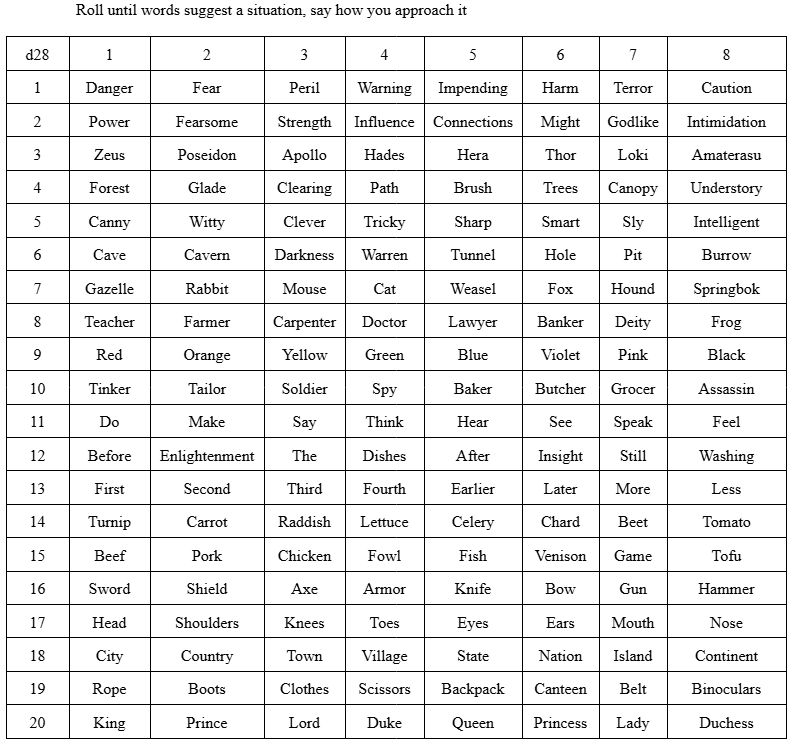
Ok to use, remix, alter, fold, spindle, mutilate, or plagiarize.
I worked out that a 9x21 grid made room for a d20, a d8, the "d28" indicator, label row and column, and 11 words of instruction. "Third edition" because I kept finding repeated words while trying to put together this post.
One might argue this is more of an improv game than a role playing game, if one were so inclined, but one might also not argue such a thing, if one were not so inclined.
Ingredients: bag of dice
You are a creature with a HORRIBLE BONE-WASTING DISEASE. The cure is to replace all of your bad bones with less bad ones.
Take a good handful of d4s and d6s. Arrange them into shape of your creature, 3s facing up. Each die represents one of your bones.
Decide how you’ll acquire bones. Roll ten dice from bag, creating CHALLENGE POOL.
Attempt a challenge by rolling any of your bones corresponding to a part of your creature’s body that you believe will be useful, physically or metaphorically. If sum is greater than value of a die in the CHALLENGE POOL, you succeed. Put that die in the BONE PILE. Otherwise, you fail and don’t do that. Put your bones back, maintaining number they rolled. Any rolled 1s are BROKEN, and can no longer be rolled.
When CHALLENGE POOL empties, REPLACE up to 3 bones by swapping dice from BONE PILE with existing bones. New bones have largest number on top. Reduce value of bones that look connected to replaced bone by 3. This BREAKS any bones brought to 1.
Repeat with new CHALLENGE POOL.
Win if you replace all your bones. Lose if all bones break.
Don't use tumblr enough to have an appropriate blog for this, so I guess it goes here. Would have been nice to have some extra words for trivialities like how many players this game is for, what you might want to roleplay while rolling dice, and the fact that you probably want dice with more than six sides in the dice bag. Oh well.
Written in less than an hour and completely untested.
Designed For Three Players
You have accepted a job as an adventurer! Unfortunately, your goal is a bit far away, so you must go on a road trip to reach it and complete your Quest.
To begin, decide your Destination. Then create Situations you'll Encounter and decide their difficulties. To Solve a Situation, gain XP equal to or more than its difficulty during that Situation. After 3 Situations, you arrive at your Destination. A Destination could be a Settlement, a dungeon, or another important Landmark that is where your Quest goal resides.
To get XP and solve situations, try to surmount whatever obstacles your current Situation poses by describing how you try to accomplish, fix, or otherwise get around it. You gain 1 XP for each Success.
Upon reaching your Destination, create three Situations to represent your goals for the Quest, with each player trying to complete a single goal. If all Players finish each goal, you've completed your Quest and are free to take on more!
Designed for 3 Players
Vampires are attempting to gather the necessary resources to complete the unfinished Dyson Sphere they constructed to cover the sun. You've been tasked with stopping them again.
On the way, you'll encounter Situations. Potential Situations include:
1: Vampire Contractors hauling materials. [3]
2: A town ransacked for metal. [3]
3: A small group (3-4) of Thralls. [5]
4: A previous group who succumbed to vampirism. [5]
5: A large group (5-10) of Thralls. [7]
6: Being targeted by the Vampiric Orbital Laser. [7]
After crafting a Situation, decide its difficulty. To Solve a Situation, gain XP equal to or more than its difficulty during that Situation. Gain XP by performing actions that make progress toward completion.
Upon reaching your Destination, you begin a Unique Situation.
Construction & Translocation Obelisk [9]
This Situation is divided into 3 parts. Each player chooses a part to complete.
1: Distract the Guards. [3]
2: Disable the Translocator. [3]
3: Detonate the Charges. [3]
Once all three parts are completed, Congratulations! The Vampire's Construction Plans have most likely been pushed back at least 5 years. You have succeeded on doing your job.
You are a talented Mage, but you have to deal with The Arcane Bureaucracy's Bullshit Regulations while being an adventurer. Before each Situation, roll 2d6 for the current Legal landscape and its influence on what spells are allowed and which are banned.
1: Spells that Affect the Mind are Banned.
2: Spells that Cause Collateral Damage are Banned.
3: Spells that Target Living Creatures are Banned.
4: Spells that Interact with The Dead are Banned.
5: Spells that Manipulate Elements are Banned.
6: Spells that Target Yourself are Banned.
To begin, create a Situation you'll Encounter and decide it’s difficulty. To Solve a Situation, gain XP equal to or more than its difficulty during that Situation.
To cast a spell, decide its Name, Effect, and Purpose. If at least two parts of a spell follow Regulations, it isn't banned. Whenever you successfully cast a spell that doesn't violate a current regulation, gain 1 XP. If you cast a Banned Spell, lose one XP or gain a Strike. Three Strikes result in a Revoked Arcane License and immediate Self-Immolation.
You are a Squire accompanying a Noble Knight who's renowned from the Dwarven Seas to The Elven Moon Empires. Unfortunately, he's also an idiot who's only good at one thing. Choose 1 Noble Trait for the Knight and 3 Common Traits for yourself.
Some example Traits may be:
1: Banter
2: Bold
3: Wealthy
4: Honest
5: Romantic
6: Frugal
1: Common Sense
2: Rake Proficiency
3: Backpack
4: Short-Sword Proficiency
5: Cartography
6: Device Proficiency
To begin, create a Situation you'll Encounter and decide it's difficulty. To Solve a Situation, gain XP equal to or more than its difficulty during that Situation.
To surmount a challenge, choose a Common Trait. Explain how you accomplish your goal while making sure your Knight's Noble Trait is involved. Your goal is to make sure he doesn't find out that his accomplishments are mainly due to your help. If the Noble Trait isn't properly involved, either lose 1 XP or your knight becomes frustrated at your Arrogance. If your Knight is frustrated three times, you are let go and need a new job.
You are a Landsknecht, ordained and tasked with being a Proper Mercenary with your Stylishly Colorful Gear. To start, choose 4 colors, assigning those Colors to your Head, Chest, Leggings, and Pike. Your gear will get magically enhanced based on what color it is and what you can reasonably (or unreasonably) claim that color is associated with. For example, using a Red Pike to catch something on fire.
To begin, create a situation you'll encounter and decide on its difficulty. To Solve a Situation, gain XP equal to or more than its difficulty during that Situation.
To perform an action, choose a piece of Gear. Explain how that Gear's Color would enhance your action. Whenever you successfully perform an action, gain 1 XP. If your action wasn't enhanced by the Color of your Gear, either lose 1 XP or Commit a Style Crime. If you commit three Style Crimes, your Skeleton becomes cursed, and you get Excommunicated from the Guild of Proper Landsknecht.
This is something I've wanted to do for a while, ever since @prokopetz mentioned making a full-fledged TTRPG made up of smaller, independent 200-Word RPGs. I just never got around to it, until now!
Mechanically, I kept it pretty simple. Obviously, having each of them be individually playable meant there's definitely overlap, but I think I did a good job keeping the three classes distinct.
Setting-Wise, I mostly just used the world from the novel I've been working on for a bit. I don't know if said novel will ever be finished, but who knows.
I haven't been able to playtest anything here, so I have no clue how fun it'll be. I hope you enjoy it though!
Fae, signing off!
You are two people, mirrored, enemies and beloved, becoming one in strife. Soul to soul, blade to blade. A conflict has arisen, for the fate of something grander than any battle. A clash to determine the fate of what lies between you.
Declare how your location matches the intensity in your souls.
Declare who has the High Ground.
Declare who you are.
Declare why it has come to this.
Both players roll 1d6. Add the results together.
If the result is 9+, the player with the High Ground describes how their action Conquers.
If the result is 4-, the opposing action Conquers.
On a 7, both players gain INTIMACY and tell each other what is sparking in their chests.
On any other result, Interplay continues as intensity swells.
If both results match, describe how players CLASH; and the other player gains the High Ground.
Interplay continues until a single player CONQUERS thrice, or INTIMACY forms thrice.
When a player Conquers finally, that player describes how they have conquered their opponent, and how the conqueror changes irrevocably.
When players form final INTIMACY, drop your blades. Describe how you have found new depths in one another, and what has formed between you.
It was very fun coming up with this, even though I am much less confident in the mechanics this year than last year's entry. Nonetheless, I hope everyone has fun reading it!
For this game you'll need:
You begin with an odd number of players. Choose which player is The Judge and write various silly arguments such as "is coleslaw a salad", "are there more doors or wheels", or "king of the hill is American anime" into a container. The Judge pulls an argument and decides teams to argue each side.
Each team sets a timer lasting 10 minutes. The timer is paused unless the team is talking, once the timer runs out the team cannot argue or give rebuttal to anything the opposition says.
The Judge can decide to add a stipulation or flip the script. A stipulation would be something such as "coleslaw is only a salad with burgers", and flipping the script would be forcing each team to argue the other side instead for the remaining time.
The judge decides who wins after both timers have run out. A player from the winning team is selected as the next judge.
The prize of winning is that each player must abide by the argument that has won. Coleslaw is now a salad for all time.
Note from me: I am uploading this on behalf of my cousin who doesn't use tumblr. I sent them my entry to proofread, and they made this in an hour, which rules. They have consented to it being included in the archive. Below is a message from them.
My central idea of this game came from sitting awake at 2am, being given the idea of this game jam and finding myself remembering arguing with the one posting this to tumblr about various silly and stupid arguments for hours at a time, some even still being brought up today. These arguments have gotten out of hand and I feel it's my duty to get wide public opinion and outrage at people who argue with as much stubbornness as them.
I don't have tumblr but you should message my cousin (the one posting) every dumb argument you have so they can lord them over me like the malicious little gremlin they are.
Have fun, never give up arguing.
Roll for an Itsy Bitsy Critter:
Roll for a location:
Roll for a weapon:
Roll 1d6 for a complication:
Roll two identical dies, take the smaller result and subtract from or add to it according to the above results. Then subtract that result from the other roll.
If the result is 1 you have successfully chased away, captured or vanquished the itsy bitsy critter. Describe the protracted battle.
If the result is 0, You have succeeded, but humiliated yourself in the process. Describe the resulting self-deprecating social media post. If the result is less than 1, you have failed and injured yourself. Describe how you explain the embarrassing injury to the doctor.
If the result is higher than 1, reroll your two dice but add the number to the smaller roll. Keep chasing the itsy bitsy critter until you win, humiliate or injure yourself. Each player does this in turn.
Can you guess what happened while I was showering this morning? 😒
Required Materials:
- 2 d20s
- 2 d10s
- 2 d4s
- 2 dice cups
Setup:
Each player sets their d4 and d20 to its highest value, visible to each other. These track Hitpoints and Stamina, respectively.
Play:
Prepare - Each player chooses a number on their d10 and places it face-up under their dice cup. You may not choose a number higher than your current stamina (excluding 10.)
Compare - Both players then reveal their die. If the values differ by two or more, the player with the lower number loses one hitpoint. Both players then lose stamina equal to the number they chose.
Reset - After the results are compared, both players regain 3 stamina. Return to “Prepare.”
Blocking - If a player sets their die face to 10, they block: neither player loses hitpoints in the Compare stage, regardless of the faces they selected. A player who blocks loses 5 stamina instead of 10. You may not block if you have less than 5 stamina.
End:
Either player has 0 hitpoints remaining.
Joust! is inspired by the combat system used in the video game adaptation of Steve Jackson’s Sorcery! gamebooks. These gamebooks were adapted into their own ttrpgs, compatible with D&D 3.5. However, the combat system from the video games (published by Inkle) is, in my opinion, a fantastic way of handling a duel between players. It emphasizes the importance of predicting your opponent’s moves, while not being overly complicated. It also leaves room for interpreting differences in strength, by adjusting the hitpoints, maximum stamina, and stamina loss of a player.
I believe this game is best used within another fantasy ttrpg to allow players the ability to duel each other, as the combat systems in many of these games are not made with one-on-one fights in mind. However, it can also be played as a standalone game if you really enjoy rock-paper-scissors and want something with more depth.
a game to walk to.
~~~~~~~~~~~~~~~~~~~~~~~~~~~~~~~~~~~~~~~~~~~~~~~~~~~~~~~~~~~~~~~
what you'll need:
~~~~~~~~~~~~~~~~~~~~~~~~~~~~~~~~~~~~~~~~~~~~~~~~~~~~~~~~~~~~~~~
rules... or rather, suggestions:
Please Be Careful When Throwing Rock. this game is best experienced if you have a good throwing arm and are ok at improv and walk slowly. if this doesn't count as a "ttrpg", replace "rock" with "d6". you are highly encouraged to tailor your story to your environs during the walk, if you want to, and highly discouraged if you'd rather not. if you lose the rock, well,,,,,,
You have encountered a pack of drunkards. They have learned that you can sing. You are now honor-bound to do so.
Also, the bar is on fire.
(Or the bus is headed for a cliff; the boat is sinking; et c.)
Fortunately you are a karaoke wizard.
By singing a song in full, you can create one effect you can convincingly relate back to said song. Make it Rain Men who can construct a bivouac; ensure that you Will Survive any weapon forged against you; bless the rains down in Africa and melt the zombie army.
The GM, or all players if GMless, determine an emergency. Go around the table antiwiddershins; sing until there is no longer an emergency, then create a new one.
Karaoke wizards can also initiate duels with one another, if the situation calls for it. This operates under Pitch Perfect "riff-off" rules; a party determined by coinflip begins singing, but their opponent can cut in on any line to begin singing a different song with that same line, from that line. If allowed to sing a song in full, the karaoke wizard subjugates their opponent's will and immures them beneath the earth, or gets free beer.
Inspired by real events. (People on the train home found out I could sing. They were very, very drunk. I killed.)
This is somewhere between "freeform diceless" and "fairy tea party", but let it not be said that a game jam entry needs to be polished.
I will not apologize for use of the term "antiwiddershins."
This work may be reproduced freely.
Kings, CEOs, generals, necromancers... The heavens tilt for guys like that. For Stars.
Starting with the Narrator, each player decides one of the following:
Then create characters. Each player decides their character’s birthday. Each other player gives you a fact that, because of their birthday, must be true. Afterwards, decide your character's name & other non-taxonomic facts.
When acting against the Stars, roll 2d6 plus one for each of the following:
2-5 or snake eyes: Dire failure. Injure a relevant fact.
5-7: Failure.
8-11: Success with drawbacks.
12+: Resounding success. Replace a relevant fact with its transcendence (elaboration) or refutation (opposite).
Narrator describes consequences, environment, foes, etc.
If all your facts are injured, your character dies. If all are transcended or refuted, your character strikes a major blow and retreats. In either case, become another narrator.
Continue until no characters remain. Narrator describes how the world changes, and each player describes their character's life or legacy thereafter.
okay to remix / archive / etc. inspired by Killing Machines by @ribstongrowback. thank you also to @txttletale for suggesting transcending.
Make a list of 10 traits that you associate with human beings. Speech. Language. Pants. You name it.
This is your definition of a human.
The machines are posing as humans, and they must be killed.
With four other people, you will walk the world, and look for threats. To that end, whenever you identify something as an obstacle, something that resists your will, declare your intent and look at your list and roll a d10. If you treat the obstacle as a human being, with feelings and thoughts and a rich inner life that matters, you succeed if the roll is equal or lower to the number of human traits from your list that match the target. If you treat the target like something disposable that can be killed, like a machine, you must roll over that number.
If you succeed, you might sway someone to your cause, move to an advantageous position, or kill a machine.
Whenever you fail a roll, someone else at the table dictates a consequence. This can be the loss of an item, or being separated from your allies, for example. If you suffer harm, cross out a trait from your list.
Author's note: a fun challenge! This is exactly 200 word including the title and I hope it's a fun read.
The Kingdom is coming to ruin. But this isn’t a story about that.
You will need:
- A tarot deck
- GM with at least a cursory knowledge of tarot or a guidebook
- 2+ players
Divide the deck so that the GM has the major arcana and shuffle and deal 5 minor arcana to each player.
To begin the game, the GM says, “The Kingdom is coming to ruin. But this is a story about...” and draws to finish the sentence. The GM describes the setting, and then players describe who they are and what they want as the kingdom crumbles around them.
Each round, the GM draws a card to represent what happens next. Players can take free actions (looking around, talking, etc.) but play a card to take a Meaningful Action.
Wands = magic, pentacles = money, swords = force, cups = reason.
The numbers represent the degree (eg. the king of cups might be a beautifully rhetorical speech. The seven of swords might be a hard shove).
Each round, the GM decides which play wins in that situation. That player gets the round card. Players draw.
The game ends when one player has 5 round cards. They win, standing alone in the ruins.
i’m not the biggest rpg expert but i think these are super cool so i decided to take a stab at it! tarot based rpgs have been done before but idk anything about them so i hope this turned out okay. it’s more of a storytelling tool than anything but i tried to make it more game like than say those story dice or something like that.
not playtested but give me a shout if you do :)
a language-based RPG
you need: 2+ players, paper, writing utensils
you are a community of newly sapient creatures inventing language for the first time.
SETUP
agree on who your community is [like "computers developing sentience after human extinction" or "ants granted the power of speech by a wizard"]
place a paper in the center of the table. this is the DICTIONARY.
agree on 6 basic, useful concepts [like "YES," "NO," or "ME"]. write them in the dictionary.
taking turns, give each concept a corresponding new word [like "ALOK," "WAWSI," or "KOKAZO"].
give each player their own paper for notes and interpretations.
GAMEPLAY
during play, no existing language may be spoken. you may only say words defined in the dictionary.
start with the oldest player and take turns clockwise.
on your turn, do 2 things:
after each full round, the players vote [with thumbs] on whether the story is over. if it is, stop playing. afterwards, you may compare your notes [or not, if you want to preserve the mystery].
You have been trapped in an inescapable labyrinth. It is time to escape!
Gather up your carefully hoarded resources (All physical d12s on hand) and go.
For each d12, your resource, roll one die on both tables below. After your roll, that resource is consumed. Actions or results marked * consume an extra resource unless you’ve a tool.
After each action, Chronicle
Where to go:
1: Left
2: Right
3: Keep going
4: Backtrack
5: Break a wall *
6: Dig *
7: Call for help
8: Decipher glyphs *
9: Listen for clues *
10: Contemplate your path
11: Follow tracks *
12: Make camp *
What you found:
1: Nothing special
2: Rotting food
3: Swarm of rats *
4: Armed skeleton
5: Angry skeleton *
6: Abandoned camp
7: Murderous adventurer *
8: Parchment scraps
9: Fellow wanderer *
10: Cache of supplies
11: Echoes of activity *
12: A way out?
Of course, merely finding a way out is not the final challenge. Be sure to chronicle how you dealt with the monster at the end of the labyrinth.
This is CC BY 4.0
Also written for the zero hour challenge
A Game For Two Players
To begin, go to the other player's home. It is suggested that the other player not be informed that they are playing.
YOU are a youthful scion of LADY FIONA'S line. The other player is LADY FIONA.
As play begins, you are visiting the old bat. She has never respected you, and you stand to inherit nothing. Unless, that is, you take matters into your own hands.
Steal as much of LADY FIONA'S stuff as you can without being caught. For each item you steal, make either a veiled remark about the item, or a less veiled one about your relationship with LADY FIONA, with a tone indicated by the roll of a d6 and the consulting of the table below:
1. BITTER
2. SNIDE
3. HISTRIONIC
4. SMUG
5. DIFFIDENT
6. POETIC
LADY FIONA’S player should respond as feels natural.
Play ends when you depart from LADY FIONA’S MANSE, either having been caught and in disgrace, or bearing your ill gotten gains.
You will need 1d12 per player.
Once, you thought yourselves heroes, but no longer.
Each player creates a character. These characters were teammates. Determine what kind of team, or roll on the table.
Each round is a new tale of your exploits.
Each round, roll 1d12 per player.
When one character is left, the game is retroactively framed as their melancholy ramblings.
It is Autumn 1942. Fascists drive into the Caucasus Mountains. If they capture the Baku oilfields, your beloved Union will be destroyed.
It is your seventh mission of the night. Your navigator was killed on your first attack run. The fascists must be stopped. There is no-one else.
Your plane has 3 Structure. You have 2 Wounds. Make a pass over the fascist positions:
To roll Damage, roll a D6. Kill that many fascists.
Repeat. When you lose all Structure or Wounds, you may make a final Damage roll to crash your Po-2 into the fascists.
Total Damage:
<10: The attack is not affected. More of your comrades will die.
11-40: The attack is barely affected. Many of your comrades will die.
41-80: The attack is slowed. You are awarded the Medal "For Courage" posthumously.
81-120: The attack is blunted. You are awarded the Order of the Red Banner posthumously.
121+: The attack is heavily blunted. You are named Hero of the Soviet Union posthumously.
Inspired by this post and my username. Also (sort-of but not really) by the much better game about the same regiment. Of questionable historical accuracy and probably more questionable playability. 'Playtested' exactly once.
My first attempt at making an RPG.
Permission granted to do whatever you want with it, as long as attribution is given.
A LARP for 3+ players.
You died and woke up on a talk show hosted by a spirit of death. Throughout the evening, the Host will introduce guests from your past and judge whether you deserve Heaven or Hell based on your conversations with them.
One player plays the Departed, one plays the Host, the others play Guests. The Departed and the Host will constantly be playing, while the Guests will swap out.
The Departed should note their:
and announce them to the group.
While this is happening, the Guests should begin creating their characters.
Each Guest should note their:
and privately tell these to the Host by writing them down or privately messaging the Host.
The Host begins by chatting with the Departed before introducing the first Guest. As the Host, try to lead the conversation to reveal the Guest’s traits. One player may play multiple guests, but try not to hog the limelight! Once each player has played a Guest, or whenever the Host wants to end the game, the Host condemns the Departed to Heaven or Hell and the game ends.
Also available on itch.io here! Shout out to Long Time Listener Last Time Caller by Jeff Dieterle, which the structure of this game is heavily based on.
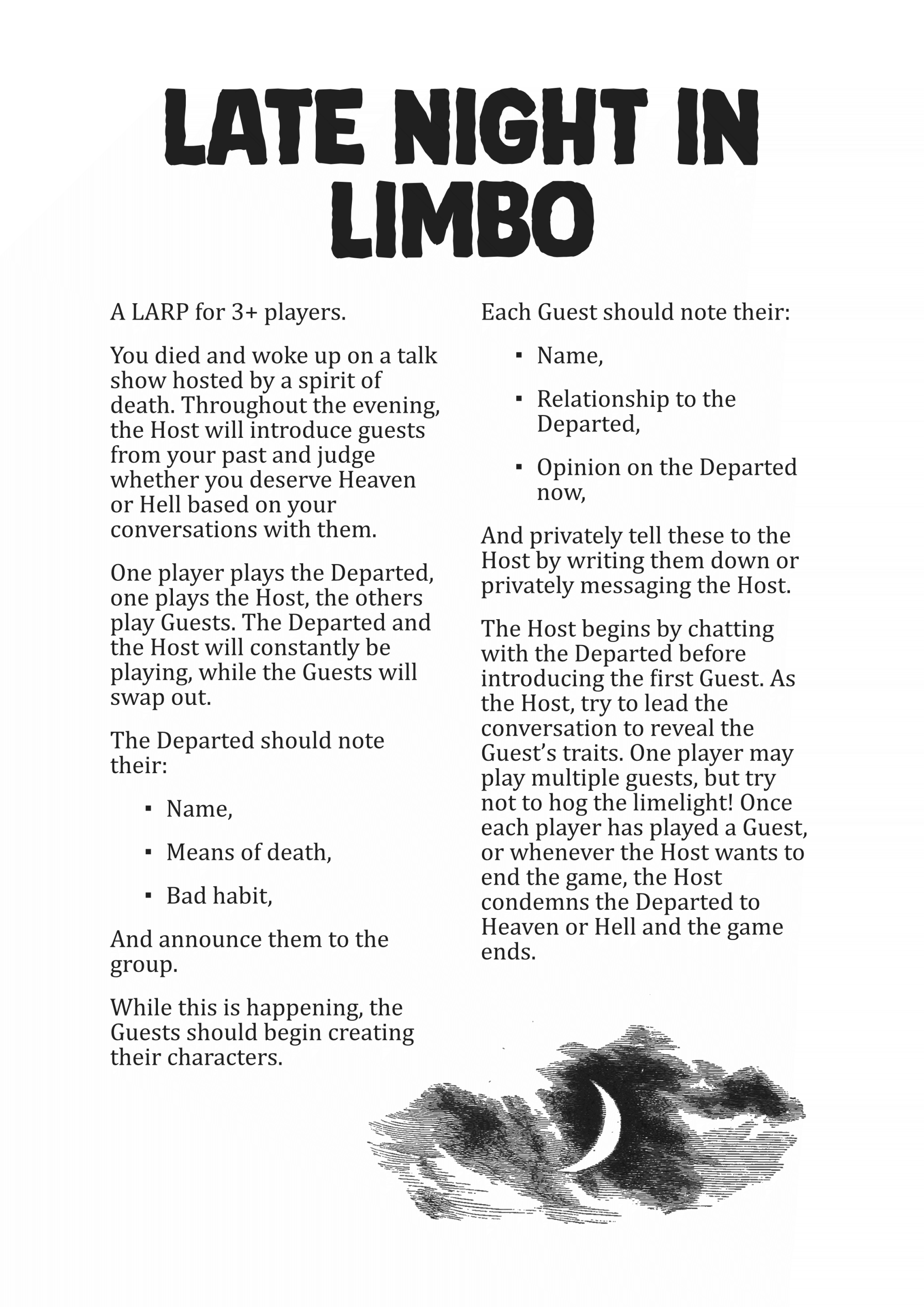
Image credit: British LIbrary on Flickr
Vous jouez un groupe de linguistes et d'extraterrestres qui interagissent. Le traducteur universel fonctionne mal et les linguistes doivent tenter de deviner ce qui est dit.
Prenez un jeu de 52 cartes. Répartissez-vous en deux équipes (Extraterrestres, Linguistes). À chaque tour:
Pour chaque échec, les linguistes reçoivent une carte "de réponse" de plus.
Pour chaque réussite, les extraterrestres peuvent donner, une seule fois dans la partie, une tentative supplémentaire aux linguistes si ces derniers se trompent.
À 3 échecs, la partie est perdue; à 3 réussites, elle est gagnée.
D'après mon compte, ce JDR compte exactement 200 mots. Le compteur de mots de 200 words rpg compte seulement 198 mots car il compte "d'extratrerrestres" et "répartissez-vous" comme un seul mot chacun, là où les règles habituelles du français les considèrent comme deux mots.
Vous voyez que c'est possible de rester en-dessous de 200 mots en français. P't'être même que je vais traduire les jeux en restant sous 200 mots juste pour flex.
Je vais probablement reblog avec une traduction en anglais du jeu d'ici la fin du concours, ou un peu plus tard si j'ai pas le temps.
Step in paws of detectives in an anthro city. The streets might be cute and fluffy but watch out for crime hiding on them.
It's a day like every other. You and your partners are called to solve a nasty case. You have to use every trick you can to reveal the truth.
To create your character choose an animal you want to base them on. Then roll a D6 die three times for your statistics - Speech, Logic and Nature.
Speech helps you with interrogating NPCs.
Logic helps you stumble into theories about the case at hands.
Nature lets you use your animalistic abilities in solving the case.
If you have to test one of your stats you roll a D8 die. If the result of the roll is lower or equal to your stat then you succeed. Each PC does their actions in an order that is agreed upon at the start of the game (only one action per turn).
For progress in your case the game master can award you with Eureka Points. You can then spend it to find a clue that eludes you if there are any that you didn't find or to interrogate an NPC.
So here's my entry for the jam! I have to say I love detective games both tabletop and digital. I hope you'll have fun playing my creation.
Have fun playing!
Players ≥ 2
Determine who will be The Auditor(s). The rest are Ledgermen.
Each Ledgerman secretly flips a coin: Heads = Whistleblower, Tails = Ledgerman.
Send the Auditor(s) away. Generate a column of random numbers 1<x<1000. Generate the same amount of random words, attaching each to a number. These are the company’s Financial Records.
Create four columns labeled ‘Assets’, ‘Liabilities’, ‘Income’, & ‘Expense’. Collaboratively assign each number a column based on the word attached to it. Write only the number there. A Functional Company has Assets > Liabilities, & Income > Expenses – but too much looks suspicious.
Summon the Auditor(s).
The Auditor(s) may mark ≤ 4/10 of the entries. The Ledgermen must provide the word for each entry. The Auditor must either accept or dispute the entries’ placements based on the words.
The Ledgermen must either move the disputed entries or defend their placements.
Whistleblowers may now reveal any frauds to the Auditor, guaranteeing their job security.
If the company does not look functional the Ledgermen will be Fired.
If the Auditor(s) does not dispute a fraud they will be Fired.
If any dispute cannot be settled, everyone will be Fired.
If nobody gets fired, the game is a success!
No Accounting Experience Required. In fact, Accounting Experience is actively discouraged.
Lying, on the other hand...
Invent a lesbian. Roll 4d6 or pick:
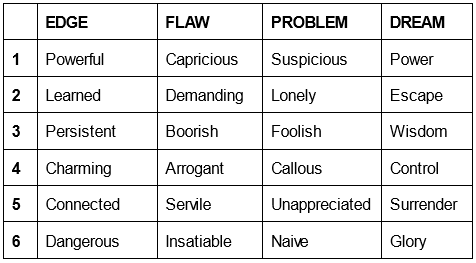
Invent 1-3 more. Relationships between every pair start with 1d6 passion and 1d6 trust.
Each turn, roll 2d6 for each woman's behavior(see table). Pick who she impacts, adjust their relationship stats accordingly. (Or spend 1 trust to reroll.) Journal the results.
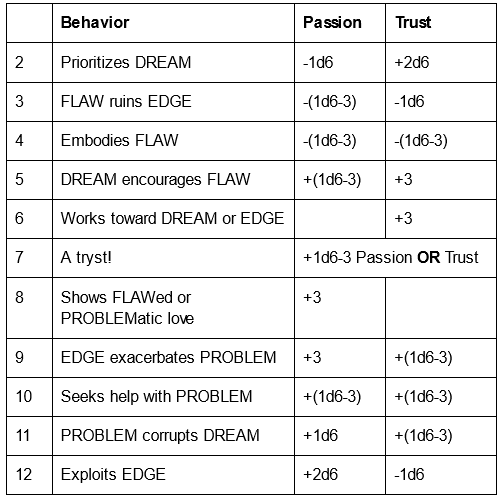
At 15+ Passion:
If Trust is 0 or less: Murder Attempt. Whoever has more trusted allies survives & gets -2d6 trust with the other’s allies.
If Trust is greater than 0: Marriage. When one cheats, she gets -1d6 trust with her wife.
Play until everyone’s dead or married.
I'm really quite proud of this one.
Earlier drafts were titled Bad Women Kissing Each Other, and I still can't decide which name I like better.
"Invent a lesbian" is possibly my favorite way I have ever introduced the rules of a game.
Game length does significantly increase as you add more lesbians. Each additional woman effectively doubles the amount of numbers to keep track of. In playtesting, we found that 3 lesbians was a good sweet spot.
I had a whole lot of fun iterating on this idea, figuring out how to express complicated passions in such a tight word count. I'm actively choosing not to spend more time fine-tuning the resource economy. This was supposed to be a fun quick thing and I've already spent almost a week on it.
I'm quite proud of how much storytelling I was able to pack into what is basically "roll on this table over and over again". If I had just a few hundred more words, I think I might be able to turn this into something really special.
I also want to thank several very helpful playtesters: Misty, Chills, Neither.nor and Crox, who all gave very good feedback and suggestions. Misty also came up with the *excellent* subtitle. It captures the entire arc of the game in three words.
Anyone who wants to has my full permission to hack this, remix it, or do whatever they want with it. You could get a whole lot of mileage out of just changing the words in the first table.
You: an unmarried woman of the gentry.
You: entirely dependent on the charity of your brother.
You live in a city you hate. Your only respite is writing to your sister/friend.
1. Name everyone.
2. Letters must include, in order: commentary on the last letter you received; an account of an event you attended; descriptions of 1-3 people; description of food; commentary on your current projects; indirect resentment/frustration with your life; indirect expression of a desire; something funny/stupid someone said.
3. Never: directly express any transgressive feeling, such as: resentment/criticism of your male relative; resentment for your place in society.
After every letter, roll 2d6. If the dice are equal, write a final letter and describe:
1s: Your male relative decides to return to the family home.
2s: Your correspondent invites you to stay with her for a few weeks.
3s: You are "invited" to visit your pregnant sister/in-law who needs help.
4s: Your wealthy great-aunt dies and leaves you a small independence.
5s: A man you do not entirely hate proposes marriage.
6s: Your artistic pursuits are successful. The sale of your art provides a small independence.
The improv RPG designed by an actual improviser
The resolution mechanic: roll a die. You may only get a 6-sided die if you took conservatory. Standard players get a 4-sided die.
1-3: No, but. You failed, but something happened that might be helpful later.
4-5: Yes, but. You succeeded, but something happened that'll be a problem later.
6: Yes, and. You succeeded and something else good happened.
Every session lasts a maximum of 20 minutes. Anytime someone gets bored or nervous they can call for a new scene. Your suggestion is "film noir elf".
They say you should write what you know.
A road trip game for two. The driver acts as Dungeon Master (DM), while the passenger takes the role of an Optimistic Player (OP). Play begins when the DM reads aloud the first three letters of a car’s license plate. The OP has until the count of twenty to name a spell for which those letters are an acronym. DNJ could become Dark Noodle Jinx, for example. It is the responsibility of the OP to explain why their hypothetical character should have access to this spell, how it ties into that character’s elaborate backstory, and why it wouldn’t disrupt game balance. The DM pushes back against these explanations and asks clarifying questions. Anything the DM says about the game and setting the character exists within is true. Eventually, the DM must grudgingly allow the OP’s character to know the spell. A new round then begins, with a new license plate, and the DM and OP roles swapped. Play continues until the players arrive at their destination, run out of visible plates, or grow bored.
If gameplay occurs in a jurisdiction with fewer than three letters on plates, look out for visiting vehicles, or consider moving.
(a games for two or more foes or false prophets)
Aw shit, you're face to face with your foe/s, or perhaps you're a false prophet found by someone looking to have their fortune told. Regardless, you must now fabricate a fate for them, since you don't actually see or know the future, lest your reputation as a worthy foe (or prophet!) be ruined. Luckily, you have your Aura Reader (color), Carved Runes (number), Ciphered Glyphs (symbol), and Fate Whisperer (word) with you.
Interpreting the Results of your Tools of Divination, dictate what the future awaits to your nearest foe. It may be a sham, but you must make it credible, and thus should follow some general rules and tips:
Alternatively, play alone by telling the fate of strangers you see. Superstitious individuals beware!
A solo-journaling rpg for one player.
You hold the immense weight of the world on your shoulders.
This is not a game where that changes.
You have 2 stats, Lift and Weight. Lift governs emotional elements, like your motivation and your support factors. Weight governs physical elements, like your fatigue, your strength, and your pain. Lift and Weight start balanced, both at 4.
Use a random word generator 5 times. Use each word as inspiration for a scenario that is affecting you as you carry the world. To start each scenario roll 2d6. Use this to inform how the scenario goes.
On a 6 or less: -1 from Lift and Weight.
On a 7-9: -1 to either Lift or Weight.
On a 10-11: +1 to either Lift or Weight.
On a 12: +1 to both Lift and Weight.
At the end of the game, write an epilogue. Use these outcomes as inspiration:
Lift is 0: Lose something of yourself.
Lift is between 1-4: A friend disappears.
Lift is 5+: A wave of hope.
Weight is 0: Something breaks.
Weight is between 1-4: Ache increases.
Weight if 5+: Second wind.
Regardless of the outcome, you endure.
Inspired by the poem ‘Lift with your knees’, by @poemsforpersephone:
atlas, your shoulders are broken
and all the strength in the world
will not heal them,
do not weep if you falter,
lift with your knees, brace your arms;
know that you were made to endure.
A game of dreadful inheritence for a GM and 1+ players, by Sabrina Hawthorne
to Card.
You are the Heir to a dying bloodline who must INNOVATE on your family’s magic without forsaking its TRADITIONS.
Begin with 1 TRADITION, 1 INNOVATION, and 5 TOKENS.
When you use TRADITIONAL magic, it must reflect all current TRADITIONS.
When you use INNOVATIVE magic, it must reflect at least one current INNOVATION.
Using either kind grants +1 TRADITION, but only using INNOVATIVE magic grants +1 INNOVATION. Using both at once grants +1 TOKEN.
You can spend a TOKEN to reduce your TRADITIONS by 2 (minimum 1).
If, after spending all TOKENS, you have more TRADITIONS, you become an Ancestral Vessel, puppeted by your forebears.
If, after spending all TOKENS, you have more INNOVATIONS, you are devoured by the ghosts of your family and shall haunt whoever comes after you.
TRADITIONS (1d20):
INNOVATIONS (1d20):
I'm not great at roll tables, but there's only one way to improve.
Players need 1d6 and 1d4. GMed or GM-less. Any genre.
POWER Choose one: Bash, Enchant, Manipulate, Conjure, Avoid
Powers work (no roll) and their effects scale:
1 basic
2 expanded
3 huge
4 scene-changing
Your power resource is the d4 Power Die: starts at 4 and depletes with use. Manage it.
Pay a TOKEN to roll the d4 Power Die: roll higher than your current and recharge to the value of the result.
Gain TOKENs by satisfying narrative triggers (start w/1):
ACTION
Use the D6 Action Die for anything dramatic or risky that isn’t your Power. You can use a TOKEN to reroll and take better:
1 catastrophic failure (2 Hits)
23 success/major cost (1 Hit)
45 success/minor cost
6 big success/no cost
Hits - You can take 4 Hits. Sacrifice 1 Power to reduce Hit by 1. At 0 you’re “taken out” - you define what that means.
Signature Item
Each PC has one weapon/item that grants +1 to Action Die roll when used.
You are gods: commuications have broken down. Despite this, you must build a world, together.
Each player secretly draws 10 logograms. In turn, each player selects one of their logograms to add to a shared pool, until the pool consists of at-least 15 logograms with each player having contributed equally. Discard all unused logograms.
A player asks a question, the other players use only logograms to answer it. The player who asked interprets the answer into words. Their interpretation becomes a fact. Facts, once established, cannot change.
Each player takes a turn asking a question. Rotate the first player to take a turn each round.
Once per round per player, that player may draw and add one logogram to the shared pool.
Before starting a new round, if the shared pool has 25 or more logograms in it, cull the shared pool down to 20 logograms.
The game ends when either: you, as a group, are satisfied with the world you've created (win) or the facts about your world reveal an unresolvable contradiction (loss).
You score one point per use of your logograms in any answer.
Each player distributes 5, 4, and 3 among Body, Mind, and Soul. Your low stat defines you:
• Body? You are a HUMAN.
• Mind? You are an INTELLIGENT ANIMAL.
• Soul? You are a ROBOT.
Describe your identity. What are you running from? Collectively describe your vehicle.
Each stop, one player is the DRIVER: the focus character for this stop. One is the JUKEBOX: they control the music. Everyone else is the CHORUS: they play the environment and NPCs alongside their characters. Between each stop, roles rotate, then the JUKEBOX plays a song. Characters may chat or sing along.
Everyone can attempt one CHALLENGE each stop; the DRIVER may attempt multiple. Roll 1d6: results at or below your relevant stat value succeed. Otherwise, lose a point from that stat.
• Physical difficulty? Body.
• Mental puzzle? Mind.
• Interpersonal effort? Soul.
SOUVENIRS can be collected from stops, and spent at later stops to bypass CHALLENGES. Limit one per character. Take only one per stop.
If any stat reaches 0, your character ends. Do not make another.
• Body? You die.
• Mind? Your sanity fails.
• Soul? Your past catches up with you.
Next stop, the others mourn you, and decide their futures. The game may end here.
Adapting an old design sketch I made. Started at around 400 words! Very proud of getting it down enough to include most of the Souvenirs rules in there.
Obviously, credit needs to go to KRZ and the team that made it at Cardboard Computer. Thanks for making me cry.
Please feel free to archive this, share this, and remix this or add to it with credit.
2+ players, 9 index cards per player
Decide as a group whether you’re playing in icebreaker, story, or campaign mode.
On six cards, write six different fictional characters’ names; the less familiar your fellow players are with each character, the better. On three cards, write three different scenarios or relationships (e.g. fake dating, stuck in an elevator, kismesissitude).
When everyone’s done, shuffle all blorbos into one deck and all situations into a separate deck.
Draw two blorbo cards and one situation card. The author of each card introduces the character (or fandom-specific situation) for anyone unfamiliar.
Talk about what it might look like for these two blorbos to be in this situation. The card authors guide the conversation, but anyone can speak up. Stretch the characters, situation, setting, etc. as much as needed to make it work. If you’re playing in icebreaker mode, that’s it—rinse and repeat.
In story mode, start roleplaying. Frame a scene based on the previous discussion, and see where it takes you. Stop whenever you want. Campaign mode is the same, except all scenes throughout the game must share continuity.
Repeat this process until both decks are empty.
Create your character. Choose name, appearance, and other markers of identity. Write it down in journal.
Spread five points across three stats - Aesthetics, Charisma, and Intelligence
Aesthetics refers to how attractive a character is
Charisma refers to how persuasive they are
Intelligence refers to the ability to know and apply knowledge
Create three potential love interests - the serious student (intelligence), the campus charmer (charisma), and the model (aesthetics). Describe appearance, interests, etc
Interact with each love interests for three rounds. You may choose one of these actions to take
TALK: Requires intelligence + aesthetics
FLIRT: Requires aesthetics + charisma
PERSUADE: Requires charisma + intelligence
Add 1d6 for each required stat. Add another 16d if stat is 2 or more.
1-6: Failure
7-8: Push/Neutral
9-12: Success
13 or higher: Critical success
After three rounds, the love interest with the most successful interactions is the one you will date. Write a journal entry describing a date. At the end, roll 1d6.
4-6: it's true love - together forever.
1-3: it was horrible - we'll never talk to each other again.
2-4 players.
The War has just begun, a war of words, or a war of bullets, of planets, of trade, of atom bombs - it doesn't really matter. Make sure you agree before you start, but discard the first few ideas. The war has three factions, Grey, White, Black.
Find a loud, unpleasant road, and an awkward, unpleasant place to loiter. Find some way to make a tally. Start counting. Every grey, white, black, vehicle is a victory for their faction. Narrate this like a race, overtakes, losses, lulls, broad swings and movements. Accept ambiguity.
Watch for but don't count colored vehicles. These are moments of humanity, of light. Connection, growth, in accordance with the symbolism of the colour. Keep a symbolism chart handy. Narrate these briefly. Red, lost lovers reconnect. Blue, quiet by the beach. Brown, a perfect midnight kebab. End the game when it gets exhausting, or when the moments of humanity are too numerous to describe.
3+ players
Win parameters: roll 1d6. 1-3 mean the goal is to make brown. 4-6 mean the goal is to avoid making brown.
Colour selection: each player rolls 1d6, and is assigned a colour:
1 Yellow
2 Blue
3 Red
4 Green
5 Purple
6 Orange
Then, starting with the player who has the shortest hair* and rotating anti-clockwise, commence gameplay.
Starting player and person directly to their right will both roll 1d6. Highest wins. If you win, you get to keep your original colour. If you lose, you combine your colour with your opponents colour to get your new colour.
The next round is with the player directly to the right, regardless of who wins or loses.
The player who makes the colour “brown” first either wins or is first to lose, depending on the win parameter.
For advanced players: attempting to convince your fellow players that you new colour is - or isn’t - brown based on hyper-specific pedantry is encouraged. To facilitate this, try using more specific colour names. Instead of blue, try cyan.
*If all hair is of uniform length, go by longest fingernails as an alternate.
Okay to remix, refine, revive, revolve, recreate, rephrase, repossess, renew, revolutionise, or mangle according to your needs and wishes.
A collaborative storytelling game for 2+ players.
The world is ending tonight. It is inevitable, and all we can do is come to terms with it.
Agree as a group on a suitable apocalypse.
ENTER THE ACTORS.
Each player spends exactly one minute introducing their character in a mundane setting. Another player times them with a stopwatch. The player that got closest to one minute gets to introduce a detail about the world.
ACTS 1-3
Going clockwise from the player left to the one who won the last round, each player gets one minute to tell a story about their character, following the prompt. Time all players. The winner gets to introduce another worldbuilding detail. Anyone who goes over the minute mark dies in that act; decide on how.
ACT 1: RADIO. The news about the end of the world becomes known.
ACT 2: CHAOS. Business will be left unfinished. Nearly everything becomes insignificant in the face of the end. What is mourned?
ACT 3: LIGHT. It is almost upon us now. The people gather. What meaning do you find in these last moments?
CURTAIN CALL
The world ends. Silence falls. The actors leave the stage.
Couldn't help myself and made another one. This is not so much a game as it is a story, though I find the idea of trying to get as close to a minute without going over it as a method to determine success or failure (of a kind) intriguing. Wonder how it would play out.
Players are divided into fates, gods, and men.
For character creation, fates don’t participate, gods write down their domains, and men write down their strengths and weaknesses.
Anything a fate narrates either has happened, does happen, or will happen with minimal restrictions.
Gods and men play by narrating what actions their character or characters take. Certain natural forces and supernatural events can count as actions of gods depending on their domains.
If the outcome of an action is uncertain, gods automatically succeed if the action falls under one of their domains or if they are turning a man into an animal, but gods acting outside of their domains and men must ask a fate for the outcome, who will make a judgement based on their whims or a man’s strengths and weaknesses. If a god aids a man via a blessing or item, actions corresponding to the aid automatically succeed.
If gods’ domain-supported actions contradict each other, any fate decides the outcome.
Fates may not directly deny gods their powers, but they may use other forces to counteract the effects.
Play can happen anytime and anywhere as long as a fate is present.
I am okay with off-site archival, but I want a second person credited. A Discord user by the name of manguypersondude came up with the title (which means fates in Greek and is pronounced mi-res according to him), and he read the text before posting, which exposed an error that has been corrected in the version you see here.
The words "man" and "men" are used here to support the Greek mythology vibes; they are used to mean all humans and not just male ones.
A little background information for those who want it: A friend of mine likes a lot of individual aspects of ttrpgs, but they hate dice math, so they don't play them. This game was designed from the basic premise of replacing dice with a human moderator to break that barrier. The rest of it was to pad out to 200 words and give it a Greek mythology theme. The theme was stumbled upon accidentally, but I'm very happy with it because the concept of struggling with an inevitable and often cruel fate turns the inherent partiality of the gamemaster(s) determining every outcome for the player(s) into a feature and not a bug.
You have a secret. You’re not a man or a woman. These things are unrelated.
Use a random word generator to generate 6 words. Assign 3 of these words to be about your gender. Assign the other 3 to your secret. Interpret the words how you wish.
A private investigator has been hired to figure out your secret. Who by? Roll a d6.
At each of the following stages, you must interpret one of your gender or secret words to work through the stage. You may only use a word once.
Players: 1 Materials: 1d6, paper and pencil
----------------------------------------------------------------
The end of your journey is at hand.
Visualize the Dark Lord: What they want (Power, Destruction, Immortality) and how they are going to get it (Strength, Magic, Monsters).
On your paper, draw the Dark Lord. Next, list up to four companions (friends) who you befriended on your journey. Then, battle the Dark Lord.
Roll your die: on a 2-6, pick one of your friends and write a scene from one of [The Journey] prompts for them from your time spent traveling together. You cannot use the same prompt twice for the same companion, but you can repeat prompts for different friends.
On a 1 on the die, the Dark Lord uses their ultimate attack: answer [The Destination.]
[The Journey]
-Your Meeting
-Traveling Together
-The Big Fight
-The Loss
-The Confession
-Their Dream
[The Destination]
-Think about who you are. Consider all of the moments you have shared with your friends: what do they say about you? If you can visualize who you are, you can muster the strength to strike down the Dark Lord and return to your friends victorious. Otherwise, you fail, and the world is lost to darkness.
Roles: director, encounter-controller, adventurer-patrons
--------
Preparation:
Together, write a realm sheet. Record:
Realm-name
Creation-date
player-bylines
starting social-groups, one per-player, with:
group name
general aesthetic
three common member traits
several common names
frequent hazard
Encounter-controller: Define enemy characters in relation to common realm traits and frequent hazards.
Director: Mock up introduction and outline, formatted for convenient encounter production.
Adventurer-patrons each have:
reserve-deck of character-cards
spirit deck for dead and retired characters
Character-cards are 3x5 note cards made starting with:
character-name
player-alias
creation date
three traits, each from a different social-group
--------
Adventuring:
Director: Present introduction, passing control to encounter-controller.
Encounter-start: adventurer-patrons without a living party member draw from reserve-deck.
Encounter-controller: Present situations, asking each adventurer-patron in turn for character responses.
Players argue over applicability of character traits using Septem-Circumstantiae questions.
After all responses, roll any dice to determine party luck, then describe outcomes, including any character deaths. Decide if encounter ends.
Once per-encounter per-player: Optionally draw from spirit deck for a trophy-assist style summon.
Director: Observe, produce further encounters for encounter-controller as needed, steer adventure to resolve in one or two sessions.
--------
Session-end: Record each party member's most memorable success and failure (or death) as timestamped traits. Retire character-cards when almost full.
I also posted this to Pollowfort, and if reasonably practical, I would like for the Pillowfort post to also be linked directly from the archive, but if that seems like it could be a hassle don't worry about it.
The game was completed fairly early on and is being submitted last-minute mainly because I was holding out for anyone to show interest in doing even one playtest of it, I'll maybe consider just skipping that part next year. I did get some feedback from someone proofreading it though, so that was nice.
Anyway, a quick rundown of the ideas here is that having adventuring players help in filing out information about the realm, and having a specifically designated player serve the role of building out encounters while the other game master actually runs them are both meant to reduce pressure to constantly come up with and keep track of everything in the game.
The argument system sort of goes against that a bit, but ideally it should also just take the desire to rules-lawyer and direct that itself toward storytelling by asking adventurers to philosophically justify why what they're doing should work. It's also a nice excuse to name-drop the ancient Greek version of the Five Ws.
It should also be helped by having every character card act as a log of the most notable story events they were involved in. The card system, where characters are initially made via simple templates and dead characters kept in a spirit deck, are both there to make it so running a game where death comes fast and easy is can run as smoothly and painlessly as possible.
If I could easily fit more stuff in this, I would want to expressly make it so new characters can also take inspiration from one random dead character as one of their traits. I also kind of like the idea of having players each design a deity character who they use to add divine intervention moves to the spirit deck, mainly because having that be a player's main character could further help players feel comfortable playing fast and loose with their mortal underlings.
Incidentally, the process of building the realm together out of whatever aesthetics the players think of first kind of resembles how in the Disney Animated version of Peter Pan (1953), the island of Neverland mainly consists of features that the principal characters used as happy thoughts to fly there. I didn't realize I was working that in at first, but it's incidentally something I've been thinking would be cool to design into a game.
Edit for some extra design notes I thought of:
The part where you give each character a new ability each session was something I thought of thanks to an untitled game where you play as possibly-ghosts of mysterious origin that I played on Discord once with some people. In that game you got a new ability basically every other phase of play and that really got out of hand quickly, hence why I reduced it to once per session.
Also designed for speeding things up is the part where you only roll once for the entire party, since performing and interpreting rolls does take up some time, and I figure condensing the overall luck of the party as if they were acting as a single unit wouldn't be too bad for a game where parties are supposed to act as cohesive teams anyway.
Additional edit: Oh right, I also grant general permission for copying, distributing, and deriving from the game rules above the read more divider of this post, CC0 license, as the whole point is that it's meant to be a system that can get sprung on the unsuspecting as if it were just a common sense method of fantasy gaming while also being altered through word of mouth accumulation of house rules.
Third edit because the archives aren't done yet: Minor rewording (moved an 'and' to where it was more useful), fixed indenting a little, also further emphasizing here that I intend this to be the kind of game you teach to young children for them to teach each other from memory like they would Dots and Boxes.
Two years ago, the entire titled nobility of the empire just …disappeared.
Apparently, they'd prepared for the wrong apocalypse. Imperial religion was preoccupied with a prophesied war against their reanimated dead. The world is strewn with relics of their paranoia. Fortresses. Armies. Crypts. People.
Shuffle a deck of playing cards, draw five and place them face-up. This describes your environment.
Whenever a card without a meaning is drawn, the GM assigns it one -- character, location, weather, whatever. (Should write this down)
Characters have three skills -- speed, sense and strength. Represent each with a die (any value, you choose) which mediate interactions:
Magic - roll your sense against your speed: On success replace target face-up card; else replace a random card and roll again.
Force - roll your strength against your sense: On success put target face-up card at the bottom of the deck; else remove a random card from the game and roll again.
Talk - roll your speed against your strength: On success choose any card from the deck to put face-up; else draw from the deck bottom and roll again.
(The GM should also replace/draw/remove cards where relevant. Put replaced cards at the bottom of the deck. Shuffle whenever.)
Okay to archive! Or for anyone to do whatever they like with it. WTFPL terms apply.
Last year my mechanical instincts got the better of me and I ended up with more of a card game than an RPG, hopefully this strikes a better (read: any) balance!
Is it interesting? Probably not -- there isn't a tremendous amount of design space to explore in 200 word when trying to play it straight. Not at my ability, anyway. "What if magic, fighting and speech were like rock paper scissors" is like design 101.
Still, it was as fun an exercise as ever, and a great opportunity to explore my "what if the a magically enforced, typo'd version of the Titles of Nobility Amendment passed and accidentally exiled everyone with a government position" world I've been kicking around for a while. I look forward to next year!
Before you lies No Man's Land.
You need to clear out The Enemy and Advance.
Unfortunately, the Enemy before you is always plotting, waiting for an opportune moment to usurp your plans and make advances of their own.
To play, each player must roll a d10.
In the first round, the players must roll off for 'advantage'. The higher roll becomes the active player.
In each round, players roll off. Before rolls occur, the active player must declare if their roll will be 'High/er' or 'Low/er'. If their guess is correct, they advance the difference in the rolls, and the round ends. If they tie or guess incorrectly, no progress occurs, and the round ends.
Players alternate roles each round.
Progress is tracked by points made on a shared number line, marking each player's base at 25 away from the starting point of 0. (P1-0-P2 structure)
Advancement is made by moving the number line towards the opponent's base along the number line.
The game ends in the event of a ceasefire, surrender, or if an enemy's base is breached.
Good Luck.
If you want more than 2 players, make lines so that there is a line shared between each player.
If you do so, the active player must choose an enemy to try to make advances against.
I don't recommend playing this game unless you want to be supremely loud and frustrated with your friends over what is mathematically an attrition game, but feel free to give it a whirl.
Needed: M&Ms (one packet per player), pencil and paper, d6s
Open a packet of M&Ms and separate them into different colors. Come up with an Adjective for each color, then write all your Adjectives down on your paper and place one color of M&Ms by each Adjective.
When you wish to do something that may fail, you may choose a single Adjective that you think applies to what you want to do. Roll d6s equal to the number of M&Ms assigned to that Adjective, plus one. (If you don’t have an applicable Adjective, roll 1d6.) 5 or 6 is a success.
One+ success: Normal success
Two+ successes: Impressive success
Zero successes: Normal failure
Zero successes, any die 1: Catastrophic failure. Eat one M&M belonging to the Adjective.
If you run out of M&Ms for any Adjective, you lose that adjective forever. If you lose all your Adjectives, you die.
Note: M&Ms may be replaced with Skittles, gummy bears, or any other multicolored candy that comes in small packets. For fairness, each player should be given a packet of the same candy. For chaos, each player may be permitted to bring their own packet (preferably the same size for everyone).
This is my... third entry so far this year? I've had the idea since before my first entry, but didn't get around to writing it up until just now. I have no idea how playable this is, but I recommend that someone try it and find out.
Fun fact: The word counter recommended by this challenge gives "M&M" as one word. I feel no need to protest. This makes the full RPG exactly 200 words sans title, as I always strive for.
Each player makes up a secret agency with an acronym and a civilian organization with the same initials. (Write them down on index cards.)
Each player secretly draws an agency that their character is from. Each player draws a civilian organization that their cover identity is from. Combine all cards; each player draws one as their infiltration/surveillance target.
Give your character one or more names and two assets (examples: 'camera concealed in bowtie', 'backup on standby')
Draw layout of the train to Washington DC. Pick seats, in alphabetical order by cover organization.
On your turn, do two of the following:
Colonel Flagg: I'm with the CIA.
Major Burns: But we thought you were with the CID.
Colonel Flagg: I just tell people that so they think I'm with the CIC.
- M.A.S.H.
(quoted from memory, so phrasing may be wrong)
You are each secretly a horror movie monster (unkillable slasher, shapeshifting alien, vengeful psychic, etc) pretending to be a normal human; you each think the others are normal humans. An unrelated monster has targeted the group of you. You will survive this night; but, will your human identity?
Share your human persona. Decide what kind of monster you are; don't share it yet, or ever, if you're careful/lucky enough.
3+ on a dice roll is a success.
Roll d4 and d8 when you try something a normal human might or might not manage in those circumstances.
d4 succeeds: normal success
both dice fail: normal failure
d4 fails, d8 succeeds: success via monstrosity. No human can do what you just did. If witnessed, give an explanation, and roll d4 if it's lame, d8 if convincing; on a failure, gain one Suspicion.
If Suspicion reaches 5, your true nature becomes undeniable. The "normal humans" might still work with you to "survive", as they choose.
End once the enemy is vanquished, or everyone escapes, or everyone has 5 Suspicion (no need to hold back any more).
Enemy:
This is the game I was actually PLANNING on doing for this event; I had the concept and mechanics worked up early in the month (maybe at the end of October), but then I just didn't actually write it until yesterday.
I'm not completely happy with my choice of the word "Suspicion", but I looked through thesaurus.com, slept on it, AND looked up each potential word to see if that would give me any ideas, so I went with this because it was functional and the least-bad option. My original idea was to have it called "Innocuous", and to count DOWN instead of UP, but that would have required some extra words (to establish what the starting value is) so yeah. Also I'm not sure if "five" is a good number for this, but that would have to be discovered in playtesting, which... is unlikely to happen.
Here's one more table that couldn't fit in the game with the wordcount. It's thus not a part of the game for this event proper, but I'm putting it here for future reference, so if I ever end up doing a full version of this, without a word-count limit, I'll have it available.
Your group is:
A game of chivalrous doom for a GM and 1+ players, by Sabrina Hawthorne
To Card.
You are a KNIGHT who must do your DUTY without abandoning your PASSION.
You have an 11-point meter from DUTY to PASSION (-5 to +5, with 0 in the middle).
Whenever you sacrifice pleasure for your OATH, gain -2.
Whenever you neglect your OATH to protect what you love, gain +2.
While -, you can use DUTY powers, which move you closer to 0 – but no further.
While +, you can use PASSION powers, which move you closer to 0 – but no further.
If your meter ever reaches its minimum, you become a Spectre of Devotion, a hollow thing following the cruel orders of your master.
If your meter ever reaches its maximum, you become a Beast of Desire, a creature of steel scales tearing apart all which would threaten its treasure.
This won't be the last you see of this idea. It's not at the top of my list, but I've had an idea bouncing around for years, that I call "Project: AUTHORITY." This was a fun way to vent some of that creative buildup until such time as I'm ready to tackle the thing properly.
One player is The Demon. They will need a pair of scissors and a pen. On a piece of paper, leaving vast white space, they detail the state of the world.
Each other player wishes to remake the world. On a sheet of paper, borrowing the pen, they each list why, their name, six people they have relationships with, four talents they possess, and their body parts. On six index cards, they list six resources they control.
Taking turns, each player describes how they enact change. The Demon states if this will cost or create resources. Players may trade these index cards at any time, for other cards or promises. If another player objects, they must each roll 1d20. The highest roller describes the outcome. The Demon records any changes. The Demon adjudicates disputes.
At any time, the Demon may offer a bargain to a player and ask for a word. They pass the scissors. The player may cut that word from their character sheet and offer it back. If they do, the Demon may cut or write or tip a die to fulfill the promise. The players may plead with the Demon, but it need not respond.
It’s 23:45 and you have just opened your email inbox after 2 months, because let’s be honest, who reads those damned things.
In your inbox you find an email reminder about an assignment that is due today, and the teacher does not grade late work. This class is necessary for you to be able to continue your study.
Start a 15 minute timer. To find out what the topic of the assignment is, look for a random game jam/creative writing prompt/other challenge with a theme online. The goal of the game is to write a 100-200 word document that completes any applicable submission requirements (i.e. if the challenge requires you to make a computer game, you do not have to do that).
Before your timer runs out, you have to save the document amd you cannot edit it again. To evaluate, show it to a friend without telling them the time limit you set for yourself. Ask them what they think about it.
inspired by me reading @prokopetz's post 15 mins ago which explicitly does not suggest people start writimg a submission 2h before the deadline.
Celestial bureaucrats trying to get their last reports in before the apocalypse.
It’s the End of Days, and Metatron needs those reports before sending out the Angelic Legions to fight the Great Enemy.
One player is Metatron, and says what the Reports need. Everyone else are Angels.
Angels choose 1 Virtue and 2 Sins.
Sins: pride, greed, lust, envy, gluttony, wrath, sloth
Virtues: humility, charity, chastity, gratitude, temperance, patience, diligence
Whenever you deal with issues getting in the way of finishing your Reports, describe your approach and roll 2d6. Add 1d6 for each relevant Virtue and Subtract 1d6 for each relevant Sin, determined by Metatron.
≤ 6: Failure, gain another Sin.
7-9: Success
≥10: Great Success, gain another Virtue.
Invoke a relevant Sin you already have to get in your colleague’s way. Roll d6. On 1, they fail, you both gain the same Sin. On 2-3, they fail, only they gain a Sin.
NO DUPLICATE SINS
When you have 7 Sins, you Fall just before the Apocalypse, when 100% of layoffs happen. Tough luck, but Hell is hiring!
First to have 7 Virtues gets a bonus on their next trimillenial review!
One of you is an adventurer, the rest are gargoyles.
The adventurer has a sword, 1d6 days of trail rations, a lantern, a map of the dungeon, and his wits.
The gargoyles have a riddle: Behind only one door lies the path forward, the others only result in death.
Gargoyles each roll 1d10 (hidden only from the adventurer), they can only:
Shuffle playing cards equal to the number of gargoyles and designate one card as "The correct door." Every other card corresponds to a deathtrap. Gargoyles each pull a card and can't reveal them to each other. When the adventurer picks a door, the gargoyle reveals whether they picked correctly or have perished. All gargoyles want to kill the adventurer, if the adventurer picks the right door they get to live another day.
The adventurer can kill any gargoyle, but it won't help.
Another one! This one sprang to mind entirely from the idea that you'd need a third gargoyle to explain the riddle. In case it's not clear: Gargoyles can communicate with each other about what's behind their door, but only in-character and in front of the adventurer, so it's not much use. All gargoyles should know each other's traits, but if you forget that's fine.
Equipment: 3-5 detectives, 52 playing cards
Congratulations! You've graduated from a detective-generating orphanage. Time to solve real mysteries with(?) your fellow detectives!
What do you mean, "that sounds unethical"? Don't worry about it.
CHARACTER CREATION
Every detective draws a card for Strength and Ranking.
Strength:
Higher card number means better Ranking. (Ace = 1, J-K = 11-13.) Break ties by suits: hearts > diamonds > clubs > spades.
CASE
The lowest-ranked detective places a card:
Everyone describes a Clue (places another card).
The game's afoot! Going clockwise, each detective selects a Clue (call it c), then draws a card (call it n).
If your Strength fits the Clue, increase potential success range by 2.
If you fail, place the new card down - another Clue!
WORKING TOGETHER: Everyone involved draws a card. Pick the best outcome.
WORKING AGAINST: Pick the worst outcome.
GAME OVER: when all Clues are resolved, or the deck runs out.
"the rankings don't do anything?" yeah. exactly.
this is very strongly inspired by the death note series, but probably not enough to warrant copyright striking. (elaboration on fandom stuff in tags.)
if i had more space i'd probably add more reminders to roleplay, though then again surely people playing rpgs know that already. describe how the rankings tear your group apart, or bring them closer together! describe your clues! describe how you (don't) solve them! have fun! if anyone ever plays this i'll weep with happiness
A game of transactional violence for a GM and 1+ player, by Sabrina Hawthorne
To Card.
You have made a deal, and will make DEMANDS of your Patron – at a COST.
You have a deck of 13 cards (A-10 + all faces). Whenever you make a Demand, draw cards equal to the DEMAND’s Degree. Pay the COST, then re-shuffle. You can make each DEMAND only once.
If you cannot pay a COST, you become a Debtor, hunting your Patron’s enemies for ever.
If you make all of your DEMANDS, your Patron will renegotiate, offering you more.
1st Degree DEMANDS:
2nd Degree DEMANDS:
3rd Degree DEMANDS:
COSTS:
I made another one. I have at least one more in the chamber.
This is another entry in the AUTHORITY project - my followers should keep an eye out regarding that.
You are prehistoric people.
Roll 1d4 + 1 per Skill: Hunting, Gathering, Inventing, Care
Roll 1d6 under Skill to test it.
Test Hunting to deal 1 Wound. Fail = gain 1 Wound. 3 Wounds kill you.
Test Gathering to acquire Materials.
Test Inventing to turn 1 Material into 1 random Item, or 3 Materials into a Spell or Potion (conceive with GM).
Test Care to turn 1 Material into Food, or cure 1 Wound for 2 Materials.
Home (1d3):
1. Cave
2. Tent
3. Hut
1d6 Items at home (2d4):
2. Salve (Heals 2 Wounds)
3. Crystal (+1 Inventing)
4. Hide (Blocks 1 Wound)
5. Food (1 day)
6. Torch (+1 Gathering)
7. Spear (+1 Hunting)
8. Sled (Carries 3 Items)
You can carry up to 2 Items.
Explore your environment twice per day (2d6):
2. Roll twice
3. Lion (4 HP, double damage, 1d6 Materials)
4. Other Tribe (2d10 People)
5. Wolf (2 HP, 1d4 Materials)
6. Friendly Traders (2 People, 1d4 Items)
7. Fruit tree (1d6 Materials)
8. Cave (1d4 Materials, +re-roll)
9. Deer (1 HP, 1d8 Materials)
10. Fae (1d6 HP, 1d4 Potions)
11. Mammoth (5 HP, 1d12 Materials)
12. The Antlered Man
I haven't seen a paleolithic or pre-historic fantasy TTRPG before, and I feel like that's a really interesting setting to explore if you can internalise how clever our ancestors were. Let me know if you know any RPGs set in prehistory!
For 2 players
“Sometimes
I am quite CERTAIN
there's a JERTAIN
in the CURTAIN.
And when I hear a TOCK,
I know a ZLOCK's
behind the CLOCK.”
You and your friend have entered a dark, terrifying manor. Within lurks all manner of vile creatures. The door in the entryway closes behind you, separating the two of you.
First: Think up as many unique rhymes for your name as you can. You have that many hit points. You heal all hit points between rooms.
From here on, players take turns entering new rooms until you have entered and exited six rooms.
Each time you enter a new room, describe the room you have entered. Then, roll twice to see what type of monster lurks within via the following table.
Finally, name your monster by taking the word for a household object that may appear in the room and changing one or two letters.
1 Gigantic
2 Sinister
3 Ferocious
4 Ancient
5 Shriveled
6 Iridescent
11 Gnarled
12 Scaly
13 Horned
14 Clawed
15 Winged
16 Barbed
21 Chitinous
22 Tentacled
23 Fanged
24 Eldritch
25 Vile
26 Twisted
31 Shrouded
32 Enchanted
33 Spectral
34 Ethereal
35 Haunting
36 Divine
41 Chaotic
42 Dreadful
43 Merciless
44 Bloodthirsty
45 Venomous
46 Cunning
51 Greedy
52 Ravenous
53 Ruthless
54 Unpredictable
55 Flaming
56 Luminous
61 Shadowy
62 Toxic
63 Blighted
64 Demonic
65 Berserk
66 Tyrannical
For example:
To fight the monster you must describe your attack in rhyme. For each unique rhyme in your sentence, you deal one damage to the monster. After you have said a sentence, the other player takes the turn as the monster and attempts to damage you the same way. A monster has hit points equal to the number of rooms you have entered.
Toaster > Boaster
Lamp > Scramp
Television > Smellovision
Closet > Woset
Pocket > Wocket
Shower > Zower
If you both survive six rooms, then you appear in front of the other as a horrifying corruption of your true self. Only one can escape the house. Take turns attacking until one of you dies.
The loser becomes a new monster to haunt the house. The next time you play this game, the dead player can appear at any time instead of the rolled monster.
One player acts as the martial arts master (GM), while the rest play as students. The master's objective is to teach the students life lessons and help them overcome their flaws. The students' objectives are to learn the secret special technique that the master insists doesn't exist.
Each student has one flaw, and 5 points in each attribute (Mind, Balance, Heart, Spirit, Strength), adding 1 to an attribute of their choice and subtracting 1 from another. The master presents a series of challenges such as a training regimen or fighting villains, and if satisfied grants more points to students’ attributes.
For non-combat challenges the master chooses an attribute and difficulty (10 = easy, 15 = hard), with students adding that attribute to 2d6 to check for success.
Combat involves secretly choosing a move, revealing simultaneously, then rolling a d20 to attempt a special attack which adds their associated attribute bonus. The master rolls for non-students. Each move’s power is listed below. Highest power gets a point and first to 3 points wins.
Move | Power | Special | Attribute
Block-Counter | 0 | 4+ | Mind
Dodge-Counter | 1 | 8+ | Balance
Throw | 2 | 11+ | Heart
Quick-Strike | 3 | 14+ | Spirit
Powerful-Strike | 4 | 18+ | Strength
This was a lot of fun! And a lot harder than I expected! I'm more about mechanics than roleplay, but I think this one leaves a lot of room for player creativity. I can't deny that I was pretty inspired by some of my childhood favorite cartoons (Xiaolin Showdown, TMNT, etc.) but I love imagining the sorts of characters that people might play here.
I'm pretty proud of the math on this one too, since it's balanced enough to make for some great mind games. It looks like some of the moves are better than others, but you'd be surprised!
Your Abilities are STRENGTH, INTELLIGENCE, WISDOM, DEXTERITY, CONSTITUTION, and CHARISMA. Roll 3d6 to determine each in order and swap 2 if desired. Subtract 10 for Ability Modifier.
Pick a Class:
CLERIC
DWARF
ELF
FIGHTER
HALFLING
MAGIC-USER
THIEF Everyone starts with 5 rations, 5 torches, a lantern with oil, and a rope. If your Class starts with a Spell, come up with any effect for it that your Game Master approves of. Armors and shields negate 1 damage each.
Damage and Ability per weapon: Roll d20 under your Ability Score to succeed a test. If opposed, subtract opponent's Modifier. Heal 1 HP per day. Roll d20+DEXTERITY to determine initiative order. An experiment to see if 200 words are enough to get a group ready to play published OSR adventures. Easy to convert in case these rules prove insufficient.
d8 HP. Armor, sword, heat-vision, immune to magic.
d6 HP. Sword, heat-vision, 1 Spell.
d8 HP. Any weapons, armor, and/or shields you like.
d6 HP. Dagger, bow + arrows, you can re-roll DEXTERITY tests.
d4 HP. Dagger, 2 Spells, nice robe.
d4 HP. Dagger, thieves' tools, do double damage when your target is caught by surprise.
Unarmed: 1 damage, STRENGTH
Dagger: d4, DEXTERITY
Mace or bow: d6, DEXTERITY
Sword: d8, STRENGTH
Greatsword or warhammer: d10, STRENGTH
Author's Comments
At any time:
when you think or hear a phrase
with a rhythm that you like,
write it down.
(You may alter it later,
but never erase.)
Write phrases, as well, with
evocative imagery,
impactful rhetoric.
Make a list,
or several.
This may constitute a poem –
though probably not a good one.
Play with a phrase –
does it spark inspiration,
alone
or in any permutation?
Consider each phrase.
What makes you like it?
How can you create such effects,
or refine it?
Recall
moments that changed you,
stole your breath;
ones you want to remember,
or long to forget.
Write, in stream-of-consciousness,
each detail and feeling that struck you.
Forget frippery like grammar, expressions, clichés;
embrace your mother tongue new-born.
Mark phrases that catch your attention for later –
for now, write to the end.
Add phrases to a list
or poem;
let your experience(s) inspire others,
filling gaps.
As you permute your poem,
consider its themes.
What does it evoke?
What do you want it to?
At any time:
Record words you find beautiful,
or otherwise evocative,
impactful.
Seek opportunities to use them.
But remember:
Edit.
Pare excess.
Each word must be the best word for its
purpose,
perfectly placed.
This arose from contemplation of how the specific constraints of poetry and 200-word RPGs engender similar effects on language and construction, particularly in terms of the final stanza. I'd fallen out of the habit of poetry-writing and was looking for ways to apply my usual framework more systematically; iterating sentence construction while holding it in my head long enough to write it down tends to result in my writing English in iambic meter, so the first mechanic I set down happened to match the rhythm of "If you're happy and you know it" – a useful mnemonic, one hopes, if not exactly high art. While I did briefly flirt with the idea of a self-demonstrating RPG by formatting it as a poem from the start to temper my natural verbosity, I figured that might be unbearably pretentious – only to realise, around the 170-word mark, that excising enough excess words to fit in the most important mechanics made the language read as unnatural unless I added line breaks to format it as poem.
This was not so much playtested in the process of making it as written from experience, in hopes of making poetry more accessible to anyone who isn't as used to those habits of thought. I welcome input and critique on both the poetry and the delivery of the mechanics! It's certainly not up to a poetic standard that would demonstrate my credentials, but technical-writing requirements for comprehensibility and usefulness hold sway in this case.
Discussion questions:
You are a group of nerds who've been isekai'ed into a fantasy world. The only way to get back is to become the heroes of the realm by accomplishing these goals, in order:
(If there's >4 players / you want the game to last longer, brainstorm more goals to add to the list.)
Each player goes to Wikipedia and clicks "Random article". Whatever you get is your Specialty. You're an expert on your Specialty, and know everything that's possible to know about it.
Decide on a turn order. On your turn, attempt to accomplish the current goal. If you convince the other players you can do this with your Specialty knowledge, you succeed automatically and remove the goal from the list. Otherwise, say what you'll try and roll 1d6. On a 6, you make it through somehow. Otherwise, you fail; the other players narrate how you made things worse, and add a new goal to the top of the list.
If you defeat the Sorcerer, you win! If you have 3x as many goals as players, you give up and settle down.
Priest journeys thataway. Monkey protects Priest. Monsters want Priest's flesh.
Monkey cannot be defeated in combat; can see through transformation/illusion; is notorious among monsters.
Priest has restrictive code of conduct (3+ items, plus "no killing") and wants Monkey to follow it; can stop Monkey's action when nearby; is generally respected among humans.
Gain point when you:
Monkey: refuse to explain yourself; follow your whims
Priest: follow (or make Monkey follow) code despite it potentially making your situation worse; accept an obvious deception
Points are shared among group, and can be traded for divine intervention in chunks of five (5: low-rank, 10: higher-rank, etc) when nothing else will get you out of your mess.
Scenario ideas:
Play freeform, or with the non-combat-focused system of your choice.
This is quite obviously based off Journey To The West, or more accurately, a simplified version of my surface-level knowledge of it. I'm not sure about the 'exchange rate' for divine intervention, but working out its particulars would also require codifying the different ranks, plus playtesting, so that's not going to happen for here. My thanks to @eyeloch for the suggestion of using "left" in the title.
A game for two players
One player is the Supplicant, the other the Augur. The Supplicant starts with one of each of the polyhedral dice; the Augur starts with none.
Decide on a setting for these two characters, the crisis looming for the Supplicant, the means by which the Augur sees the future.
The Supplicant will ask the Augur three times for knowledge of the future. The first time, the crisis is far away; the second, the crisis is approaching; the last time, it is here.
Whenever the Supplicant approaches the Augur, they offer the Augur a gift: some of their dice. Describe what those dice represent in the story, and what the Augur thinks of the gift.
The Augur rolls the offered gift. A total of 10 or higher is a good omen, below 10 a bad one. The Augur then answers the Supplicant's question.
Together, describe what comes to pass. If you disagree whether the Augur saw truly, roll the Augur’s highest die against the Supplicant’s lowest.
Once the final question has been asked: describe what happens to the Supplicant -- and the Augur, if appropriate -- and how knowing the future helped or failed them.
Each PC is the pilot of a prototype combat mech.
A player mech has 5 hull, and slots for two weapons and one system.
Weapons:
Cannon - Range 5. Hit: 4 damage.
Autogun - Range 3. Makes three attacks. Hit: 2 damage.
EM Projector - Range 8. Hit: 2 damage, on target's next turn increase Difficulty by 3.
Missiles - Range 8. Missiles count Base Difficulty as 0. Hit: 2 damage.
Target Laser - Range 8. Hit: 1 damage and decreases Difficulty of next attack against target by 3.
Disintegrator - Range 5. Hit: 3 damage, ignores damage reduction.
Systems:
Maneuver Jets - Move does not cost action.
Flicker Projectors - Once per enemy phase, one attack that hit instead misses.
Plating - Decrease incoming Damage by 1.
Heavy Plating - Decrease incoming Damage by 2, movement by 2.
Boost Jets - Upgrade move to 8.
All mechs on the same side take their turn, then next side goes, until all sides have gone. Repeat until over.
Base Difficulty equal to number of spaces target moved its last turn.
Each mech takes two different actions, from this list:
Move: Move 5 spaces.
Attack (separate action per weapon): roll D6, if higher than Difficulty, hit.
Lock: Lower Difficulty by 3 this turn.
Meant to get this in earlier, but I ran into an unexpected plumbing issue that sapped all my energy.
I wanted to see if I could build a mech RPG, complete with build tinkering, and see if I could get the fee in the vicinity of correct within 200 words.
Just like last time, I haven't playetested (haven't had the time) so I have no idea what sort of tweaking it needs or if it flows the way I'd like it to.
You are a puddle of ooze. Your goal is to expand and absorb things around you, growing in size as you do so.
A game for 1 or more players
Materials:
Pencil and paper
D6
Describe your slime, including color, viscosity, and scent if you wish. Roll the D6 the resulting value is your diameter in inches or centimeters depending on preference. Choose an object within reach, you will now try to absorb that object. Roll the dice to determine success.
If the object is than you:
SMALLER: roll above 2
SAME SIZE: roll above 3
LARGER: roll above 5
On a success you absorb the object! Write down the object absorbed on your paper. If you successfully absorb something of equal or larger size to yourself you may add it's rough diameter to your own. On a failure you will lose a point of GLORPABILITY after losing 5 points of GLORPABILITY you are destroyed. If you get larger than the room feel free to look at a map for reference.
If there are multiple players take turns absorbing items around you. If you touch you may choose to MERGE and add your sizes together. Continue playing as normal.
there's no pvp rules because I didn't feel like coming up with them as I came up with the idea in the middle of the night and then promptly went to sleep
To cope with the inevitable crushing boredom this entails, the locals swap off their ADJECTIVE and ROLE by lot.
Roll a d66 for your ADJECTIVE.
Roll a d20 for your ROLE.
Farmer
Fisher
Tradesman
Pensioner
Cobbler
Schoolteacher
Postman
Publican
Undertaker
Fancy woman
Drunkard
Dressmaker
Preacher
Policeman
Cockler
Tidy wife
Baker
Milkman
Lord
Child
Now you know who you are today!
Repeat daily for the next seventy years.
I'd have liked to have added numbers for the d20 but ehhhh word count considerations, and twenty didn't seem too much to count manually.
The players are limbs of a very uncoordinated person.
Anyone is free to mess with, remix and do whatever they want with this.
2+ road trip game
Anyone in the car may invoke the game by stating "I hear The Angel on the radio".
Others respond "Speak, Our Angel" To play. Unwilling participants must be silent. If there's no responses, the game doesn't start, and Caller loses invocation rights until next full stop.
The Caller asks a question. Scrub through radio stations for a suitable phrase. Second player interprets its meaning. Others interpret it further. The Caller repeats the latest interpretation as prophecy. Note it down.
Then, Reverse order: scrub for a new phrase and treat it as how a layperson would respond to the prophecy. Take turns elaborating how laypeople misinterpret it further.
The Caller then explains a potential disaster that follows the latest misinterpretation. The others give short sympathetic responses about the disaster and how they should've listened to them.
Name the disaster, vote on the best name, then note it down, connecting it with the prophecy.
The second player then becomes The Caller. Repeat until every player has asked a question. Whoever named the most disasters wins "Best Prophet".
Then, everyone states "The Angel has spoken" and game concludes. Players cannot invoke the game until next full stop.
This is a smaller test version of a different but similar ruleset improv game that's been sitting in my drafts, awaiting layout and general edits. Enjoy.
You and your partner were just called to the Ramsey manor. There you find the scene of the crime. Three corpses, three fled witnesses. The servants are only too happy to talk.
One of you is the optimist. The other the pessimist.
Optimist and pessimist take turns describing the six attendees. Give a physical description, history, hobbies, vices.
Next, optimist and pessimist take turns describing connections between the attendees. From rumor, deduction, or grilling the servants, the optimist discovers secrets between two attendees (e.g. Count Erdős and Lord Ramsey are having an affair). Draw a line between them in one color. The pessimist discovers animosities (e.g. Ms. Lovász and Dr. Simonovits fought over a man). Give them a different color.
Watch for triangles, three attendees with either mutual secrets or animosities. When one player draws a triangle the other player concludes. If the three shared secrets the pessimist describes their conspiracy to murder the others and where they've fled. If the three shared animosities the optimist describes the fight that broke out and where the survivors have gone.
A neat day of work. Pat yourself on the back.
Ramsey theory, named after Frank P. Ramsey, is a branch of mathematics that studies the appearance of substructures after a structure has grown to a certain size. The foundational problem involves a question. How many people can you invite to a party before there is guaranteed to exist a clique of three friends or an anti-clique of three strangers. The answer, 6, forms the basis of the game Sim, which in turn forms the basis of this game.
Count Erdős is named for Paul Erdős, the most prolific mathematician in history, who championed Ramsey theory and worked towards solutions in many problems.
Lady Schur is named for Issai Schur, parts of whose broad work would later be contextualized as an early expression of Ramsey theory.
Reverend Graham is named for Ronald Graham, a frequent collaborator with Erdős, perhaps now best known for the astoundingly large Graham's number, which describes the upper bound for a problem in Ramsey theory.
Ms. Lovász is named for Lázló Lovász, another of Erdős's collaborators whose work includes, and goes far beyond, generalizing Schur's earlier work.
Dr. Simonovits is named for Miklós Simonovits, a mathematician in the field of extremal graph theory, which studies the sort of graphs in which Ramsey properties arise.
Players: 1+
Supplies: d4, pencil, paper
Congratulations - you found a decent job. It won't destroy your body, pays decently, even comes with mediocre insurance. But it's still a job, so it sucks.
Begin with 0 STRESS, 0 DEBT, and 0 ENNUI. Minimum for each stat is 0.
Each workday, roll d4 for each stat - these are responsibilities which will incur a penalty to that stat if unaddressed. If 4, immediate +1 to stat. Then you may take 8 actions:
ADDRESS TASK: Address one of today's tasks. Requires 2 actions if relevant stat >=3.
HAVE FUN: -1 ENNUI, -1 STRESS, +2 DEBT
BUDGET: -1 DEBT, +1 STRESS
LIVE CHEAPLY: -1 DEBT, +1 ENNUI
GET HELP: If another player agrees to spend one action to help you, gain 3 actions for the day. Only once per day.
FREE TIME: If no tasks remain, -1 to stat of choice.
For each unaddressed task at the end of the day, relevant stat +1.
Each weekend, choose one:
REFRESH: -2 to stat of choice
JOB HUNT: +2 STRESS, +2 ENNUI. Roll d4. If 4, set all stats to the number of times you've successfully taken this action before.
Game ends when you're sick of it.
I wanted to be able to dedicate a little more time to the challenge this year, but this month has been difficult for me because of nonsense at work, which I've chosen to use as the theme for this year's (admittedly rushed) submission.
In absolute terms, I'm extremely fortunate to have the kind of job that I do - but it's still incredibly demoralizing to do it day after day for people who don't understand or care about what I'm doing, especially when living paycheck to paycheck. So, I decided to channel those feelings of frustration into a game with no exit condition and what's intended to be a system that leaves a faint glimmer of hope, but will almost certainly lead to a negative feedback loop you're unable to require from - if you're playing alone, that is.
It's possible that I did the math incorrectly, but my intention was that the only way to consistently keep on top of the daily tasks is with multiple players and the GET HELP action. In a group of two or more players, the GET HELP action basically means that, if you're all willing to cooperate, everyone gets 9 actions per day instead of 8, which I think tips the scales just enough to where you will usually be able to stay at low enough stats to avoid the additional cost for ADDRESS TASK, which is when things really start to spiral.
The JOB HUNT weekend action is mostly a trap if you're playing alone, since it does nothing to actually fix the systemic problem you're facing and will usually just give you +4 to your stats for no gain. But in a group, it should be able to serve as a way to try and recover from an unlucky start.
Required tools for play:
One or more of
One of the bigs (henceforth the "DM") controls the world and all things in it. All other siblings (henceforth "players") exist in the world.
The world is exploding or something. The DM describes how everything is exploding. Joey and any auxiliary sibling do something about it.
Players can act on the world in ways appropriate for a child their size. Tebe is large enough to interact with grownup things like kitchen appliances and pre-calculus. Sammy is slightly smaller, but he plays soccer and he watched Power Rangers, so he can kick bad guys.
At any time, a player can Reach Into Their Pocket. Upon reaching into one's pocket, an object is produced. It is not necessarily relevant. It is not necessarily pocket-sized. It is not necessarily even a physical object - though if it is not, players may start whining.
It is encouraged for the Pocket to produce the Empire State Building at least once per session of play.
Gameplay concludes when the car trip is over, or when Joey loses interest.
This one's kind of just an autobio microfic. I really do not know why they put up with me. (Apart from not having a choice in the matter.)
This "game" may be freely reproduced, if it even counts.
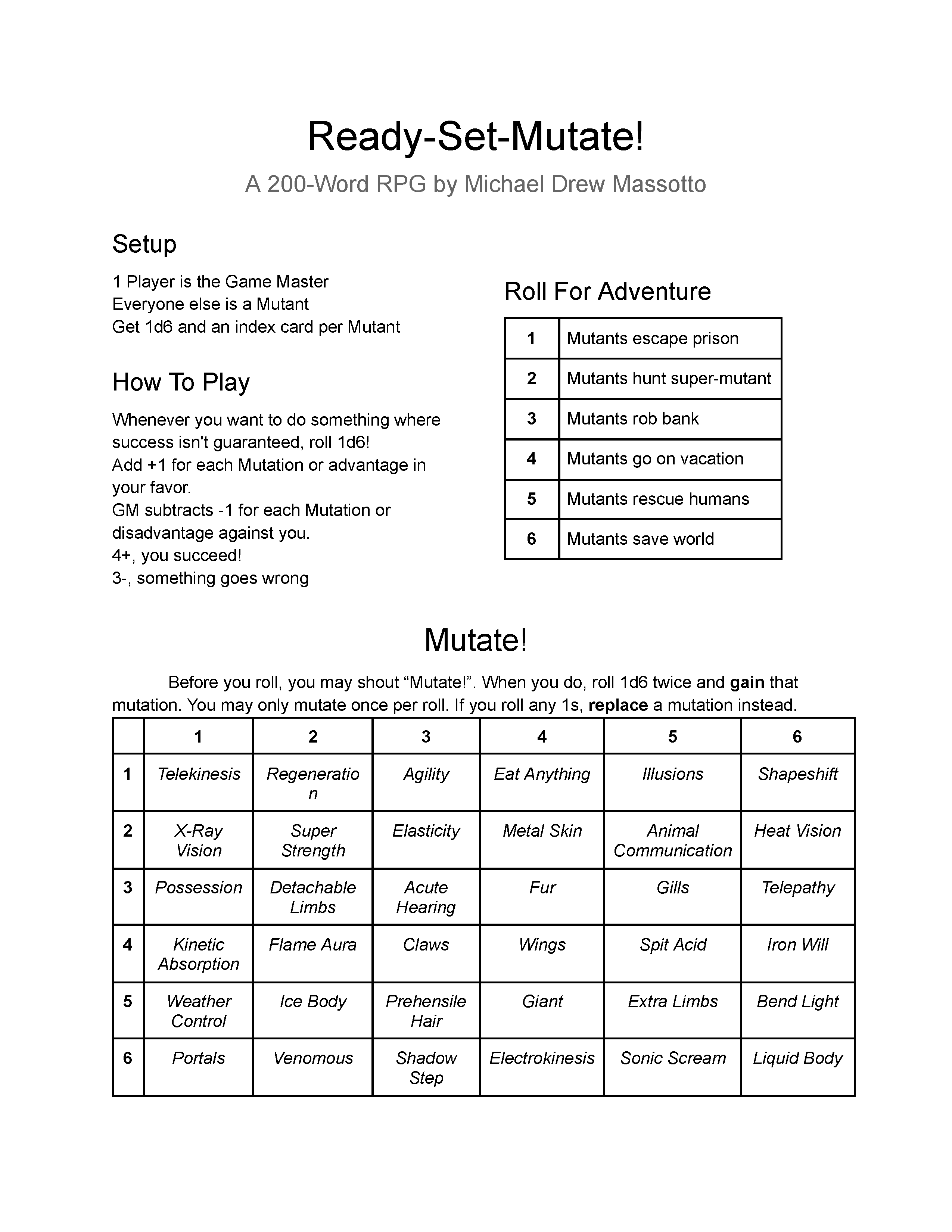
Had a lot of fun creating this! I made a post earlier last month about making a TTRPG where players can get new abilities just by yelling, and here it is!
Needed Materials: 10 d6s, a level playing area, paper and pencil.
Stamina
You start with 10 dice. At the beginning of each turn, Preform an action.
Dice Stacking/Height
As the game progresses, you stack d6s, gaining Height. If your stack falls, return any dice that fell to your stamina and remove that much hubris from your character.
Obstacles
Obstacles are challenges your character must overcome. They can have any number of Stability Points and are overcome if they run out of them.
1-3: Chasm. If your stack falls while overcoming Chasm, lose an additional hubris. 1 Stability.
4-5: Stellar Monster. If your stack falls while fighting Stellar Monster, you die. 2 Stability.
6: Constellation Shrine. Remove one Hubris OR Dash to choose next Obstacle.
Actions
Jump: Jumping lets you progress upwards. Roll a d6 from your Action Pool, then place the die on your stack. If your stack doesn't fall over, you make a successful jump, gaining one hubris and removing a Stability.
Dash: Dashing allows you to destroy obstacles. Tap your tower a number of times equal to your hubris. If your tower doesn't fall, you remove two Stability from the obstacle.
Winning
Once you have a full stack of ten dice, tap your tower a number of times equal to your hubris. If your tower doesn't fall, you win.
Players: 4-6
Place strips of paper into a hat, one labelled "communist", the rest divided evenly between "liberal" and "conservative". Each player takes one and declares their alignment. Commies lie.
Everyone is dealt (number_of_players + 1) cards. Aces are ones. Face cards are vetoes. No jokers.
Each round a player proposes legislation. They choose a card from their hand and reveal it.
This pile is handed to each player clockwise, who secretly adds a card to it.
After the last player adds their card, the pile is revealed.
If there is a veto, it fails.
If the value is greater than (3 * number_of_players), it passes.
Players discuss results. Players may expel a commie saboteur with a majority of non-accused. On expulsion, their hand is revealed then discarded.
The round ends after players' expulsion vote. Next proposing player is counter-clockwise.
The game ends once every player proposes, or if there are only 3 players left.
The commie wins if 3/4 or more of the bills fail, regardless of expulsion.
The conservatives win if the commie is expelled AND they have more bills passed than the liberals.
Liberals are the same except bill condition is reversed.
I started with the idea of a game where paranoia was the main feelings throughout play.
I settled on this setup since it has two publicly-known adversaries directly competing (they cannot win together), but they also have a common issue (both lose if the commie isn't expelled). And because there is a larger conflict, as well as a random element with card draws, players (particularly the saboteur) have cover for making moves that are not ideal for their party's interests. This hopefully should result in players becoming suspicious of each other.
An interesting observation is that the commie can win alongside another team, so at some point it may be in their advantage to start actively supporting one side.
I think the main issues are scoring. I ran some local simulations but it still seems a bit lopsided in favor of the communist player. With some playtesting this could probably be refined into a tight adversarial social deduction game.
In terms of theming, think of the face cards as political favors that the player can expend to kill a bill, and the number cards as being their level of support for legislation beyond simplying voting yea or nay.
Generate an rpg that matches the following
^(?:\b\w+\b[\s\r\n\.\,\?\!]*){0,186}$
A 200 word RPG
You're a group of aspiring poets, and, like all great writers, you must learn how to steal. To aid you in your crimes, you've developed the power to manifest rhymes into reality. You can transform anything based on rhymes - A wall can become a ball, a door can be a store, or a dog can become a fog!
The more you use these powers, the more elaborate the rhymes must get. After the group uses them three times, future rhymes need to be a minimum of two syllables - a bedroom into a lead broom, a thin man into a tin can. After using the powers three more times, rhymes must be three syllables long, and so on.
Choose a target for your theft and an antagonist you must face:
- Shakespeare's pen; the wyrd sisters
- Basho's frog; some guy who thinks haiku aren't real poems
- Emily Dickinson (kidnapped by demons); literary demons
- Shel Silverstein's buried treasure; snooty poetry nobles
- Lewis Carroll's chessboard; the Red Queen
Play out what happens, taking it in turn to describe events.
Once you've succeeded or failed to steal your target, the group must work together to write a poem describing the events, mimicking their target's style.
1 player, GM-less.
Requirements:
EVERY MORNING, WAKE UP AND OPEN PALM SLAM A VHS INTO THE SLOT. IT'S CHRONICLES OF RIDDICK. RIGHT THEN AND THERE, START DOING THE MOVES ALONGSIDE WITH THE MAIN CHARACTER, RIDDICK. DO EVERY MOVE AND DO EVERY MOVE HARD.
MAKE WHOOSHING SOUNDS WHEN YOU SLAM DOWN SOME NECRO BASTARDS OR EVEN WHEN YOU MESS UP TECHNIQUE.
NOT MANY CAN SAY THEY ESCAPED THE GALAXYS MOST DANGEROUS PRISON. YOU CAN. SAY IT AND SAY IT OUTLOUD EVERYDAY TO PEOPLE IN YOUR COLLEGE CLASS AND ALL THEY DO IS PROVE PEOPLE IN COLLEGE CLASS CAN STILL BE IMMATURE JEKRS.
YOUVE LEARNED ALL THE LINES AND YOUVE LEARNED HOW TO MAKE YOURSELF AND YOUR APARTMENT LESS LONELY BY SHOUTING EM ALL.
2 HOURS INCLUDING WIND DOWN EVERY MORNING
Mostly inspired by the bit behind Catan and the notion that the Chronicles of Riddick copypasta could theoretically be formatted as a ruleset, though it might have been interesting if someone actually formalized a sort of movie-karaoke(charades?(miming???)) RPG.
That aside, it's a little fucked up that apparently Riddick's runtime takes up that entire 2 hours, unless you're cutting out the credits, I guess?
Requirements:
Designate one player the newbie. The rest are veterans. You are all at a kink party. The veterans must teach the newbie about kink by raising their stats.
There are 4 stats:
The newbie starts at 1 for all stats. Put the d6s down on 1. The veterans roll their d6s and choose which one is which stat.
Each player also chooses an interest (ex: shibari)
Each turn, every player gets 1 action. Narrate all actions.
Possible actions:
The game ends when no player has a stat of 2 or lower.
A game for an equal number of players.
You play this game with your body.
Split into two equal teams: Robots and Mechanics. Mechanics choose a Robot to pair with.
The game takes place over 5 Rounds. Each Round lasts 1 minute. Before the game starts, Mechanics make a list of 5 Directives. Directives are challenges for a Robot to complete before the Round ends. Robots share Directives.
Before each Round, Robots will choose which Directive they aim to complete. Mechanics will give their Robot 1 Modification and 1 Parameter. Modifications affect the body and senses (hands tied together, one eye closed). Parameters affect behavior and strategy (have to sing, have to refer to oneself in the third person). A Robot must abide by their Mechanic’s changes.
When a Round starts, Robots have to complete their Directive while working around their Mechanic’s changes before the time runs out. Points are given to each team accordingly: a Robot that succeeds earns 1 point for the Robots, while a Robot that fails earns one point for the Mechanics. Whichever team has more Points at the end of the game wins. If there is a draw, play more Rounds until one team wins.
Players: 3
Tools: Paper, Pencil, Cool Hat
Set Up:
Write Wizard, Knight, and Archer on three slips of paper, and put them in the hat. Take turns drawing a slip, in order of dedication to the bit, selecting your class. Keep this secret.
Game Play:
In the same order as drawing a class, a player may select one of two actions:
This is fine to archive, or use wherever one sees fit. Feel free to modify.
For this game, you will need a deck of 101 cards (made from the matchups described here: https://www.umop.com/rps101.htm, or any other variant of 101-state rock-paper-scissors), and a poster describing the victory cycles of said cards. At the beginning of the game, draw 5 cards. Whenever you play a card, draw a card.
This is a collaborative game, all GMs, as you describe a world.
To begin, all of you should play a card, and work out how those elements describe the current state of the world.
Whenever there is a disagreement, all involved players should play a card. If everyone both wins and loses, they progress to an add'l round. If there is a chain where some people win without also losing, all such people go to the next round. This continues until there is one winner.
That winner then needs to incorporate every winning card into the story elements that were being discussed.
Play continues until everyone gets tired of reshuffling the deck.
The story bias's this would introduce via opposing pairs of cards rarely being introduced together would be fun to suss out.
I kinda want to introduce a level of strategy, perhaps by involving partial knowledge of someone else's hand? Perhaps cards aren't discarded immediately, or it costs to do so? But being the GM who wins the argument isn't really a "victory" anyways, so making it strategic would perhaps just be needless overhead.
The idea of 6 players finding themselves in a near infinite deathloop of everyone winning and losing at least once every single round amuses me :) The chance of a 50% wide gap between cards played, when you align the cards on a circle such that each card wins over the next 50 and loses over the past 50, shrinks greatly with each new player involved in an argument. (that is, the chance that no one doesn't win)
There's nothing driving world development except conflict here, so there's not anything to *start* conflict in the first place. Might be worth changing up when cards are played down
This game is made for 2-5 Wizards and 1 WizardKing(WK). Wizards will need six Bones (Bones means any cylindrical objects of equivalent shape and size eg. Bones, Sticks, or Pens)
First Wizards must make a character by choosing a name, two mundane skills, and five adjectives to describe their magic, two common adjectives, two uncommon, and one archaic.
The WK will give the party of Wizards a task (eg. Defeating a Villain, or Committing crimes)
To solve challenges that arise in completing this task a wizard may describe how they use their mundane skills or magic. The WK decides How many magic adjectives apply to magic uses, and whether or not skills apply to mundane uses.
If a skill applies the Wizard succeeds automatically.
If the Wizard's magic applies they must ROLL THE BONES, by gathering (1 + the number of magic adjectives used) bones, and dropping them from a set height onto the ground. If any bones land touching each other the magic succeeds, magnitude of success is determined by the number of bones touching. If no bones touch the magic fails spectacularly.
No matter what something always happens, the WK describes it, and play continues.
I think this is technically the first TTRPG I've actually published anywhere which is pretty neat. If I ever write more for this I'm going to make a big stupid table for magic adjectives.
A game of flipping coins.
Needs: 3 players and a Coin
Decide amongst yourselves who flips the coin who reads the coin and who determines fate (the Player).
To begin the Flipper flips a coin and the Reader calls the Result. The Player then explains where the three players find themselves for their discussion and chooses an artwork (any medium; film, book, painting).
After the first flip each turn the coin flipper must flip the coin without looking at the result and shows it to the Reader. The Reader calls either heads or tails regardless of the face shown on the coin.
If the reader calls the same result as the previous result the Player raises an element of the chosen artwork and asks the other players what the meaning of that element was, whether it positively contributed to the artwork overall and any metaphorical implications of it. When this discussion concludes, take the next turn.
If the Reader calls a different result the Player describes a change in the scene, if all players want the game to end then the Flipper and the Reader should die during this change. Otherwise, begin play again.
This is my first foray into properly completing an rpg im very open to feedback!
A game of sorcerous inhumanity, for a GM and 1+ players, by Sabrina Hawthorne
You are a Wizard who must master SPELLS without losing your HEART.
You have 4 HEART and know 1 SPELL.
You can sacrifice 1 HEART to learn a new SPELL, or forget a SPELL to regain 1 HEART.
While you know a SPELL, you are subject to its BANE.
If you forget all SPELLS, you become Nobody, and are forgotten by history.
If you lose all HEART, you become a Lich, a corpse animated by your own magic.
ILLUSION
Conjure some aethereal image to confound, distract, or deceive.
BANE: You do not sleep, and cannot feel rested.
BLAST
Attack your target with a blast of elemental fury, such as fire or lightning
BANE: Your touch burns and breaks things.
CONJURATION
Summon some creature to your aid; banish it whenever you wish.
Bane: Nonhuman creatures seek you out and attack you.
TELEKINESIS
Manipulate the world around you, throwing objects and reshaping the land.
BANE: You cannot touch or cross fresh water.
PORTAL
You open a doorway connecting any two surfaces which you have seen.
BANE: You must be invited over any threshold.
I can't promise I'll have the fourth one up tomorrow, but I'm on good track to finishing this little sprint before the month is over.
Resources: Rubik’s Cube, Something To Write With, Coin
One Player
You are a Monstrosity.
To determine your Form and Abilities, scramble your Rubik’s Cube with your eyes closed. Count the number of squares of each color on top, then assign those numbers to the following Aspects:
Red: BLOOD; hunger and craving, flesh and vitality
Orange: FLINT; fire and change, breaking and making
Yellow: POWER; thunderous and overwhelming, direct and brutal
Green: VENOM; swift and deadly, flora and chitin
Blue: GLASS; cold and clear, sharp and understanding
White: CHALK; simple and formless, unassuming and overlooked
Describe how you manifest these Aspects; the larger the number, the more prominent that Aspect should be. Decide your Goal; you will do anything to accomplish it.
Use the side of the Rubik’s Cube opposite the one you used to determine your nature to determine the nature of the Obstacle(s) keeping you from your Goal. Use the previous method, but you may divide the results between as many or as few Obstacles as you wish how you wish. Describe the Obstacles and whether they counter or exhibit their Aspects.
Call and flip a coin, then write a brief story detailing your success or failure.
I impulse bought a Rubik's Cube two days ago, which inspired this game. I actually decided not to do this idea and do one vaguely based on FTL: Faster Than Light, but I could tell I wasn't going to be able to fit that one into 200 words once I started writing it, so I pivoted back to this one.
The Aspects are intentionally kind of vague so you can interpret them how you want for the most part; I'm not 100% happy with these versions of the descriptions, but you can also just use the names of the Aspects themselves as inspiration for your Monstrosity. So, for example, is your CHALK high Monstrosity indistinguishable from a human being until the fangs come out, or is it a shapeshifter, or is it literally a chalk statue of some kind in a museum that's secretly alive? Does your POWER high Monstrosity look like a biblical angel, or are you going to run away with the word "thunderous" and interpret that as it having lightning powers?
I'd've liked to do something else with this with more players and using the Rubik's Cube to determine your stats, but the single player writing prompt game was what I had the easiest time fitting into the word limit, and I'm still pretty happy with this.
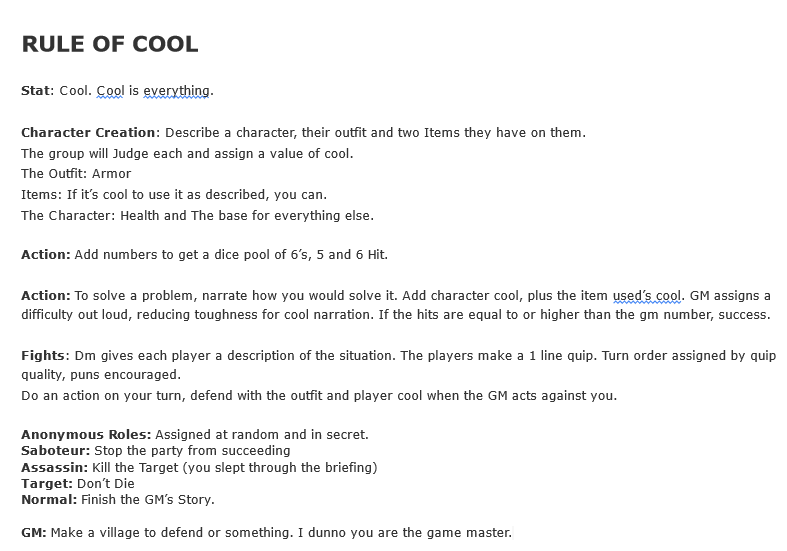
It's not much, but I had something only 600 words, so I simplified it a bit more.
Two players sit at a table facing each other. Place a single d6 on the middle.
Each player embodies a character they've played before elsewhere (it is recommended that Russian Roulette be incorporated into a larger playthrough of another TTRPG).
Use a character you are genuinely attached to and want to continue using. If you lose, never use them again.
Detail what brought your characters to play russian roulette. If the setting requires so, justify the existence of the modified (6 bullets instead of 7) M1895 revolver with a red star on they'll be using.
Set an in-game prize for the winner. The loser won't need anything.
Flip a coin to determine who'll go first. They'll pick up the d6 and select one of the numbers. They shall press that face of the die as if they were loading in a bullet. In-game, they are.
Before rolling the d6, give a brief impression of the character's thoughts as they hold the cold metal to their head.
Pull the trigger.
Any number other than the loaded one is empty. Pass the die to the other player. They do the last two lines. Keep playing.
If the number is the loaded one,
.
Time-warp travails, 1+ players
A chess set suffices for play. Supplement with any miscellany you would find pleasing to place on your board.
Put a Pawn and Queen on opposing ends of the chessboard. Distribute other pieces haphazardly, ensuring every row between the pair has at least one piece.
The Queen must time-warp to accompany her younger self through a rough stretch. Time-warping distorts reality: impossible creatures and landscapes will seek to bury her. Each other piece is one such distortion.
Move the Queen row-by-row towards the Pawn, taking turns counterclockwise. Choose a distortion in each new row to describe. (A knight may be a chariot pulling itself inside-out; a coin may be a bridge made of her lovers' lungs.)
After they meet, move the pair forward row-by-row, taking turns clockwise. The other pieces are everyday troubles; describe one from each row they reach. In the final row they may part ways or merge, as desired.
Consider retitling the roles to cue a throughline. Here are examples:
[the Pawn, the Queen]
(Glint, Dazzle)
(Naïf, Crone)
(Wisp, Willow)
(Bare Minimum, All-Out)
(Green, Ultraviolet)
(Regular, Diva)
(Unhewn, Statuesque)
(Boy Scout, Madwoman)
(Conjecture, Immanence)
(Innocent, Betrayer)
(Spark, Flaming Fullness of Noon)
(Dot, Flourish)
One might imagine that the more modular syntax of the list at the end helped to hit precisely 200 words (by my reckoning); one would be mistaken. Refusal to cut more lines there forced considerable parsimony elsewhere in the instructions, but I have no regrets.
Setup: Record the words SEA/FOOD per player. Min 2D6.
In this ritzy ocean-side restaurant, nouveau riche are treated to the freshest saltwater delights. Tonight, that's you!
Each player plays an edible aquatic being (eg. lobster, salmon, shrimp, etc), in kitchen aquariums.
Other fish are in varying states of preparation - rinsed, gutted, cleaned, smoked, boiled, braised, seasoned, and served. Navigate the kitchen to the ocean-side window, and fast!!
Lose SEA and suffocate/become salvageable. Lose FOOD and become dinner. Dead fish players always announce an additional complexity at 4, above.
Upon request by my beloved mutual @philosophicalbutts who really liked that one Ratatouille escape scene. We had talked about a L&F hack, but I really liked a recent 200 word rpg that used HORSE as the resolution. Wrote the core resolution on a receipt a few nights ago.
I hope the colors aren't too distracting, hehe. I think this one's my most playable rpg to date.
It is the 1960s! You must locate the supervillain’s lair, infiltrate it, and save the day!
PLAYERS: Choose your 1960s archetype, then describe your character:
GM: Roll 3d6 or invent your own:
Supervillain:
In a [...] lair:
Plans to:
GM: Tell the player their target roll and the stakes if they fail.
Player: Roll 2d6:
Difficulty | Target
Add +1 to your roll if:
(These bonuses stack up to +3. Advantages can also make tasks easier.)
Want an Advantage? Name it. The GM defines how hard it is to get; maybe you also need another Advantage first. Advantages can include:
You can use each Advantage only once.
Notes: Next year I'll learn how to do tables properly and avoid coming within hours of the deadline. Maybe. MS Word counts this as 199 words - just barely within the limit!
Special thanks to @prophecyforgotten and @rincewitch for peer-reviewing earlier drafts and providing invaluable ideas.
I'd like to flesh this concept out into a more complete game some day, but this was a great way to actually make something instead of endlessly going in circles thinking about it and never doing anything. I had a lot of fun and highly recommend this jam to anyone who hasn't done it.
It's OK to archive this RPG off-site for posterity.
The players are a MONSTER and a HERO.
The MONSTER chooses a verb, noun or adjective in secret and writes it down.
The HERO narrates about where the story takes place.
The MONSTER narrates about its monstrous form.
The HERO guesses the word.
The HERO narrates about how they came in possession of their weapons and powers.
The MONSTER narrates about what threat it poses.
The HERO guesses the word.
The HERO narrates about why they chose to confront the MONSTER.
The MONSTER narrates about the perilous journey to its lair.
The HERO guesses the word.
If the secret word was guessed, the score is zero. Otherwise, it is the number of times the word was used in narration.
0-1: The MONSTER was no threat, and is slain or driven out. The HERO wins.
2-3: The MONSTER is formidable, but is slain or driven out. The HERO wins.
4-6: The MONSTER is slain, but the HERO must make a great sacrifice. The MONSTER wins.
7-10: The HERO is slain, and the MONSTER reigns supreme. The MONSTER wins.
11+: The MONSTER is more powerful than imagined. It slays the HERO and many more besides. The MONSTER wins.
I planned partaking in the jam from the very beginning this year. Then, current events happened, and somebody suggested making something as a way to sort of de-stress. The next day, today, was my day off work. I am posting this before lunch.
Struggled to find inspiration this year, since I didn't have a concept already brewing this time. Walking the dog did wonders, though! Apparently my brand is narration-heavy asymmetrical games with a greed-based scoring system.
Also like last time, I am posting this before testing. Last time, statistics did a lot of the heavy lifting balance-wise, but this time it really depends on how the players play! The numbers are completely arbitrary, and it's probably very unfair.
I did, however, make some design choices I'm really proud of. For one, the monster decides the word before the hero decides the setting, opening up opportunities for both to be both creative and strategic. The monster may also determine their own playstyle, like sprinkling in the word from the very start to make it stand out less but risk being found early, or going heavy later so the hero has fewer chances, but better ones. Perhaps consider using strange words on purpose to divert attention away from your actual secret word?
The monster is of course incentivized to keep talking a lot, and the Hero probably wants to keep it short to keep themselves from using the secret word accidentally... But eh, who cares? Fighting diamond dragons or space krakens isn't meant to be fair. For the hero OR the monster.
This isn't a simple children's card game anymore.
Need:
Gameplay:
1. Passion.
2. Wisdom
3. Skill
4. Money
5. Spite
6. Possessed by an ancient ghost where coincidentally [Thing] is based on their civilization's magical ritual.
Extra Resource:
If you're not sure where to start, have an Arc.
Optional Rule:
In a duels against NPCs, Curse of [Weakness] automatically activates in a draw. You can't overturn it with your own Power, but your friends can still use theirs.
Players: You are WORDSMITHS, who can realize whatever they speak!
Roll 2d6: your MAGNITUDE. Your NAME and LYNCHPIN are equal in syllables to MAGNITUDE. To act, describe ANYTHING. You only affect SUBJECTS that you directly refer to! Your LYNCHPIN is a NOUN, always shouted. You alone can apply it sans CONSEQUENCE.
Your actions, taken clockwise around the table, contain appellations at least as many as your MAGNITUDE. Do not repeat vocables (save for FUNCTORS; https://en.wikipedia.org/wiki/Function_word) a player has hitherto used, or use hyphens*. Fail this, and lose 1 MAGNITUDE (take a new NAME and LYNCHPIN). At MAGNITUDE 0, you explode, and your prior utterances lose their properties. At a TRIBULATION’S end, clear the history of words.
*Dictionaries very encouraged.
One player is Ea-Nasir, the others are merchants. Each merchant starts with 5 gold.
Ea-Nasir has five dice for sale - d4, d6, d8, d12, and d20. Each round, Ea-Nasir sends a message to each merchant saying which die is for sale. Each merchant replies with the amount of money they bid. These messages are private.
After the bidding, Ea-Nasir rolls a die in secret (not necessarily the one he named) and gains that much money. Then he privately informs each merchant if they won. If they won, Ea-Nasir gives them the amount rolled. If they lost, Ea-Nasir gives their bid back.
Ea-Nasir may lie to the merchants about what number he rolled, and if they won or lost. However, Ea-Nasir must roll each die exactly once by the end of the game, and he cannot give out more money than he has.
If a winner suspects they have been cheated, they can send an angry letter to demand a refund. This message is public. If a majority of the other merchants agree, Ea-Nasir must pay them half the value of the advertised die (10 for a d20, etc).
The player with the most money at the end wins.
This was inspired by a prokopetz post about a year ago, suggesting that a play-by-mail format would work really well for a game about our favorite Mesopotamian copper merchant. I wasn't able to come up with a mechanic I liked at the time, but it sat in my drafts until the contest came around this year.
I haven't playtested this, but hopefully the outcome depends more on bluff and politicking than on the actual numbers involved.
Pen your wizard-ass name, beard length (roll for it), and—secretly—ultimate design.
Introduce yourself by name, look, and most heinous act of spellcraft to date.
Taking turns, challenge your enemies to duels. Longest beard challenges first.
The challenged frames the scene. Take turns casting spells, challenger first.
To cast, declare the magical effect (NO REPEATS!) and roll your wand. Each spell should counteract the previous.
(For the first spell per duel, 2–19 has no effect.)
If you’re not in a duel and someone rolls your beard length, join the duel (your turn’s next) or advance your plans.
Once per game, reveal your ultimate design in a monologue to force a reroll.
The game ends when all wizards, including you, are dead.
Take a role of someone who went where they shouldn't and has to escape the Danger.
Every character has:
SD can be lost due failing at tests and can't be regained in any way.
Loss of all SD means the character is LOST (unplayable).
Part 1 - How We Got Here? Describe the environment. Discuss what got you into the situation.
Part 2 - What Went Wrong? What is the danger as you understand it now? Talk about the signs about the Danger the characters ignored before.
Part 3 - Survive! Play out the scenario and escape the Danger!
Part 4 - Conclusion. Who survived and how it affected them? What about the Danger?
Decide on the used ability and roll as many of your SD as its value. Their sum +1 for each applicable proficiency must be no less than the threshold (3 - easy, 7 - normal, 11 - hard).
Extra dice:
As it's typical for me, it's done at the eleventh hour with little time to spare. This was an interesting task and I really needed something to motivate me try to design an RPG again. The part of removing ideas so the description could fit within 200 words was both painful and fun!
In the end I figured it's better to simplify mechanics rather than trying to sacrifice the suggested structure. I think it's fun to have a framework on survival/escape scenario that is flexible.
I deliberately didn't mention matter of GM or number of players, because in the end it felt this is not that important here. Want to play with a GM? Go for it! You feel it can be fun as an exercise to practice storytelling alone or with friends? Go for it too! I admit I winged the maths here, which bugs me a bit, but the provided values should work more-or-less (or at least work as a guidance).
As for the formal matter: I'm perfectly fine with this submission being archived. I'm also perfectly fine with sharing and remixing it (just be clear about it).
You and another player have a civilian relationship plus a secret identity. (It doesn't have to be a Superman/Clark Kent deal. You could be an assassin, an FBI agent, a murderer, Sasquatch, etc.) It doesn't have to be the same secret either.
Together, you will determine:
How are you two connected?
What are your secrets?
What caused your secrets to be revealed?
Where are you two talking about it now?
How will this revealed knowledge change your relationship?
Here are some ideas for each answer. Roll a d6 or pick and choose.
Connection:
Roommates, Lovers, Coworkers, Separated Parents, Best Friends, Regular at Restaurant and Server
Secret:
Superhero/villain, Dragon, Cheater (Marriage or academia), Identity Thief, Ran over the other's dog
Revelation:
Eavesdropping/Snooping, Said the same phrase twice, Wore the same scent, Whispered freely, Publicly revealed against their will, Undid a memory wipe originally done to hide the secret
Where:
Diner, Rooftop, Apartment, Highway overpass, Busy street corner, Public pool after hours
Change:
Become/Stop being lovers, Move away, Try/Succeed in killing the other, Do a(nother) mind wipe, Pretend it never happened, Steal something in retaliation
Game ends when all questions are answered, preferably in chronological order.
I've been eyeing this event for years, and I'm glad I got an idea this year so I could participate! Originally based on superhero identity reveals, I wanted to make it a bit broader than that.
This was fun! Word count was a little tricky, especially with the way I sorta combined two words in that final 'table' but I'm happy with how this turned out!
You are an enigmatic gathering of shadowy figures, moving pawns against each other in your eternal conflict for unfathomable objectives.
Need:
-3+ mysterious players
-Several items to be used as symbolic pawns, distributed evenly among participants. Books, cookies, toys, actual chess pieces?
Gameplay:
A tarot trick taking rpg for 4 players.
You play foppish revolutionaries in the days before the French revolution arguing over your pamphlets layout.
To start, shuffle the deck and deal it out 3 cards at a time to each player, and 1 card to the discard until the deck is dealt. Each player will then pronounce what hill they are willing to die on in regards to the layout and contents of the pamphlet.
The major arcana is a trump suit and tricks won with it are worth no points. When you win a trick with this, describe how you veer wildly off topic to derail the discussion.
Tricks won with cups represent having a draft ready. Argue why this is the best draft, worth 1 point.
Tricks won with coins represent paying for the pamphlets to get your way, worth 1 point.
Tricks won with wands represent coming up with new philosophical jargon, pontificate on your new jargon. Worth 1/2 a point.
Tricks won with swords represent violently destroying your comrades efforts, discard immediately, choose a trick won with cups or coins to cut up and discard.
The game ends when the national guard arrests you while distracted.
I learned how to play classic french tarot (or at least some variations of it, something something games as oral traditions) recently for fun as I was doing readings at a historic event. Got me thinking about how I could turn it into an rpg. French revolutions being some of my favorite periods in history I thought it would be fun to turn it into a silly little game about leftist infighting and painful meetings about pamphlets that I have been to too many of.
Feel like I cheated a little by assuming that the audience already knows how to play trick taking games. But they've been very popular for hundreds of years so what excuse do you really have?
Might turn this into something better realized if there's interest.
-----
Materials: Notecards, 2D6, counters
Your spaceship crashed on an uninhabited planet, and you are the survivors. The air is breathable, the plants edible, and rescue is coming—but you have to survive the weeks until they arrive.
Each player begins by describing their ROLE on the ship. Each player writes down three items from your ship on notecards. The cards are shuffled, and two are handed to each player. These are your SUPPLIES.
One D6 represents a “weeks” countdown, starting at 6.
Each week, roll another D6 to see what danger you face:
Describe the danger.
Each player rolls a D6. If you roll equal to or lower than the danger number, take 1 damage, UNLESS you:
Players who reach 2 damage die. It’s a harsh world out there.
After the D6 countdown finishes week 1, rescue arrives. What do they find?
If anyone plays this, I would love to know how it goes.
Wrote this yesterday instead of doing my dissertation work. I ended up with big ideas spiralling way past 200 words so it was fun to get the core idea down. If I build this out, I would definitely have a simultaneous feature where you are building the distress call beacon, and you win the game if you finish the beacon before you all die; you get bonuses for using a SUPPLIES or explaining how your ROLE gives you Building A Distress Beacon Skills, and penalties each round for anyone who has taken damage or had to mitigate damage. Didn’t make it into the 200 word version though. I playtested it a little on my own and I'm still not fully satisfied with the balance, but it's got the bones of something I'd love to keep poking at.
This also lends itself well to reskinning for, like, historical 19th century whalers being shipwrecked, or contemporary plane crash in the Canadian wilderness, or something. I just like sci-fi.
This was fun! I’ve never written a TTRPG before, but I’ve been so inspired by seeing everybody’s 200 word projects. (I'm sure I'm not the first person to do a wilderness survival game like this, but it was fun to come up with!)
You are a Knight, tasked with slaying the Dread DracoLich Marciolo. You have reached his lair and now must traverse it to succeed in your quest.
Materials: a 3x4 grid, three dice, Pen and Paper.
[1a]-[2a]-[3a]
[
[1b]-[2b] [3b]
[ [
[1c]-[2c] [3c]
[ [ [
[1d]-[2d]-[3d]
You start at 1a. When entering a new area, look for that area's Event.
Combat You start with Three Health and One Attack. For each fight, roll two dice adding each Attack to their respective rolls, one for each combatant. The higher roll wins. Repeat until a combatant dies.
Events
[2a]: Guard - One Health, One Attack.
[3a]: Add FIREPROOF SPELL.
[1b]-[1c]: Burning Corridor. Inaccessible without FIREPROOF SPELL.
[2c]: Phantom - One Health, Two Attack.
[3c]: +1 Health, +1 Attack.
[1d]-[2d]: Coward - One Health, One Attack. Runs away after attacking. Drops KEY when killed.
[3d]: Locked Door. Inaccessible without KEY.
[3b]: Boss - DracoLich Marciolo. Three Health, Two Attack. For his first attack, roll an additional die, using the higher result for that attack. You win after Marciolo is killed.
It's pretty simple, but I had fun putting it together. Feel free to archive, repost, or whatever with this, just make sure to credit me!
what you need:
the table creates:
for each PC, create:
set up:
scenes:
outcome:
ending:
One player is the GM. He controls "The Sir," who is some manner of upper-class twit, and the rest of the world, which is the kind of place where being an upper-class twit affords you considerable privilege.
The other players play his Servants.
Character Creation
Pick your servant's Profession, then choose whether they're Competent or Incompetent. Professions may not be repeated within a group.
The Profession of "personal valet" is entirely overpowered, and every group should have one.
The Rules
When a Servant attempts an action, determine if it is related to his Profession. A Competent Servant will always succeed at these actions. An Incompetent Servant will always fail at these actions, no matter how trivial, but may decide the manner in which they fail.
For other actions, roll a six-sided die. A Competent Servant succeeds on a 5 or 6. An Incompetent Servant succeeds on a 3 or better.
The Scenario
A game of Snarky Servants begins with The Sir deciding on something he wants. The Servants may have strong opinions on whether he is correct. The scenario ends when The Sir has his prize or loses interest.
The winner is the Servant who gave the best pithy one-liner.
(This game may be archived, unless giving permission is counting against my word count. In that scenario, I'd rather see the world burn.)
3-5 Players
You are a pet. You’re well-fed, but your human’s food smells so good…
Pet stats: Sneak, Speed, Sweet, Strength. Assign each a different number from 0 to 3, then add racial bonuses:
Human stats: Awareness, Aim, Aloof. Assign each a different number from 1 to 3.
Rolls are 1d6 plus the stat. Highest roll wins. Each action takes one turn, except Dodge. The player whose turn is next rolls for the human. The game ends after 5 turns each, or after 10 Morsels have been taken.
Actions:
Whoever ends with the most Morsels wins.
I wasn't planning to participate, but I was inspired by the thieving beasts that live in my house. So I wrote this in about 2 hours on the last day to submit. Thus, there was no playtesting; I do not know if this is balanced or fun to play.
If I'd had more words I would have written a few different scenarios: the human preparing a meal, eating alone, a family dinner, a holiday dinner.
Materials:
2+ Sommeliers
1 Customer
1 deck of playing cards, including jokers
Wine (optional)
The Customer shuffles the deck and pulls the top card without revealing it. They tell the Sommeliers what kind of wine they want based on suit of the card and the event for which it is meant.
Heart = red
Spades = white
Diamonds = rose
Clubs = sparkling
Each Sommelier describes their recommended wine using ONLY one herb/spice, one wood, and one fruit. The Customer awards the card to the Sommelier who describes the least gross and most situationally appropriate wine. OPTIONAL: losers drink.
For example, the Customer asks for a red to be served at a gender reveal part for a horse. One Sommelier recommends a red with notes of cinnamon, oak, and apple.
No herbs/spices or fruits may be repeated.
Each Customer event must be unique.
First player to 7 points win. Switch Customers between rounds.
Points awarded as such:
Numbers (+ aces) = 1
Jack = 2
Queen = 3
King = 4
Jokers = -4
A joker may be any wine (red, white, rose, or sparkling) of the Customer's choosing.
A game for three gerbils (plus GM)
You are three gerbils in a person-size mech suit, impersonating a famous galactic bounty hunter. You'd rather not let this get out.
Materials
Deployment
Gerbils are too small to contain stats. To create your suit, draw a three-by-three grid. Choose six of the following verbs; write one beside each row, and one below each column, in any order: Blast, Channel, Engineer, Evade, Exert, Interface, Prowl, Scan, Shift.
Mission Start
When play begins, place each gerbil's token on a square of their choice. The suit acts by group consensus. When performing a risky act, find the most suitable verb on the grid, and roll a number of dice equal to the number of occupied squares in the corresponding row or column, taking the high result. (When rolling zero dice, roll two and take the lowest.) Interpret as follows:
1-3: Failure
4-5: Complication
6: Success
Additionally, for EACH die showing an odd number, the suit incurs 1 Stress.
After rolling, each gerbil may move to an adjacent square OR repair 1 Stress. If Stress reaches 5, the suit blows up!
Each year, I challenge myself to write a 200-word version of one of my games currently in development, both for fun, and to help refine my thinking about what the core experience of play is. This time around, I chose Space Gerbils; given that the current draft of Space Gerbils is over 100 pages in length, this proved to be no small task. Unlike the full game, which can accommodate up to five players, this version wants exactly three – no more, no less.
As always, special thanks to go Caro Asercion, whose game Dwindle provided the seed of inspiration that would become Space Gerbils. Go buy their stuff!
The Valley is vast and magical, with dense forests home to spirits and fae. Silent castles and ruins sit on the mountains, while life in the few villages along the rivers is cozy and uneventful. Until, with winter came the Emissary of the Necromancer King, bringing war and destruction.
Players, describe yourself and tell your stories: How did you survive? Who have you lost? Why do you want to fight?
The Valley is not lost, not until your swords are held with hope.
When facing danger or risking something dear, roll 1d6
If you fight prepared or if you choose to take a wound (Die heroically if it’s the 3rd) get +1
If you fight Nightmares, Monsters or formidable Foes get -1
0- Failure with consequence
1 The Emissary draws closer, feeding on your fears. Reroll with -2
2-3 Failure with opportunity
4-5 Success with consequence
6 The Valley fight with you. Reroll with +2
7+ Success with opportunity
GM: ask further questions, play to find out, put them in danger, call for rolls, and add details in your style.
Consequences: Things get worse, New threat, Setback, Cost, or Future complication
Let the Players propose Opportunities
Hi Everyone Dr Maicol (He/Him) here.
I'm here to add little more context \o/
First, I'm Italian so sorry if my english does not english well :v
This year i challeged myself (and failed) to write one game a week (only mate do week 28 till burnout) with the space of a Threads/Bluesky post (more or less 300 characters spaces included). So 200 words were more of a challenge on "adding more". Anyway this experience really helped my with my game-design fatigue and I look forward to retry my challenge here on thunblr and maybe on Substack. This time with the 200 word limit instead.
Feel free to, copy, remix and reflavour this game. You can easily change the fiction-tags on 1 and 6 to suit your setting. Than change the contitions to get +1/-1 to adapt the narrative tensione and what you want your players seek during play.
Keep it simple obv
Thank you all for reading and happy holidays
A game about spice merchants on the Silk Road for 3+ players
Start with 10 chicken wings, preferably of ascending heat.
You are trying to get your spices to a foreign market. On your turn the player to your left describes a challenge that threatens your cargo.
Eat the next wing, then explain how you overcome the challenge. Stop when you eat/drink anything to cut the heat, or when you finish.
Player to your right narrates the outcome, determining if you lose any or all of your spices. If all your spices are lost you return home in shame, take out a loan and begin a new journey. If you complete 3 challenges with any of your cargo intact you have made a successful journey and may return home with exotic goods!
Play then moves left. The game ends when all players have eaten their last wing. Laud your successes, bemoan your failures, make plans for how you will strike it rich next time.
Challenge Examples
Environmental:
Rough Seas
Sandstorm
Flood
Mirage
Road Blockage
Infestation
Serious:
Pirates
Bandits
Rival Sabotage
Partner Betrayal
Mutiny
War
Silly:
Traveling Performers
Drunken Cravings
Raucus Wedding
Horse Shenanigans
Time Travelers
Murder Mystery
You were an adventurer and you died at the hands of a terrible monster. Your spirit now inhabits your sword, shield, or a magical ring. A new adventurer is using your equipment to fight the monster that killed you.
What you need:
A friend
Two 6-sided die
Choose who will be the spirit and who will be the monster.
This young adventurer is ready to fight the monster. Describe the adventurer and the monster.
The spirit can aid them by giving them a +1 to attack or defense rolls. Powering the ring turns the adventurer invisible, They cannot attack this round but also cannot be attacked.
Each turn, decide which aid you give and you both roll the d6. A 5-6 is a success and deals 1 point of damage. Providing attack aid increases damage by 1. The monster deals 2 points of damage. The adventurer has 4 hp and the monster has 6 hp. Providing defense aid reduces the monster's attack roll by 1.
If the adventurer is defeated, the spirit resides in the sword, shield, and ring again until picked up again. If the monster is defeated, the spirit finally departs for its eternal reward.
This game originally started out basically what you read here, but I was trying to find a website or app that would allow you to put in a set of criteria (number of rooms or cells to fill) and that a random map with those criteria would pop up every time, but different. I couldn't come up with one. The idea being that you died and so many people had taken up the items and tried that your memory was fuzzy, so using a random map generator would have worked really well. Sadly, I couldn't find anything like that.
I had been thinking about this game jam for the last few weeks and was having trouble coming up with anything, so I went through my '"not yet completed" folder and stared at things for a while. Then, in the space of two hours, I came up with this nonsense.
A post-expedition game for 3+ players
With much effort, your dungeoneering party secured many various artifacts. Now you only need to split all the loot.
For X players, prepare: X d10 dice, 1 backgammon doubling die (called a doubler here), X paper strips per player; one hat.
Give your character a name, a party role, and a themed stat. Once all players do this, rank all X stats in order to assign to your character. On your paper strips, write down one artifact, preferably useless for your character, per strip. Don't set the doubler yet; its value is considered to be 1.
Shuffle all strips into the hat. First player to prepare starts.
Take turns counterclockwise by drawing strips and making sound arguments why your character deserves the drawn artifact.
Other players may challenge with a sound counterargument. All invested players pick a relevant stat and roll that many dice. Winner claims the artifact.
Any loser who rolled above their doubler may double down once per artifact. To do so, set the unset doubler to 2 or, if set, increment it (if possible) and reroll. Winner may challenge back.
Once no strips remain, the player with the most artifacts wins.
(by Spekkio / blackratbighat)
"Usual" setup below: all things are flexible.
You have stats, 3 abilities, 2 skills, 12 slots, and 12HP.
The Stats: assign a net +2 bonus, negatives allowed.
Write abilities (use natural language), next to appropriate stats.
Your skills can be anything: describe SOURCE and time practiced e.g. "professional thaumatherapist 3yrs", or "backalley gorilla rodeo 2mo". They give -2 to +2.
Resolution is 2d6 vs DC ~10. Usually one stat and one skill (if any). Approach and using personal abilities will change DC. Ability and stat matching helps! Big things give FATIGUE.
Slots: 4 can be either physical or mental. Divide the rest.
1 slot ea: Fatigue, gear, spellbone, injuries, confusion, hampered.
Attacks do 1d6.
Combat:
2 tokens per PC and some per enemy in a bag, plus end-of-round.
If Ready, you can freely act/react, becoming unready.
On draw: someone from that SIDE becomes Ready. Also, Token owner has +1. Can only Rally on your token.
On combat start (if all else is equal), end-of-round, or an ally Rallying team, test Nerve to see if you become Ready.
This is a loose pile of ideas that have been knocking around in my head for about a year on average, aggressively pared down and slapped together. Most of it can be directly traced to existing systems: Maze Rats / Knave, Troika!, Mausritter, diverse GLoGs, and Whitehack are all in there - but the readiness-based combat is original.... and completely untested. If you actually run this, I AM BEGGING YOU TO TELL ME HOW IT WENT.
This is a game about the Nowhereville Chronicle, a strange and unreliable newspaper.
One player is the ACTING EDITOR. (The CHRONICLE's real editor has mysteriously vanished.) One player is the WORLD. The rest are JOURNALISTS.
(...but roles will change later on)
ACTING EDITOR mandates a TOPIC THAT SHOULD APPEAR IN THE NEWS, and the paper's POSITION ON AN ISSUE
JOURNALISTS look for stories
WORLD describes what they find. WORLD and ACTING EDITOR play interviewees, or nominate players of journalists not in the scene to do so
JOURNALISTS each write a headline, describe the article
If the ACTING EDITOR says your article...
Edition published!
If your article is printed, and the WORLD says it's...
If there are no articles about the mandated TOPIC, all JOURNALISTS decrement APPROVAL
JOURNALIST with greatest absolute value of HONESTY becomes WORLD. JOURNALIST with highest APPROVAL becomes ACTING EDITOR. Old ACTING EDITOR and WORLD become JOURNALISTS, with APPROVAL and HONESTY reset.
Start on the next edition!
One player is the Author. The rest are Illustrators.
The Author chooses a random animal (either with intent or via a random generator) and describes it without giving its name. They may use the following moves:
Each Illustrator draws the animal from the given description. Vote on the best one. Its Illustrator gains one point and becomes the next Author.
The previous Author now reveals the animal. If any Illustrator guesses the animal correctly beforehand, the Author loses two points.
When the game is done, compile the descriptions and winning drawings into a bestiary!
Felt like getting one final RPG in at the last 24 hours. Inspired by Maniculum Bestiaryposting, of course. I'm not sure how well it'd play—I tried to discourage being too transparent about what the animal is to encourage the same sort of creativity as Bestiaryposting, but I don't know how it'd go in practice.
The world you used to know is gone. You wander the wasteland with a group of strangers, telling stories about your lives to pass the time.
Characters turns telling a story. Start with the letter A: you notice something which sparks your memory. A noun or important adjective must start with that letter. After each story, progress the letter by 3d4.
Roll 3d4. As the story progresses, decide what each die represents. Only one for each category. If the story changes unexpectedly, you may shift dice around.
Emotion:
You gained/lost:
You wish to:
You are under no obligation to be truthful.
Characters should discuss for a few minutes. Each listener decides the emotion of the story: 1 is most negative and 4 is most positive.
When the group decides to be done, tally up total scores. You've reached a safe-house to rest for the night.
If the lowest-scoring character trusts the group, they stay. Otherwise, they steal away with something important from the highest-scoring to continue their sad journey alone.
You are a wolf pack. Devour everyone else and be the last pack standing.
MATERIALS
STEPS
1: Everyone peels their tangerine and chooses how to divide the segments:
1 piece = pup
2 pieces = wolf
Fastest player steals a pup from any other player
2: Place your pups & wolves on the peel.
3: Slowest player starts. Covertly pick one pup/wolf and play SPS with another player. Win = eat the other player’s pup/wolf.
pup vs wolf, pup wins = pup survives
pup vs wolf, wolf wins = pup dies
pup vs pup, win = pup dies
wolf vs wolf, win = wolf dies
4: After everyone has lost at least 3 pups/wolves, roles reverse. Time has passed; your pups are grown.
1 piece = new wolf
2 pieces = new pup
5: Repeat Step 2-4., switching wolf/pup pieces. Play until one player remains.
EXTRA
First game I've ever made! Inspired by the ridiculous amount of tangerines I ate this month. It was going to be a warlord game at first but I realised I was overcomplicating things.
I thought about this the whole of November but waited until today to start writing. Finished it on the train to meet friends for dinner and I had so much fun figuring out the rules! Tangerritorial has not been playtested so I have no idea if it works or is any fun. If anyone happens to play this please let me know! tag me!
According to the wordcount check link, this is exactly 200 words. woo!!
EDIT: played this with my brother! short game, pretty fun. the last two tangerines in the fridge had brown spots so i peeled both first to check, skipping the 'fastest player picks...' thing. will probably try this with my friends next
Techniques and Talents Abridged (TnTA) is a game for one Game Master (GM) and any number of players, for any sort of story.
To make your player character, write up six TECHNIQUES, each describing actions your character can take (“walk,” “run,” “cast meteor storm,” “write novel trilogy,” “create portal,” etc.); Then write down six single-word TALENTS, naming things your character is good at (“persuasion,” “stealth,” “vehicles,” “toasters,” “flexing,” etc).
When you describe your character doing something, your GM may declare that you can only do that if you know it as a TECHNIQUE. Such rulings apply to all players.
When you describe your character doing something challenging, your GM can tell you to roll 1D20, and tell you a value you must exceed. Add +5 to your roll for each TALENT you possess related to the task. If your roll total is lower than the GM’s value, describe how you fail the task instead.
When you do something impressive, dramatic, or funny, your co-players can reward you by writing a new TECHNIQUE or TALENT to add to your character. They must write this together, and the GM must agree that it's something your character might learn from their experience.
TnTA is based on a much longer TTRPG I'm writing. But that one is currently so messy and broken that this silly 200 word version looks a lot more fun, and I think I might actually throw a oneshot at my players with this while they're waiting for me to finish fixing the original TnT. Thanks, @prokopetz and all previous 200 word writers, for the inspiration!
Compressing TnT was much easier and SO much faster than I expected it to be. I now strongly believe every TTRPG author should try compressing their systems into abridged versions, for fun and mental health.
Draw lots secretly. Winner (or loser) is That Guy.
Play a game of Catan, the 200-word RPG.
That Guy can only win That Guy, The Game if no one identifies them AND they win Catan, the 200-word RPG.
The other players can only win if someone correctly identifies That Guy AND someone wins Catan, the 200-word RPG. That Guy is identified by accusing a suspect of being That Guy. The suspect must then reveal their lot. Any player may accuse someone of being That Guy but may only accuse immediately after they (the accusing player) have built a settlement or bought a development card. If they are correct, That Guy is eliminated from the game. If they are wrong, the settlement is not built or the card not bought. Resources are not refunded.
If That Guy is eliminated, all their resources are evenly divided amongst players, with the remainder going back in the pile. Same for development cards, except the remainder go to the bottom of the deck. Roads and settlements are left. The game continues as normal.
Catan, the 200-word RPG used with permission from @tarilaran. Thanks!
Ran out of time last year, nearly forgot this year and so the majority of the text above is from last year and is insufficiently playtested. "Punishment" for falsely accusing probably needs to be harsher, but I tried to keep the game flow as close to vanilla as possible in order to make the metanarrative clearer.
2+ players, one twenty-sided die
Choose any genre except Godzilla Movie.
Start telling a story of that genre. Either choose an appropriate TTRPG system or engage in free-form roleplay, taking turns framing scenes. Either way, adhere as closely as possible to the genre’s tropes. Get into it. Make the stakes feel real.
The Godzilla Timer starts at 20. Once per scene (or equivalent), anyone may roll the die. If the result is less than the Godzilla Timer, reduce the Timer by 3 and proceed as normal. Otherwise, Godzilla arrives on the scene: the genre is now Godzilla Movie, and it's almost over.
Determine each significant character’s fate by rolling the die. Start with characters in the scene, then jump forward to the rest of the cast.
Your kind has taken to the stars, is hunted for it.
Each tag’s worth -1 to +1, left to right:
Your ship is QUIRKY, RELIABLE or TOUGH;
and it's also: PONDEROUS, HOMELY or NIMBLE.
Your squadron is RECKLESS, TOUGHENED or SUPPORTIVE;
your commanding officer CALLOUS, REASONABLE or ADORED;
your kith clan ENTRENCHED, COMPETENT or WELCOMING;
your mothership, where you live, BARELY HOLDING, A REFUGE, OUR BEAUTIFUL HOPE.
Pick two -1s; two 0s; two +1s.
Write up three new for yourself, also, one +1, two 0.
When in doubt, roll d6, plus one more for each:
Each d6, add modifiers of relevant tags.
5 rolls are one success; 6+, two. Well-understood actions need one; tentative, two; desperate, four.
If you're cornered, you must stake. On failure, tags at stake get worse: +1 to 0; 0 to -1; -1 to lost. (To worsen yours, make up a new appropriate one and replace.) Their bearer is injured or struck. When anything or anyone loses their last tag, they're downed. Describe catastrophe.
Fly true.
Challenge your people.
Survive seven jumps.
a game about playing pretend with your friends
Characters have a name and points spread between 5 stats.
(optionally a special ability/power may be listed)
Whenever there's a conflict between characters, both character's player will choose a stat and argue what they do to resolve the conflict using their chosen stat. The other player(s) will act as referees decide the argument's validity.
If a player describes an action that is not constitute a conflict, other players again act as referees to decide it's validity. Majority rules.
I think it's probably a little over 200 (depending on if you count the subtitle :p).
Essentially I wanted to create a game inspired by the way conflict goes back in forth in Shonen manga/anime while also capturing the slapdash nature of elementary school pretend play. I was especially inspired by Dragon Ball Z which I read feverishly recently and found the format of heroes and enemies getting stronger and outclassing other heroes/villains. I guess it's a game about power-scaling.
If I had 100-200 more words I would add more direct information about power-ups and probably a section on time-skips or something. The thing that's probably most important that's missing is examples for some terms that might be slightly more ambiguous / specific than they could be.
I did write this in 30 minutes though, so there's definitely a lot of improvement that could be made. Also sorry for if I made any formatting errors, this is honestly my first time making a long tumblr post.
You will need 4 Fate dice.
Assign skills following Fate rules.
On your turn, describe your action. Roll 4 dice. Your result is the total + your skill rank. Positive-valued results are good; negative are bad. Narrate the outcome and create an appropriate status (representing damage, advantages, information, items…) with value equal to the result, unless it's 0.
Once per round, you may repeat the above as an immediate reaction to another's roll (e.g. to defend, dodge, counterattack…).
Positive statuses for the PCs are negative for their enemies, and vice-versa.
Statuses may have Fleeting, Temporary, or Lasting duration. Fleeting is the default. If the roll's absolute value is above 4 (respectively, 8), subtract 4 (8) and upgrade the status to Temporary (Lasting).
Where narratively coherent, you may add the value of a positive status to your roll or subtract it from an enemy's roll. Each side can do this once per roll, if they ask before the dice are rolled. If the status is Fleeting, it disappears.
Temporary statuses disappear after a scene; Lasting, after a session.
If two statuses with the same duration cancel each other out narratively, combine them into one (e.g. +1 and -3 become -2).
Special thanks to @child-of-delirium for helping with editing!
Might not be as creative or original as other entries in this challenge, but my goal was to see if I could fit a complete generic adventure system into 200 words. Think of this as a systematized version of the playground make-believe game where kids go "I shot you with my laser!" "I blocked your laser with my shield!"
I originally wanted to add something about situational bonuses or penalties that the GM can give that affect the result of the rolls, but I didn't have enough words for it. But thinking about it afterwards, I think it works better if this is just handled purely by the narrative aspects of the statuses. For example, say that the PCs are in jail, and one of them rolls a +4 when trying to convince the guard to let them out:
This seems cleaner and more fun to me than simply giving the player a -2 penalty or something for a bad argument. Anyway, I've probably given this way too much thought and these notes are already 150% of the size of the RPG itself.
The world is young, and its people tell tales of glory. From these tales, gods begin to wake. A nascent god, you shall foster the spark of your story by your Works.
-
You need:
Playing cards
1-4 players
Choose a domain.
Hearts: love
Diamonds: wealth
Spades: war
Clubs: nature
-
Shuffle. Draw a card.
If within your domain, lay it before you and proclaim your Work. If outside your domain, declare how you undermined another god. Numbers define power; 10 is highest. You may have three Works in front of you at most, side by side.
You may place a more powerful Work over another of the same domain, to glorify yourself or blaspheme another. You may also deny another's Work against you with a Work of greater power. Detail your crusade against them, then discard both Works.
Face cards are Prophets. Tell their story and lay them nearby. You may draw twice while they live. A Work of 6 power is required to smite a Prophet.
When all domains have three Works, total them. Works you completed in your domain are positive. Works completed by others in your domain are negative.
The most powerful god triumphs.
I hope folks enjoy playing this as much as I enjoy mythology, storytelling, and simple card games.
Players: 1 +
Materials: Writing supplies, d4 dice.
You are a traveling theater troupe. Your goal is to travel downriver to the city of Gapthorne and win their festival competition in under 30 days.
Your troupe has:
PLAYS
COINS
SUPPLIES
Plays earn coins, coins buy supplies and passage, supplies feed you. If supplies or time run out, you lose.
Start with 7 coins, 2 supplies, and 1 play.
Give each play a title. Each play has a level, which starts at 1 and maxes out at 5.
The river runs through Allerton, Boarville, Classing, Dearborn, Elias, Falling, and Gapthorne. Travel between each town takes two days.
Perform one action each day:
You can always:
LEARN PLAY - Add new play to your repertoire, Supplies -1
PRACTICE PLAY - Increase level of one play by 1, Supplies -1
While in a town you can:
PERFORM - Earn Xd4 coins, where X is the play’s level. Each play can only be performed once per town.
BUY -
Passage - 5 coin
Supplies - 2 coin
While traveling you can:
FISH - +1d4 supplies
While in Gapthorne you can:
ENTER FESTIVAL - Add up levels of all plays, and compare to 6d4. If your levels are greater, you win!
Inspired by “Fox Curio’s Floating Bookshop”.
Give your character a name and vocation. Name the group/club all PCs belong to.
...is a row of boxes. Starting length 5. Label the start with 'Shifting' and the end with an attribute from Table 2.
PCs choose where to start.
Move on the track whenever; back costs 2 points; forward costs 1.
...roll on both tables for the city's attributes today. Add five boxes to the track. Label the end with one of yesterday's city attributes (GM picks which). PCs gain
GM describes happenings in the City. Players describe their character's lives that day.
I consider numbers in the rules text and the table headers to count towards the 200-word limit, but the numbers of the table rows to not count.
a 200-word TTRPG for 2 players. best played by lovers or best friends. each silently read the rules, and then play.
you are the MONSTER. they are the OTHER, who you know to be a HERO. despite your nature, you love them. and they love you.
they don’t know what you are.
secretly choose three words: these are your monstrous traits or weaknesses. things that make you less-than-human.
the OTHER will also choose three words: things that make them a HERO. things that make you love them.
together, describe a moment of tenderness between you. either may begin the scene, and you will end it together. while narrating, provide hints to your MONSTER words. but also show your love and humanity. the OTHER will do the same.
at any time, you can call for a pause in the game.
guess any number of their words.
they may guess any number of yours.
both say how many were correct. if all are correct, you win.
if you win: you really were the MONSTER, and you kill them.
if they win: they were really the MONSTER, and you let them kill you.
if neither wins before it ends: you love each other.
first of all, the important bits:
secondly, some thoughts:
For 2+ players, more is better. Requires pen and paper.
One player is designated the Catsitter. The other players are Unruly Cats.
Before the game starts, the Catsitter writes down one Catsitting Strategy and one Helpful Item per Unruly Cat present on a flashcard and keeps all their flashcards face down.
The catsitter has three Sanity for every cat, as well as six Attention. Every cat has five Energy. Start the game with the player to the left of the catsitter and go clockwise afterwards.
On their turn, a cat can:
On the catsitter's turn, they can:
The game ends if the catsitter loses all their Sanity, or all cats are out of Energy.
This is my first time writing anything like this, and it's probably not particularly original, but I had cats on the brain and this looked like a fun exercise. I didn't run the numbers to see if this results in a somewhat fair chance for both parties so the exact numbers might need to be changed to result in a fun game.
Requirements:
Generate ≤200 random words, putting them in a common pool.
Throughout the climb, players may only communicate using words from the common pool and their own personal pools.
Ascending the Tower:
Each floor houses a Challenge. These should require synchronicity/collaboration. The GM describes it, then players discuss their plan. Each player then writes down what their character does, and passes it to the GM. (This note may include non-pool words.)
The GM describes how the scene plays out. If players fail to resolve the Challenge, the GM confiscates a helpful word from the common pool, then players try again. If they succeed, they ascend to the next floor.
When players ascend, the GM confiscates one helpful word from the common pool. Then, each player takes one word for their personal pool.
Repeat until the Tower’s top.
At the top of the Tower, much language is lost. The GM confiscates the entire common pool. Then, they describe what divine horror awaits at the top, using only confiscated words. Players have one attempt to resolve this final Challenge, or be smited.
is it smited? smitten? smote? that was the most difficult part of writing this tbh.
2+ players, many six-sided dice
Choose a big, collaborative, life-consuming lie. Place a die in the center of the table, 6 face up: the foundation of the tower of lies.
Take turns rolling dice, following the prompts.
On your first turn, introduce your character and how they got involved in the lie. You’re a:
On subsequent turns, tell us about a time you almost got caught. You cover yourself:
After each answer, place your die atop the tower, face-up as rolled.
As the tower grows, so does the lie. When it collapses, the truth comes out. Locate the lowest number as the dice fell:
Everyone died in an encounter gone wrong. Then, the story begins.
On your turn, either CREATE or CONTINUE a character. Record all answers and keep track of the current "survival" result for each character.
CREATE: give name and pronouns (and only that) for a character; set default "survival" result as "dead".
CONTINUE: answer the next unanswered question for a character; roll "survival", choose whether to take this result or keep previous result.
Once the last question is answered and the last roll done for a character, their fate is sealed, and cannot be changed by this game.
Continue until there's enough completed (and animate) characters that everyone has one they want to play; stat up in your system of choice as the adventuring party (non-chosen characters become NPCs).
QUESTIONS: class/role, race/type, notable heroic deed, [apparent] cause of death.
"SURVIVAL":
I suppose this ended up as more of a character creation minigame, and I think it'd work well as that; all of the "survival" options (aside from "didn't") come with built-in "hooks" (someone is probably upset that the artifact is broken! the duplicate had replaced that person for a reason!) that can be followed up or not, and combined with one notable heroic deed that each character has done, that gives everything you'd normally want in the game from an elaborate backstory.
Your Character is trapped in the last RPG rulebook you read. If they reach the end, they escape.
The Character is a blank slate with the ability to copy one example PC’s characteristic per page in their path. If there are no PCs, only their experiences shape them. You may give them a name of their own.
Start on the page that contains the first rule according to your judgement.
Your Character can progress by using the game’s resolution mechanics (dice, cards, jenga tower,...) to reach the next page any way one can think of (jumping, turning the page, tunneling,...). Apply modifiers or similar as you see fit or randomize.
Cross-references to pages count as portals your Character can jump through freely.
You can insert your Character into any example of play and act through it alongside the written characters to unlock a secret passage to the next segment of the rules.
One illustration per page in their path can become a companion or equipment if you know their true nature, e.g. name, stats, effects, anything that makes them identifiable in game.
Once your Character escapes, recognize who they have become and what you learned.
If anyone ends up playing this, please let me know what rpg you chose and how it went!
Dedicated to ridiculous group chats everywhere, but especially mine
Materials: 1d6 and a way to take notes
You are 3 previously lonely spirits who wish to do a public, human activity together. Find and possess 1 creature each who can fit in this trench coat you found!
In rounds, each player chooses a creature, assigning 5 points into 3 stats: Determination, Intelligence, and Chaos. Describe the creature's proposed role in the trench coat. The other two players vote; only a unanimous vote for yes may invite a creature in.
Each player has only one yes or no until both are used, upon which time the player gets another set until a three-creature consensus is reached. When each player has one creature in the coat, roll a d6 to choose the public human activity.
1 movie
2 shopping
3 canoeing
4 driving
5 dancing
6 zoo
Creatures in the coat will assist; vetoed creatures will sabotage out of jealousy for the fun they’re missing. Whichever group has the highest cumulative number in any one stat will win.
Describe the ensuing scene together. Each player describes how their proposed creatures influence the outcome.
A Pinteresque TTRPG
Choose a man. Enter the room. Sit down at the table. Each note 3 Pride, +1 for the last to enter.
The man with most Pride, if any, is Dominant. Group decisions must always be agreed by a Dominant man.
He now says: "This is too much, too long. Somebody ought to sort it out."
+1 Pride when you detail injustices against you. -1 Pride when you let insult or injury pass unchallenged.
Decide what to do about the situation. You may speak and move normally, except for violence. Describe all violence, then participants move to their final positions.
You may enter or leave the room. Play occurs only in the room.
The game ends when nobody is in the room.
The Men:
Frank: early 30s. Insult or injury you inflict strips Pride even if challenged.
James: early 20s. +1 Pride when you contradict a past statement unchallenged.
Michael: late 50s. +1 Pride when you speak of past triumphs.
Edmonston: late 30s. +1 Pride when you rearrange the furniture and it stays there.
Winston: late 20s. You always have 3 Pride.
Sam: teenager. +1 Pride when praised. -1 Pride when you make an original suggestion.
This started out as a game in the vein of my academic interest in Northern Irish Loyalist paramilitaries. A game about a group of aggrieved (semi-competent at best) men gathering in a nondescript place to plan poorly-targeted vengeance.
I'm fine with this being archived online. A copy will also be going on my blog, possibly with more commentary.
I also really like the plays of Harold Pinter where groups of nondescript (mostly) men have ambiguous and threatening conversations and occasionally attack each other, and I slowly realised this was that so I just made it that in the end. I think I covered all needful mechanics pretty well!
Requires two players, dice, and a way to keep score.
(Something's OFF in this room. The thermostat is too low, or the television is too loud. You really should say something about it, but you are AVERSE TO CONFLICT and the remote control's, like, right there. Surely the other person in the room won't notice.)
At the start of the game, the TEMPERATURE and VOLUME are 20. Each player secretly chooses target numbers for both values.
(These values are arbitrary, and you may add or substitute others at your discretion. Perhaps there's too much LIGHT in the room? Perhaps you'd rather be watching a different CHANNEL?)
Each round, each player secretly chooses to add to or subtract from one of these values, then rolls a die to determine how much. Then each player reveals which value they adjusted.
(If you both try to adjust the same value at the same time, you might cancel each other out, or overshoot your target and have to backtrack. Set reasonable goals. Or don't. Who'll stop you?)
After five rounds, reveal your target numbers and compare them to the current values. Whoever got closest overall wins.
You are an underwater monk living and working in an underwater temple overseen by the bishop-fish.
You need a pitcher of water and drinking glasses.
One player is the bishop-fish. The other players decide upon a turn order.
EACH TURN: -The bishop-fish describes the situation and the consequences of the previous monk's actions. -Pour yourself a glass of water and narrate your monk's actions while drinking from it. -When you cease both drinking and talking at the same time, your turn ends, and play passes to the next monk.
Each monk has an occupation, vice, and talent. They may perform one brief action pertaining to each of these without drinking water. This recharges on feast days.
Underwater monks are powerless above water. They only flee or slowly asphyxiate.
Bishop-fish: If you feel the scenario is becoming too dull or slow, feel free to have one or more heretics enter for a debate or contest of (sucker-lined) arms.
MONK OCCUPATIONS:
1: Vent Cook
2: Squidscribe
3: Coral Gardener
4: Drunken Layabout
5: Blind Penitent
6: Keeper of Alms
VICE:
1: Gambling
2: Self-Doubt
3: Surface-Envy
4: Masochism
5: Morbidity
6: Kleptomania
TALENT:
1: Mathematics
2: Harpoonistry
3: Camouflage
4: Narcotics
5: Sport
6: Rhymes
HERETICS:
1: Gnostic Clam
2: Polytheist Shark
3: Docetist Anglerfish
4: Ebionitist Merman
5: Iconoclastic Urchin
6: Pelagianist Isopod
This is an entry for both the 200-Word Jam and the Deep Water Jam on itch! It's un-playtested, dubiously playable and not very good, but since it exists mostly for a Bit anyway I'm not too concerned.
This 'game' is public domain - do with its text whatever you will.
Players: You
Materials: Candle, Camera
Choose your candle. It is a star. You are a planet orbiting this star. Describe your star, your planet, and those who live upon it (if any) to yourself alone. You may light and extinguish your candle whenever you wish.
Choose a word that you will hear, but not overly often. Whenever your friends say this word, take a photograph of your candle when next you are able. Describe how it has changed to yourself alone. Describe how you have changed to yourself alone.
When someone sees your candle, tell them it is a star. If they ask, tell them its story. Do not tell them the story of the star if they do not ask. Their telescopes have not found your star yet.
When you learn of another star, you may ask its orbiters about its story. You may not add to the story. You cannot cross the distance.
When your candle burns out, dispose of it. You may continue to tell its story to those who ask. Its light continues through space until that, too, burns out. You may not add to the story anymore.
You may begin again, if desired.
A google docs link to this RPG is provided here.
Also, by sheer coincidence, it is one year to the day since my previous entry, CHRONOCIDE. Unplanned. I guess November 7th is my 200 word RPG day.
(with reference to this post.)
Very Specific Thresholds
An improvisational presentation game for 3+ players
Materials: one set of tabletop gaming dice (d20, d12, 2d10, d8, d6, d4)
Player to your left chooses a person, real or fictional, to be the subject of your speech. Player to your right rolls dice to determine the occasion of your speech. They roll the largest die to start, then alternate the next descending die with each sentence of your speech.
You won’t know the total sum of the dice, and thus why you’re speaking about the subject, until the last sentence of your speech. Be creative and noncommittal!
9, 14, 18, 22, 26, 30, 34, 38: divorce
10, 39, 43, 47, 51, 55, 59, 63: wedding
11, 13, 17, 21, 25, 29, 33, 37: death
40, 44, 48, 52, 56, 60, 64, 66: birth
12, 16, 20, 24, 28, 32, 36, 67: laid off
41, 45, 49, 53, 57, 61, 65, 68: promoted
7, 15, 19, 23, 27, 31, 35, 69: sent to jail
8, 42, 46, 50, 54, 58, 62, 70: won the Nobel Prize
Play proceeds clockwise. After everyone has spoken, vote on the winner.
You've been traveling the astrovoid for years now. Interstellar transport takes hours when braving the warped negative spaces which black holes shred open behind the curtain of traditional reality. However, such a gig required replacing your heart with a Negacore™, used to operate your crew's Void Vessel™, and bond with its resistance to the hostile astrovoid and its many strange perils.
Every 24 Vhours, VoidCorp (voiced by a non-crewmate player) assigns your crew a new load to deliver. Complete it and return to BaseHome™ for each crewmate to legally keep their Negacore™, repair any 5 harm, and earn 20 VoidCreds™, required to legally obtain anything not scavenged, broken, or void-cursed. Finish early to earn bonus VoidCreds™, secure more time for patching up extra harm, and maybe even enjoy life a bit.
Assignments are never easy. VoidCorp may declare a certain course of action threatens your provided Void Vessel or its contents (which includes you). To push through, roll a d6 for each VoidCred™ you decide to spend, optionally rerolling everything once per relevant expertise (you have 3), assisting crewmate, and bartered sacrifice. You succeed if any dice match. Failure harms you or your Void Vessel™; accumulating 10 harm means annihilation.
Every word within brackets [] must be replaced with a nonsense word. Any piece of definition given to these words during gameplay must be recorded and adhered to.
Players create their Travelers:
[Name]
[Trait], [trait], [trait]
Starting to the right of the GM, every player creates a Monster:
[Name]
[Danger], [danger], [danger]
After all players except the GM have created a Monster, the GM creates one. The Monster created by the GM is the Villain, and the Travelers' goal is to defeat the Villain.
Travelers must face each Monster in the order they were created. Facing a threat proceeds as follows:
Aaaand that's the first TTRPG I've ever finished making! Technically I've got a couple which are pretty close to finished but this is the only one which is actually like, done done
I haven't playtested this but I think it should probably be decently fun
If you don't want to come up with nonsense words yourself, then you can borrow them from other sources as long as they don't have an "official" meaning associated with them- some good places to get these would be Jabberwocky (this game is named after the vorpal sword, after all) and the nonsense word generator I've linked below
Requirements:
at least two white dice
at least twice that amount of black dice
dice tray to roll them all on
You are out for a late evening stroll. Roll all your dice whenever you go somewhere new, such as "through a gate" or "around a corner". If a white dice is adjacent to a black dice, and their shown values are identical, then you have encountered a skunk; you must turn back and go a different way.
I thought up the whole thing while on my walk; I didn't encounter any skunks today, but I'm always wary whenever it's past dusk and I see something pale next to something dark.
Requires several players and a GM
Players:
Before the GM tells you what the plot/tone/setting/etc of the game is going to be, make the most Rule of Cool DeviantArt-OC-ass character you can think of and give them a revolver with six chambers. They should be named something like Saint Vermillion Dragongod or some dope shit like that.
Load this revolver with six actions, things like “kill someone” or “schmooze” or “teleport behind ‘em.” Besides moving around, talking, and breathing, these are the ONLY actions you can take, and you can only take them in the order they fill the chambers. When you’ve taken all six actions, you can reload your actions in any order you’d like, but you CANNOT change the actions themselves.
Do not coordinate your action choices with other players.
GM:
Once everyone has made their characters, throw them into a heist or a dungeon crawl or whatever you think will be funny. Their specific actions always succeed, but they can do literally nothing but those things in that order. If no one can do anything, you all lose and a big snake eats the sun or something. Rinse and repeat.
Good fucking luck.
Materials: 13 Flashcards + 6 per player.
Write “Cursed!” on a card per player and shuffle. If you ever draw a Cursed! card to write on, make it spooky and dangerous.
Write “The Woods” on a card, put it in the middle of the table.
Each player writes ___ and puts it __:
Take Actions in turn: (each involves writing on a new card)
You can “reference” your equipment, character, current location, and its features if you can argue they are helpful. Mark them: they can’t be referenced again.
Win: when the group has progressed three times.
Lose: if you run out of cards first.
You can tune the difficulty by adding or subtracting cards. Just a few cards makes a big difference.
You're likely to end up with a mix of genres across your cards. Good!
Someone has been murdered, and your locked-room crew must find Who Dun It. The problem: You Dun It, and you must pin the blame elsewhere.
Assign d4, d6, d8 to: Search, Solve, Lies
Search: Find new evidence. Resists Solve by complicating the situation.
Solve: Put together clues. Resists Lies by uncovering the truth.
Lies: Lies. And occasionally truths. Resists Search by steering people wrong.
Each player introduces their character and gives one statement about the victim. Privately write down your Motive and keep it in mind as you play.
Start a timer.
One player describes what they want to do and how. One other may choose to Resist them. In this case, both roll, and the winner describes the outcome. If the active player wins, they describe how it casts suspicion onto someone else. If the Resisting player wins, they describe how it proves their own innocence. Play continues to the right.
When the timer runs out, the Trial is held. Each player chooses someone to accuse, and states their case. After everyone has done so, vote for Who Dun It.
You’re still guilty, but no one has to know that now that the real culprit has been found, right?
To begin, understand your strengths and weaknesses. Subtract 10 from each stat.
[(18,12,16,14,10,8) and (14,13,15,8,12,10) to (8,2,6,4,0,-2) and (4,3,5,-2,2,0)]
Exercises
Practice the Exercises. Self-Reflect. Who are you? Are you happy with yourself, proud of who you are? Work out your Bond with others. What are your commonalities? Your differences?
Select one character to be Normal.
In turn, everyone else who wants to be Normal should take advice from all current Normals, ways you can change in the same ways they have. Let them Project onto you, add together all the Projections then subtract it from your self.
Congratulations. You are now Normal.
If you're not satisfied try to Squeeze into your new life. How has your life changed now that you're Normal?
Calculate your Bond with your fellow Normal characters.
Thank you for coming. I'm glad this was so productive.
In linear algebra the dot product is the result of multiplying two vectors, lists of numbers, term by term and then adding. Here it is called Reflect.
The square root of the dot product of a vector with itself is called the Euclidean norm and measures the length of the vector. By dividing the dot product of two vectors by their norms we obtain the cosine of the angle between them. Here, we square the cosine to obtain a number between 0 and 1 and call it Bond.
A higher number either means two vectors which are pointed in close the same direction or in almost opposite directions. 0 means the two vectors are perpendicular to one another, also called orthogonal. In a sense they are as unaligned as possible. Any deviation would bring them closer, either positively or negatively.
The component of vector A along vector B is the portion of A which runs parallel to B. Here it's Compare with B being the one carrying out the comparison.
The projection of vector A onto vector B is a scaled version of B which gets as close as possible to the tip of A while staying on B. Our notation here is reversed. A Projection of yourself onto them is actually the projection of their vector onto yours.
To normalize a vector we divide it by its length. This returns a vector of length 1, either by Squeezing or stretching.
Gram-Schmidt orthonogonalization is a process by which a set of vectors is transformed into a set of orthogonal vectors which span the same subspace. After carrying out the algorithm the dot product of any two vectors will be 0. We can additionally take a normalization step to produce an orthonormal basis.
The rest is left as an exercise for the reader.
You are an anime chronicler. Choose an anime you have never seen with at least 36 episode. Arrange the episodes in a d66 table. Roll to select an episode.
Roll 1d6 for a complication, then watch the episode and describe the events you witnessed in your favored epic storytelling style.
Complication table:
Base media table:
2+ players
Each player has three stats: Creative, Technical, and Efficient. Divide 20 points, 1-10.
Each Work has three stats: Quality, Content, and Originality. Each start at 10.
Creative is relevant to Originality, Efficient to Content, and Technical to Quality.
When increasing a stat in a Work, increase it by the relevant player stat. When reducing a Work stat, reduce it by 10 minus the relevant stat.
Each player selects one option on their turn, no two options can be repeated:
Add more stuff: + Content, - Originality
Less is more: + Quality, - Content
New ideas: + Originality, - Quality
Burn it down: set Originality to 10+Creative, set Quality and Content to 5
Take a breather: increase all player stats by one, next turn only
Use non-traditional game design: + Originality, - Quality (use Creative instead of Technical)
New Game Plus: Double Content, - Originality (x3)
Remove a recycled idea, stitch what remains together: + Originality, - Content
Coordinate a shared universe: + Originality, + Content, choose another player to receive the same (use their player stats)
——
When all options have been exhausted, tally up all Work stats. Highest wins.
If you want the game to go longer, make up other options for how to alter your Work.
This is the first one I’ve submitted that actually kept below the 200 words mark. If you ignore the title. Which I will, because that way I get to say I stayed below 200 words.
No idea how balanced any of these are, but my hope is that any OP Strat is counterbalanced by other players being able to sweep the relevant options out from under you.
Materials: one player, that player’s least favorite d6
You want to write an rpg in 200 words. Roll on the following tables to determine what a word is.
1. in Miriam Webster/Oxford
2. in Urban Dictionary
3. searchable in a web browser
4. understandable to the Writer
5. understandable to me (@moon-of-curses)
6. a string of characters
Any string of characters that does not meet the determined criteria is not counted towards the word count.
1-2. spaces
3-4. hyphens
5-6. root words
Each entry inherits the separation criteria of entries with lesser values. Each string that is separated by the determined criteria is counted towards the word count.
1. numeric characters
2. player numbers
3. the title
4. the subtitle
5. materials
6. tables
Roll on this table a number of times equal to what you rolled on both above tables combined. Do non reroll duplicates.
Conflicts are to be resolved by adding additional rules, entries, and tables to this game such that its final word count is a multiple of 100.
I wrote this in like 2 hours. I cannot in good conscience recommend anyone actually try this. this is a game about the absurdity of language and the rules thereof and the 200 word limit (that I may or may not adhere to) serves nicely to introduce an untenable recursion loop.
You work at The Work Store, too small for your overstock, yet too big for the kind of merch you carry. Too many people on shift, yet still understaffed. Corporate is Fastidious.
3+ players: 1 random manager 2+ employees.STATS: Generate Physical, Mental, Social with 5+1d10.
Survive the season(8wks of 4 shifts.)Each week you have [Players x 4]stat based tasks. Manager assigns 1 task per player per shift.
-Task: 1d10 vs Easy: >3, Normal: >5, Hard >7
-Failure = stat -2. Success =-1. 10 = -0.
Call out: +1 To any stat, but you get a point.
Physical 0 = Death. Mental 0 = Burnout. Social 0 = fired(fought a rude customer.)
End of week manager has a “private meeting” with corporate where they are told who and how to discipline players. Manager can get points for failing to discipline by end of week.
Discipline table d4:
1 - writeup - Player(s) -1 Social
2 - Sabotage - Make player do tasks of weakest stat
3. - Favoritism - Give extra work taken from other players
4. Gaslight - Don’t tell players their tasks, punish who picks wrong task -1 Mental
3 points = fired
LOSE IF: Anyone dies, burns out, gets fired, including manager(replaced with someone worse.)
WIN IF: Make it to final day of week 8. Flip a coin. Gm calls heads or tails. If GM guessed correctly, Corporate decided to celebrate record profits by closing your store and laying everyone off and you lose, actually
LYING ENCOURAGED
Roll a dice (any kind; d20 likely leads to longer turns than d4). That's how many things go wrong. Describe each of them. Roll the dice again; that's how many things go right. Each thing that goes right cancels out one of the things that went wrong, somehow; describe how. If this second number is higher than the first, the difference is the number of things that happen good on their own. Describe each of them. Roll the dice again, for the number of things that go wrong; these cancel out any good things left from the previous step, and any left over are new bad things. Roll again; this is the number of things that go right, and cancels out bad things. Continue as desired. Finish on a roll of "things that go right"; but this isn't actually the end.
Multiple players: if there's an even number or large group, each person does two rolls (things that go wrong and right) before the next person's turn; if there's an odd number and a small group, each person just does one roll, but it goes through the whole group at least twice (so everyone has both good- and bad-things rolls).
It's okay for anyone to do anything they want with this concept, no credit needed, so long as they put it all in their own words. I didn't feel like writing up an existential dread simulator, so I took the long view here.
2-6 players, plus GM
Find a museum or gallery database, or visit your local one.
Each player chooses six artworks, two represent your character’s strengths, two are their weaknesses, one represents your character’s goal, and one represents an obstacle in their way. The interpretation of how each artwork represents each character facet is entirely up to the player, and players are encouraged to explore multiple avenues of interpretation throughout a session of play.
The GM then constructs a scenario. When characters take an action, determine if their strengths or weaknesses align with their actions. How does it get them closer to their goal? How are they hindered by their obstacle? The success of the action is ultimately decided by the GM, but compelling arguments made by players regarding the outcome of an action should be heard.
Players win when their character’s goal is fulfilled (or when all had fun).
you (and each of your friends, possibly) are a warfighter. describe what kind of warfighter you are (hoplite, warship, conscript, mech, etc.) each battle, every warfighter draws a card from a 52-card deck.
♥️: you survive the battle. describe a challenge you encountered while surviving.
♦️: you are injured in the battle. if you are injured twice, you succumb to your wounds after the battle. describe how you are injured and how it affects you.
♣️: you are debilitated by the battle. you sit out the next one while you are recovering. describe how you are debilitated.
♠️: you are killed in battle. describe your glorious death.
if you draw a face card in battle, you may have a moment of Heroism. you may use Heroism to take the effects of another warfighter’s card, treating it as if you had drawn the card instead, as well as your original card. the other warfighter is treated as if they had drawn an ace of hearts.
aces are inevitable, and cannot be affected by Heroism.
after the battle, one player draws a card and asks a question to the fellow warfighters. they may answer, but do not have to.
repeat until the war is over.
Or
The fictional film generating game.
A game for 2+ players
In a manner where responses can be shuffled and randomly drawn from, each player writes as many names of actors, directors, niche micro genres, and events that could occur in a film.
Players take turns drawing from each category and using the results to describe a non-existent film.
During each turn all other players must ask a question about the film.
Play continues until all responses are drawn or all players concede that they won't be able to come up with a better film.
Once play ends choose the groups favorite film, vote if necessary. After the game ends all the players must post on social media about the winning film as if it was a real movie they have just watched.
If you play this and do post about your personal Goncharov be sure to tag me @vforvalensa when you do
You number five: FATHER, MOTHER, BROTHER, SISTER, CELEBRITY GUEST.
Look left. If you see…
…FATHER, give him a new job.
…MOTHER, give her a new temptation.
…BROTHER, give him a new pet.
…SISTER, give her a new friend.
…CELEBRITY GUEST, give them a celebrity.
The CELEBRITY GUEST must do an impression at all times. Worse is better.
The spirits of townsfolk may possess players when the mood arises.
When outcome is unlikely or players are opposed, consult RANDOM at frinkiac.com until God speaks. Failures are funny. Season as such:
FATHER - bonus to insight through faulty logic.
MOTHER - bonus to raise her family’s profile at great cost.
BROTHER - bonus to deface and defame.
SISTER - unplaytested, overwhelming bonus to impassioned speeches, once per game.
CELEBRITY GUEST can do no wrong, per their contract.
FATHER must lose his job spectacularly but gain something in turn.
MOTHER must overcome when her family is imperiled.
BROTHER must tearfully set his pet free.
SISTER must grow beyond her friend after revelation of secrets.
CELEBRITY GUEST must impart valuable lessons.
Episode continues until all goals are met and all stories intertwine.
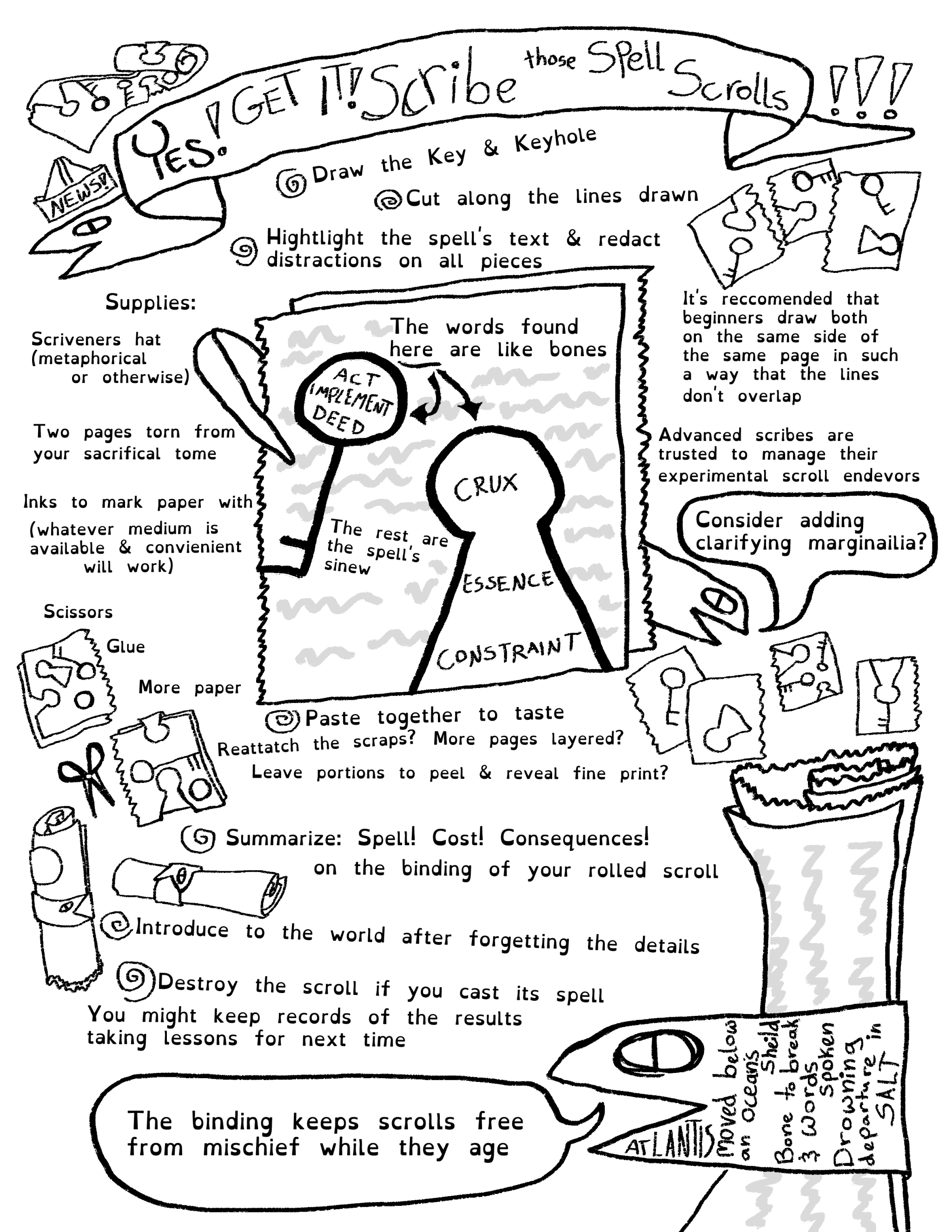
Yes! Get it! Scribe those spell scrolls!!!
Supplies: Scriveners hat (metaphorical or otherwise)
Two pages torn from your sacrificial tome
Inks to mark paper with (whatever medium is available & convenient will work)
Scissors, Glue, More paper
***
Draw the Key & Keyhole. The words found here are like bones, the rest are the spell’s sinew.
Key: act, implement, deed
Keyhole: crux, essence, constraint
It’s recommended that beginners draw both on the same side of the same page in such a way that the lines don’t overlap.
Advanced scribes are trusted to manage their experimental scroll endeavors.
Cut along the lines drawn.
Highlight the spell’s text & redact distractions on all pieces.
Paste together to taste. Reattach the scraps? Leave portions to peel & reveal fine print? More pages layered?
Consider adding clarifying marginalia?
Summarize: Spell! Cost! Consequences! On the binding of your rolled scroll. The binding keeps scrolls free from mischief while they age.
Introduce to the world after forgetting the details.
Destroy the scroll if you cast its spell. You might keep records of the results, taking lessons for next time.
***
Atlantis
Moved below an oceans shield
Bone to break & words spoken
Drowning departure in salt
This game is dedicated to the creative commons!!! Yipee! (cc0 1.0 style, ooh lala)
Anyone & everyone is welcome to indulge the wild hog in their heart be it archival, iterative, derivative, or any other flavor!
By my count the image version has 197 words & the plain text version has 198 (repeat of Key & Keyhole for clarity) The plain text version also has a bit more punctuation & a smidge of rearranging (also for clarity)
Special thanks to the creators of the OpenDyslexic typeface for making said typeface & to my beloved ponder pond for their feedback on my earlier drafts.
Also check out some of my scrolls! Including my first go at some advanced scroll techniques :D !!!
You are a monk in an ancient monastery. Your task? Assist one of your fellow monks in writing a history, based on your knowledge of the world and your own experiences.
One player is the Scribe, the rest are Monks. The Scribe will need a writing implement, and a surface to write on.
Firstly, the Scribe determines what they are writing about. Perhaps you’ve heard tell of a powerful queen, known for her military conquests. Perhaps you write about an important place, full of monsters and myths. Whatever the reason, the Scribe has little knowledge on the subject. Thankfully, their fellow Monks do. The Monks decide whether they are a RELIABLE, UNRELIABLE, or DISTRACTED narrator.
Reliable narrators recount events without embellishment; they are as realistic as possible.
Unreliable narrators recount events with too much embellishment; they have a flair for the dramatique.
Distracted narrators recount events solely based on what they were doing at the time; if a queen was pillaging a countryside, they would focus on a soup they made.
Monks take turns saying short sentences regarding the event. The game ends when a conclusion to the story is reached, or when the Scribe becomes too exasperated to continue.
1-2 players.
The task is simple: go out and fix something. You’ve done it before, and if you make it through today, you’ll never have to do it again. That is to say, you’ve been out here for six months already and if you spend another second with this Guy you think you might snap.
You have a task. The progress of this task is represented by a d12, starting at 1. When this die reaches 12 the task is completed and you get to go home.
You must maintain your cool. Your Cool is represented by a d6, starting at 6. If this die ever reaches 1, you snap and kill the other Guy with a rock. Please avoid killing the other Guy with a rock.
Every round, both Guys roll a d6. If both Guys roll less than their current remaining Cool, the Task Progress increases by 1. If a Guy rolls more than or equal to their current remaining Cool, their Cool is reduced by 1.
I was going to title this "If There Were Two Guys On The Moon", but I thought that having the intro paragraph be the full title was funny. anyway I don't know if anyone else took you up on the concept back when you suggested it, or if anyone else has done it here, but I did it a while back, never posted it, saw this, and then edited down to 200 words.
the original included an event table to roll on every round, but the main mechanic was always the frustration-induced/feeding death spiral, so I pared it down to just that. there is a small amount of the original humor still there, but mostly I'm glad I could keep the intro paragraph and "Please avoid killing the other Guy with a rock".
ACQUIRE:
Three players total
Hex Paper
Squared Paper
Pencils
A ttrpg appropriate for dungeon delving
You are a dungeon core. Your mind is a gemstone, and your body a dungeon. Absorb the world around you to grow, and destroy all who enter.
One player is THE LAND
One player is THE MORTALS
One player is THE PARTY
THE LAND dictates all of nature’s bounty. They describe the environment into which the dungeon is born.
THE MORTALS are in charge of describing culture and civilisation - how and where it’s grown.
THE PARTY are the enemies the dungeon will fight as it grows.
The game is played in three phases:
DIVINING: THE LAND and THE WORLD decide what’s close to the dungeon, above and below. First one hex, then expand outwards each time.
GROWING: collaborate to describe your growth, drawing on square paper. Invent traps, use monsters from your ttrpg.
ADVENTURING: THE PARTY presents characters of appropriate level to plunder you. Play the adventurers and dungeon together. If the dungeon wins, it feeds on the dead to grow - switch roles, repeat the cycle. If the adventurers win, take the core, this game ends, play your ttrpg with this magic item.
I've been writing a much longer version of this game, with actual systems and mechanics, so that you don't have to grab a ttrpg appropriate to dungeon building to apply rules to the system. I've been struggling with a lot of it, and thought I'd try condensing it all the way in the opposite direction to see if that helped! I've kind of become obsessed with the sub-sub-sub-genre of fantasy that is the Dungeon Core story, even though it's very hard to find the good ones (I'd personally recommend Blue Core, but they're all an accquired taste imo), and I really want to play a ttrpg as one, either as a solo game or as a group - since one doesn't exist, I'm stuck trying to make it. I'd love feedback, but tumblr doesn't make it easy to track responses to reblogs, so please dm me if you think you can help
Author's Comments
There are two players, the room master and the adventurer.
The room master begins with the phrase "you find yourself in a room, what do you do?". The adventurer describes their actions (which may include such things as "looking around"), and the room master describes the results of those actions, and this continues until one or the other gets bored, or until some prior agreed-upon goal is met.
Continuity is encouraged but not required. The players should preferably build a story together, rather than try to one-up each other, but there are no clear cut rules for player conduct. Enjoy!
We'll do you half that.
We played this a bunch with our high school bestie at lunch, thought it might be amusing to put it here, as it's kind of the ultimate minimalist "RPG", no table or paper required. It's technically exactly 100 words, not counting the title and the bit we put before that (which add 11 more in total, still well within the limit haha)
Maybe more of a glorified improv game than an RPG, but that's fine! Hope folks get a kick out of it anyways ^^
You can attribute it to The Sunroses (if possible maybe link our website)
Players: 2-6.
Materials: 1 deck of playing cards.
You have encountered a Gazebo. You have no idea what that is.
Calculate (number of players x 25*). This score represents the gazebo's patience.
Shuffle the deck and place it in the center. Decide turn order. One by one, each player draws a card, declares what they're doing to/at the gazebo, and displays it face up. Regardless of the outcome, cards remain face up in front of players.
If it's a number card - the gazebo's patience reduces by that amount.
If it's a face card - you learn one fact about the nature of gazebos.
If it's a joker - the gazebo becomes instantly enraged.
If the players collectively learn (number of players x 2) facts about gazebos before the gazebo's patience reaches zero, they win! They get to keep their lives and learn what a gazebo is.
If the gazebo's patience reaches zero, the player who angered the gazebo is caught and eaten. The rest of the players may keep playing if they wish, but the gazebo's patience is halved.
If the gazebo is enraged, all players are caught and eaten.
*(Feel free to play with this number to adjust the difficulty.)
Tonight is a special night. Its outcome is known to you all — prophecy, fate, determinism, take your pick. Point is, you know exactly how this night is going to go, and that it can’t be changed.
The real question is: when the time comes, how will you play your part?
Supplies: Index cards, pencils, a token to mark time.
1. Decide where and why your group is gathering. Write that down.
2. Everyone creates a character. Give them a Name and a Want. Introduce yourself.
3. Each player takes two index cards and writes down two Events that their character will cause or experience this night. Keep them simple and clear.
4. Place Events in a linear timeline, starting with the youngest player and rotating clockwise. Events can go anywhere in the timeline, but can’t be rearranged afterwards.
After all Events are placed, place the token marker on the leftmost Event. That Event is Imminent and must occur before the next Event does.
5. Roleplay freely through the night’s Events. When the Imminent Event happens, return that card to its player and place the time marker on the next one. That Event is Imminent.
Play until each Event has happened.
This game was originally a unique mechanic I designed for my forthcoming (and first!) TTRPG, Nostos: A Game about Sailing Home and Saying Goodbye. In that game, players portray the sole survivors of a metaphysical apocalypse, adrift on a sea composed of the dissolved building blocks of reality. These survivors of a world now gone sail across a primordial ocean, making stops at little proto-realities, Islands, while grappling with their trauma, finding joy where they can, and maybe, just maybe finding a way back home.
This mechanic was designed for the Island of Estis, “Where One’s Path Is Known”. Each Island has a number of Aspects (very much inspired by Region Properties in Jenna Moran’s Chuubo’s Marvelous Wish-Granting Engine), specific laws of reality unique to each Island. They’re as essential to life on that Island as “Gravity pulls you down” is here on Earth. Estis’s Aspects make it a place where the future is as well known as the past, and the future cannot be changed.
(In Nostos, players have resources they can spend to defy, resist, or change Aspects, but adding that to this 200-word RPG feels like it would just muddy things too much and take away from the drama of having fated Events on the horizon)
The focus of the mechanic on Estis ends up being about terminal disease — one of the inhabitants of the Island is fated to die while the PCs are visiting, and the players have to reckon with how their characters respond to this situation, especially given that the person about to die seems to have made some peace with their imminent death. You could totally use the 200-word version to tackle those sorts of topics too, but I wanted this version to be non-specific enough to fit whatever doom/prophecy/whatever your group is interested in playing.
Thanks for reading! If you're interested in reading Nostos when it's finished, give this account a follow/check here Summer 2025 when I aim to publish it.
(A game for 2–4 players & 1 GM)
You need:
You're playing Battleship against your GM.
Players roll for roles.
1 -> Peacekeeper
2 -> Spy
3 -> Insurgent
4 -> Captain
There's ONE Captain. No more/less. Reassign roles if necessary.
Each turn, one player rolls d6 against GM to determine who plays.
Captain: plays turn based on team input.
Spy: rolls d6 to spy on GM. GM rolls d6 secretly and tells Spy a red coordinate. If GM rolls higher/equal to Spy, they give a white coordinate.
Peacekeeper: can roll against GM during any turn to end the game. If Peacekeeper rolls higher, the game ends.
Insurgent: rolls against Captain (with −2 disadvantage) when turn starts. If Insurgent wins, they initiate a TAKEOVER, and play that turn without help.
Game ends when Peacekeeper ends it or when either all of either GM's or players' ships sink. Whoever has the most ships sunk loses!
A red coordinate is a coordinate wherein guessing it would result in a hit; a white coordinate is a coordinate wherein guessing it would result in a miss. I didn't know how to write it succinctly but I hope that clears things up.
If there's any other questions that you have about gameplay, just shoot me an ask! Or, improvise something! I believe in you.
I give permission for you to remix and share this! Make your own game book! Go wild! Just make sure to credit me and like... don't sell it or anything? I feel like that's probably not cool.
Recommended: 3+ players; age 6+
Materials: 5-minute timer and writing implements
Optional: History or religious texts for references
Play as golems who have awakened after centuries of sleep. The word inscribed on your forehead has been smudged or altered; you remember your purpose but not if it's your CURRENT purpose. You're drawn to something specific though, so use that and help from other golems to figure it out.
The youngest starts as Golem 1 (G1) and names their purpose. The next player (G2) names a material G1 is drawn to and suggests what G1's new purpose is. The next player to G2 (G3) names the item the material is from and makes their own suggestion.
Start the timer.
Players debate G1's new purpose based on what G1 was drawn to. Arguments based on Jewish texts and stories hold the most weight. G1 can counter arguments or take notes during the debate. After the timer stops, the debate is over.
G2 states their own purpose, G3 the material, and so forth. Continue until all players have a turn.
End with G1 stating their new purpose and what argument(s) decided it, then G2, and on until all players have stated their new purpose.
Smaller Note
I'm planning on releasing this game on my itch.io page, complete with some simple roll tables for ideas, better formatting, and the examples below. I'll share a link on my tumblr page when it's released, so keep your eyes open!
~~~~~
Example 1
G1: I'm a Builder! Or was, I'm not sure yet.
G2: You find yourself drawn to a piece of metal. Metal is used a lot in building these days, so you could still be a Builder.
G3: The metal belongs to a blade. I think you were a Warrior with a sword.
(timer starts)
G1: Blades don't use need to be used for fighting. They could be used in tools like an ax that chops lumber for building.
G3: I still think your purpose is a Warrior, and there's nothing wrong with that. What if it's from a sword that belonged to a Maccabee? Your purpose could be as a brave warrior, defending your people against huge odds and coming out on top!
G2: On that note, it could also mean you used to be a Warrior, but now your purpose is a Builder. Maybe your original purpose was to wield a sword, but once there was peace, you turned to building things.
G1: Or even growing things. The blade could be from a plough, like for a Farmer.
(and so on....)
Example 2
G3: My purpose was as a Mediator.
G4: You're drawn to a piece of wood. Maybe you're a Builder?
G1: The wood belongs to an olive tree. I think you were a Farmer.
(timer starts)
G4: Okay, not a Builder. But the olive tree could symbolize peace. Maybe you were a Mediator, seeking out truth and helping others find common ground.
G1: I still think you were a Farmer. Olive oil was huge in a lot of food in Jewish culture. In fact, it's one of the Seven Species along with wheat and grapes and stuff. Farmers grow food, including the Seven Species, so it makes sense.
G2: Oh! The Seven Species! You're right, olives correspond with Yesod, or Foundation. It doesn't just have to be in cooking, right? Maybe you're meant to build the foundation of a new city. That would make you a Leader. Wait, can golems be leaders...?
G3: I don't think so? I don't remember anything in the stories bringing up Golems as leaders. That could be a bit strange.
G4: Then I think it would circle back to Builder. Building the foundations of a new city, right?
G1: That's really leaning into symbolism. I think it's more straight-forward than that, with you as a Farmer.
(and so on....)
give up ? die : (fight ? (punch ? (hide bite ? (grapple with your complex state between human and monster ? you become a monster : you become a monster) : you are executed) : (search for weapons ? (take the gun ? run out of ammo and die : (keep looking ? (keep looking ? (keep looking ? glorious chainsaw victory : way too late to run) : too late to run) : too late to run)) : (improvise a grenade ? go out in a blaze of glory : die pointlessly))) : (flee by car ? (is it well-fueled ? (go to Cannibal Town ? literally what did you think would happen : (go mad with vehicular power ? tyrannical road-warlord ending : darkly comedic apocalypse road trip ending))) : (refuel by the lake ? eaten by Zombie Nessie : you’re out of gas and out of time) : (run north ? (stay in the cabin ? (do you hear them ? too late : they surprise you)) : die of exposure) : (walk along the riverbank ? (steal a boat ? (beg forgiveness ? (save them from zombies ? (fall in love ? romance ending : platonic boat co-owners ending) : sail the rivers alone with your dark secret) : shot by the owner) : the zombies catch you) : (swim for it ? (tread water for a while? drown : drown)) : (wait for them to find you ? you join the undead horde : you cannot hide))))
For those who don’t know, a ternary operator is structured as follows:
[condition] ? [value if true] : [value if false]
The title essentially reads as “If There Isn’t a Zombie Apocalypse, Proceed as Usual. Otherwise, Choose Your Own Adventure.”
This is a CYOA composed entirely of nested ternary operators. This makes for a game which is bad and hard to read and doing this has no benefits besides letting me fit 27 endings into only 200 words.